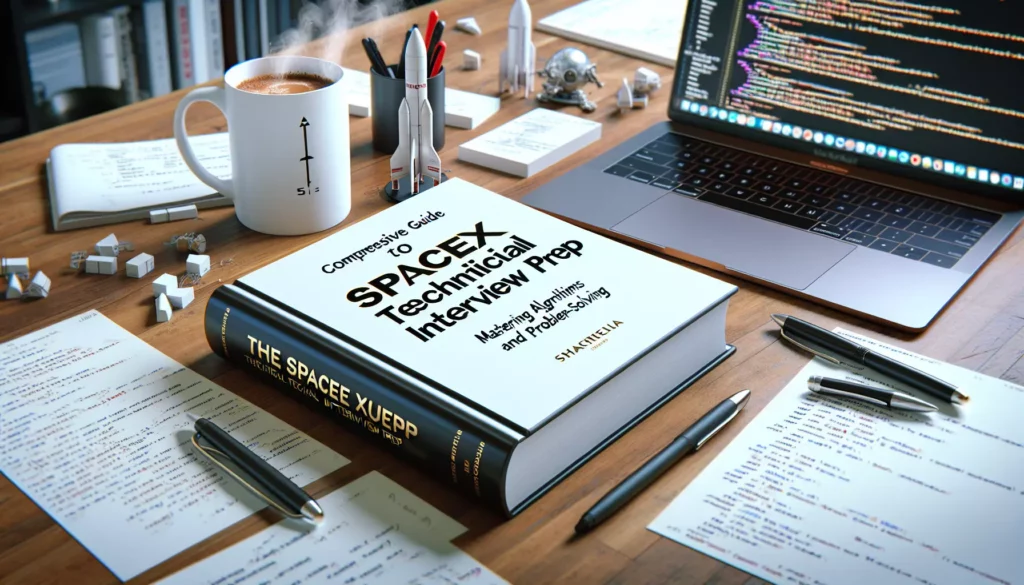
Candidates describe the SpaceX software interview as a mix of medium-difficulty algorithm problems, a deep look at your past projects, and, for many teams, C++ and systems questions. Prepare with solid data structures and algorithms, one strong language (C++ for flight and vehicle software), and the ability to explain real work you have done.
SpaceX does not publish its interview format, so everything below about the process comes from candidate reports and interview-prep sites, as of October 2026. Those reports are self-selected and the process varies by team and role, so treat them as a guide, not a rulebook. Ask your recruiter what each stage looks like.
What the process usually looks like
Reports commonly describe these stages, though the number of rounds differs a lot between accounts:
- Recruiter screen. Your background, why SpaceX, and why this team.
- Online assessment or take-home. Some candidates describe a timed online coding test, others a take-home project of a few hours. Treat it as a real filter: people report being rejected here.
- Technical interview. Live coding plus questions about your resume and past technical work.
- Final rounds. More coding, often system design for senior roles, and behavioral or hiring-manager conversations.
Expect interviewers to go deep on whatever is on your resume. If you list a project, be ready to explain its design, what broke, and what you would change.
Language: C++ matters for some teams, not all
Job postings for vehicle and flight software ask for C, C++ or Rust, while application and ground-software teams list languages such as Python, Java, Go or C#. Check the posting for your role and practice in the language it names. If you may be asked C++, be comfortable with:
- Pointers, references, and object lifetime (RAII, smart pointers, what a dangling pointer is).
- The standard containers and their costs:
vector,unordered_map,map,priority_queue. - Stack versus heap allocation, and why embedded or real-time code often avoids allocating while running.
- Threads, mutexes and condition variables (see the concurrency example below).
Algorithm topics worth your time
The coding questions people report are ordinary medium-level interview problems. Reported examples include cycle detection in a linked list or graph, top-K elements from a stream, and a thread-safe queue. That points to this priority order:
- Arrays, strings and hash maps. Most mediums are built on them. Practice two pointers, prefix sums and counting with a hash map.
- Linked lists, stacks and queues. Pointer manipulation, fast and slow pointers, reversing a list.
- Trees and graphs. DFS, BFS, cycle detection, shortest paths with Dijkstra.
- Heaps. Top-K, merging sorted streams, scheduling.
- Binary search. Including searching on an answer, not only on a sorted array.
- Dynamic programming. Start with one-dimensional and grid problems; do not spend weeks on hard DP before the basics are fast.
- Complexity analysis. You will be asked for time and space of every solution you write.
Example 1: detect a cycle in a linked list
The standard answer uses two pointers moving at different speeds. If there is a cycle, the fast one eventually meets the slow one. It runs in O(n) time and O(1) space; the alternative of storing visited nodes in a set is O(n) space, and you should mention both.
class Node:
    def __init__(self, val, next=None):
        self.val = val
        self.next = next

def has_cycle(head):
    slow = fast = head
    while fast and fast.next:
        slow = slow.next
        fast = fast.next.next
        if slow is fast:
            return True
    return False

a, b, c = Node(1), Node(2), Node(3)
a.next, b.next = b, c
print(has_cycle(a))   # False
c.next = b            # create a cycle
print(has_cycle(a))   # True
print(has_cycle(None))  # False
Output: False, True, False. The edge cases (empty list, single node) are what interviewers watch for.
Example 2: top K from a data stream
Sorting everything costs O(n log n) and needs all the data in memory. A min-heap of size K processes each item in O(log K) and uses O(K) memory, which fits a stream. The heap root is the smallest of the K largest values, so a new value only matters if it beats the root.
import heapq

class TopK:
    def __init__(self, k):
        self.k = k
        self.heap = []  # min-heap holding the k largest values seen so far

    def add(self, x):
        if len(self.heap) < self.k:
            heapq.heappush(self.heap, x)
        elif x > self.heap[0]:
            heapq.heapreplace(self.heap, x)

    def top(self):
        return sorted(self.heap, reverse=True)

t = TopK(3)
for x in [5, 1, 9, 3, 7, 9, 2]:
    t.add(x)
print(t.top())  # [9, 9, 7]
Be ready for follow-ups: what if values repeat, what if K is huge, what if the stream is spread over several machines (keep a top K on each, then merge).
Example 3: a thread-safe blocking queue in C++
Reports mention concurrency questions, which fits software that handles telemetry and commands from several sources. A blocking queue needs a mutex to protect the data and a condition variable so consumers sleep instead of spinning.
#include <condition_variable>
#include <iostream>
#include <mutex>
#include <queue>
#include <thread>

template <typename T>
class BlockingQueue {
    std::queue<T> items_;
    std::mutex m_;
    std::condition_variable cv_;
public:
    void push(T v) {
        {
            std::lock_guard<std::mutex> lock(m_);
            items_.push(std::move(v));
        }
        cv_.notify_one();
    }
    T pop() {
        std::unique_lock<std::mutex> lock(m_);
        cv_.wait(lock, [this] { return !items_.empty(); });
        T v = std::move(items_.front());
        items_.pop();
        return v;
    }
};

int main() {
    BlockingQueue<int> q;
    std::thread producer([&q] { for (int i = 1; i <= 5; i++) q.push(i); });
    int sum = 0;
    for (int i = 0; i < 5; i++) sum += q.pop();
    producer.join();
    std::cout << sum << "\n";  // 15
}
The predicate passed to wait handles spurious wakeups. A common mistake is using if instead of a predicate loop. Follow-ups usually ask about a bounded queue (a second condition variable for “not full”), shutdown, and lock-free alternatives.
System design for senior roles
If the role is senior or involves distributed systems, expect at least one design round. Use the same structure every time: clarify requirements and scale, sketch the high-level components, go deep on the one or two hardest parts, then discuss failure modes and trade-offs. For SpaceX-flavored problems such as a telemetry pipeline, think about ordering and timestamps, lost or duplicated messages, backpressure when consumers are slower than producers, and what the system does when a link drops. Say your assumptions out loud; there is rarely one right answer.
A preparation plan
- Weeks 1 to 2: arrays, strings, hash maps, two pointers, and complexity analysis. Write each solution, then state its time and space.
- Weeks 3 to 4: linked lists, stacks, queues, trees, BFS and DFS, heaps, binary search.
- Weeks 5 to 6: graphs, basic dynamic programming, C++ or systems topics, concurrency, and a design problem per week.
- Throughout: practice a problem or two a day under a 30 to 45 minute limit, talk while you solve, and redo problems you failed a week later.
For guided practice, AlgoCademy has lessons on linked lists, binary search and heaps (the Python versions are linked), and you can also use LeetCode or HackerRank for volume. For the dry-run habit that catches most bugs, see how to dry run code with sample test cases. Our list of SpaceX interview questions covers more examples.
Behavioral and project questions
Because interviewers dig into your past work, prepare three or four projects in detail. For each, know the problem, your specific contribution, one hard technical decision and its alternatives, one thing that went wrong, and what you learned. The STAR format (situation, task, action, result) keeps answers short. Be honest about what you did yourself versus what the team did, since follow-up questions will find the gaps.
Also prepare a real answer to “why SpaceX”. Name specific systems or problems that interest you, such as reusable boosters or satellite networking, rather than general enthusiasm for space.
Common mistakes
- Coding immediately without restating the problem and checking edge cases (empty input, one element, duplicates, overflow).
- Memorizing solutions instead of recognizing patterns, so one changed constraint breaks the answer.
- Skipping complexity analysis or giving it only when asked.
- Ignoring the language the role needs. A Python-only candidate applying to a C++ flight software role will struggle on memory and concurrency questions.
- Never practicing out loud. Silent solving is a different skill from explaining while solving.