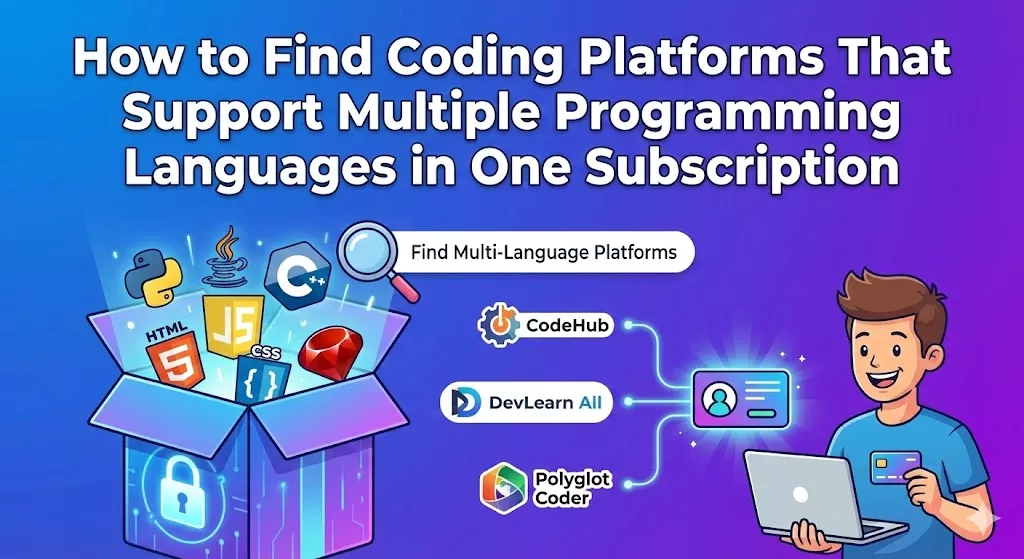
How to Find Coding Platforms That Support Multiple Programming Languages in One Subscription?
Here’s a truth that will save you money: most platforms that advertise “learn 20+ programming languages!” are actually terrible at teaching most of them.
After years watching people navigate multi-language learning platforms, I’ve identified the core problem. Someone subscribes to a platform advertising “support for 15 languages.” They want to learn Python and JavaScript. The Python course is comprehensive and excellent. The JavaScript course is outdated, poorly explained, and missing key concepts. They paid for “multi-language support” but got one good language and mediocre coverage of everything else.
Real multi-language support means quality instruction across languages, not just code editors that accept different syntax. Most platforms spread resources thin trying to cover everything, delivering mediocrity across the board instead of excellence in a focused set.
Let me show you which platforms actually teach multiple languages well, when multi-language subscriptions make financial sense versus wasting money, and how to evaluate whether a platform’s “15 language support” is genuine value or marketing fluff.
Why “Multi-Language Support” Is Often Misleading
Before we examine platforms, let’s understand what multi-language support claims actually mean:
What Real Multi-Language Support Should Include:
Comprehensive courses for each language: Not just syntax tutorials. Full courses covering fundamentals, intermediate concepts, and practical applications for each advertised language.
Up-to-date content: Courses reflect current language versions and best practices. Python 3.12 content, not Python 2.7. Modern JavaScript (ES6+), not outdated patterns.
Quality consistency across languages: If the Python course is excellent, the JavaScript course should be too. Not great Python and terrible Ruby.
Language-specific projects: Projects that showcase each language’s strengths. Web scraping for Python, web development for JavaScript, systems programming for Rust, etc.
Active maintenance: Courses get updated when languages evolve. New features, deprecated patterns, changing ecosystems.
What Platforms Call “Multi-Language Support” But Isn’t:
Code editor supports 20 languages: You can write code in 20 languages, but actual teaching only covers 3-4 well.
Translation of one course to multiple languages: Same content taught in Python, then mechanically converted to Java, JavaScript, etc. Ignores language-specific strengths and idioms.
Outdated coverage: Platform claims to support Ruby, but the course is from 2015 and teaches outdated practices.
Syntax-only tutorials: “Here’s Python syntax” without teaching how to actually build things with Python.
Inconsistent quality: Popular languages (Python, JavaScript) get great courses. Less popular ones (Scala, Haskell) get minimal, poor-quality content.
Understanding these distinctions prevents disappointment after subscribing.
The Platforms With Genuinely Good Multi-Language Support
Codecademy: Best Multi-Language Coverage for Beginners
Codecademy offers the most comprehensive, consistently high-quality multi-language support for beginners.
Languages with full courses:
Well-supported (comprehensive courses):
- Python
- JavaScript
- Java
- C++
- C#
- Ruby
- SQL
- HTML/CSS (markup/styling, not languages, but included)
- Swift
- Kotlin
- PHP
- Go
- R
What “full support” means:
Each of these languages has complete learning path from basics through intermediate concepts. You’re not just learning syntax. You’re building projects, understanding use cases, practicing real applications.
The interactive coding environment works equally well across all languages. Immediate feedback, syntax checking, test validation – consistent experience regardless of language.
Quality consistency:
This is Codecademy’s strength. The Python course is excellent. The JavaScript course is also excellent. The Go course maintains the same quality standards.
You’re not gambling on whether your chosen language got good coverage. Popular and less popular languages receive similar attention.
The pricing:
Free tier: Very limited access to basic courses in each language.
Pro: $19.99/month or $239.88/year – Full access to all languages and courses.
Pro Student: $149.99/year – Discounted for students.
Cost analysis:
If you’re learning 2+ languages, Codecademy Pro provides better value than buying separate single-language courses elsewhere.
$240/year for access to 10+ comprehensive language courses is cost-effective compared to buying individual courses at $100-200 each.
Best for:
Beginners wanting to explore multiple languages. People learning languages for different purposes (Python for data, JavaScript for web, SQL for databases).
Career changers who need multiple languages for modern development roles.
Pluralsight: Comprehensive Professional Development
Pluralsight supports extensive language coverage for professional developers.
Languages covered:
Virtually every mainstream language and many specialized ones:
- Python, JavaScript, Java, C#, C++, C, Go, Rust, Ruby, PHP, Swift, Kotlin, TypeScript, R, Scala, Perl, and dozens more.
What makes coverage different:
Pluralsight focuses on professional depth, not beginner introductions. Courses assume some foundation and go deep into language-specific patterns, performance optimization, ecosystem tools.
Multiple courses per language at different levels. Python has 100+ courses from beginner through advanced topics like async programming, performance tuning, specific frameworks.
Quality:
Variable by instructor. Some courses are excellent. Others are mediocre. Check ratings before starting courses.
Courses are generally kept current. Pluralsight updates content as languages evolve.
The pricing:
Skills: $29/month or $299/year – Access to all courses.
Skills + Role IQ: $49/month or $449/year – Adds skill assessments and role-based learning paths.
Who it’s for:
Professional developers needing depth in multiple languages. Not ideal for complete beginners (courses move quickly and assume knowledge).
Best value for experienced developers working in polyglot environments.
LinkedIn Learning: Broad Coverage, Professional Focus
LinkedIn Learning offers courses across virtually every programming language.
Languages available:
All major languages: Python, JavaScript, Java, C++, C#, Ruby, Go, Swift, Kotlin, PHP, R, SQL, TypeScript, and more.
Plus specialized and niche languages: Scala, Haskell, Elixir, Clojure, etc.
Coverage approach:
Courses taught by industry professionals. Each instructor brings real-world experience.
Multiple courses per popular language covering different aspects (fundamentals, web development, data science, etc.).
Quality variation:
Like Pluralsight, quality depends on instructor. Popular languages generally have better courses (more competition for quality).
Check instructor credentials and course ratings before committing time.
The pricing:
$29.99/month or $239.88/year
Premium subscription includes all courses across all topics (not just programming).
Integration benefit:
Certificates appear directly on LinkedIn profile, visible to recruiters.
Learning paths aligned with job roles help you learn languages relevant to career goals.
Best for:
Professionals wanting to add language skills while building LinkedIn presence.
People who value instructor diversity and industry experience.
Educative: Interactive Multi-Language Learning
Educative provides text-based interactive courses across multiple languages.
Languages supported:
Python, JavaScript, Java, C++, C, Go, Rust, Kotlin, Swift, Ruby, and others.
The format:
Text-based courses with embedded coding environments. Read explanations, write code directly in browser, see results immediately.
Interactive quizzes and challenges throughout courses.
Language-specific courses:
“Learn Python from Scratch” “JavaScript in Detail” “Java for Programmers” “Modern C++ for Absolute Beginners”
Each language has dedicated comprehensive course, not just syntax reference.
The pricing:
Individual courses: $39-$79 per course Unlimited subscription: $18/month or $199/year
Value calculation:
Unlimited subscription makes sense if you’re learning 3+ languages. Individual courses for 1-2 specific languages may be more cost-effective.
Best for:
People who prefer reading and interactive coding over video lectures.
Learners who want comprehensive courses in multiple languages with one subscription.
Udemy: Individual Multi-Language Instructors
Udemy works differently – individual course purchases, but some instructors teach multiple languages.
How multi-language works:
No subscription. Buy individual courses. However, instructors like Colt Steele, Maximilian Schwarzmüller, and Angela Yu teach multiple languages/technologies.
Buy their Python course, JavaScript course, and React course separately, but get consistent teaching quality across languages.
Language coverage:
Every language imaginable has courses on Udemy. Quality varies dramatically.
Popular languages (Python, JavaScript, Java) have dozens of high-quality options. Niche languages have fewer choices.
The pricing model:
Courses individually priced $10-$200. Sales (almost constant) bring prices to $10-$15.
Multi-language strategy:
Find an instructor whose teaching style works for you. Buy their courses across multiple languages during sales.
Angela Yu teaches iOS (Swift), Android (Kotlin), Web Development (JavaScript), Python. Buy all four for $40-$60 total during sales.
Best for:
People who want lifetime access to specific language courses without ongoing subscriptions.
Learners who found an instructor they love and want to learn multiple topics from them.
AlgoCademy: Multi-Language Algorithm Learning
AlgoCademy approaches multi-language support differently – focusing on language-agnostic algorithm concepts taught across multiple languages.
Languages supported:
Python, JavaScript, Java, C++, and other major languages for algorithm implementation.
Why this matters:
Algorithms and data structures are language-agnostic concepts. A binary tree works the same way whether you implement it in Python or Java.
AlgoCademy teaches the concepts first, then lets you implement in your preferred language. You learn algorithm patterns that transfer across languages.
The multi-language approach:
Step-by-step lessons break down algorithms regardless of implementation language. You understand what a quicksort does and why it works before implementing it.
Practice problems available in multiple languages. Solve the same problem in Python, then try it in Java to understand language differences.
The AI tutor provides help in whichever language you’re using. Stuck on a Python implementation? Get Python-specific guidance. Trying same problem in C++? Get C++-specific help.
Why this is valuable:
Many developers need to work in multiple languages professionally. Understanding algorithms at conceptual level, then implementing in different languages, builds genuine multi-language fluency.
Comparing implementations across languages teaches you each language’s strengths. Python’s readable syntax vs. C++’s performance optimization.
The pricing:
$20/month or $799.99 lifetime access.
One subscription covers algorithm learning across all supported languages.
Best for:
Developers who need to understand algorithms across multiple languages for interviews or multi-language work environments.
People learning algorithms conceptually who want to practice implementation in their stack’s languages (backend in Python, frontend in JavaScript, systems in C++).
Students who’ll use different languages across courses (Python in data science, Java in software engineering, JavaScript in web development).
When this approach works better than language-specific courses:
If you’re learning algorithms specifically (not general language features), this focused approach teaches concepts once and lets you apply across languages.
Traditional language courses teach each language separately, often repeating the same algorithm explanations for each language.
DataCamp: Multi-Language for Data Science
DataCamp focuses specifically on data science languages.
Languages supported:
Python, R, SQL primarily. Also JavaScript, Julia, and others for specific data contexts.
The specialization:
DataCamp doesn’t try to teach every language. They focus on languages actually used in data science and teach them deeply.
Python, R, and SQL all have comprehensive learning paths from basics through advanced data science applications.
Quality:
Because focus is narrow (data science languages), quality is consistently high. Resources aren’t diluted across 20 languages.
The pricing:
$25/month or $300/year for full access.
Best for:
Data science learners who need Python, R, and SQL. The multi-language subscription makes sense because data scientists typically need all three.
Not for general-purpose programming across many languages.
Platforms That Don’t Really Support Multiple Languages Well
Let me save you disappointment by identifying platforms with misleading multi-language claims:
Skillshare: Minimal Programming Support
Skillshare advertises programming courses but has weak, inconsistent coverage across languages.
The reality:
A few decent Python or JavaScript courses. Most programming content is superficial or outdated.
“Multi-language support” means individual instructors uploaded courses in different languages, not comprehensive platform-wide support.
Better alternatives:
Any platform listed above provides better language learning than Skillshare.
Treehouse: Limited Language Breadth
Treehouse focuses heavily on web development (JavaScript, Python for web, HTML/CSS).
What’s covered well:
- JavaScript
- Python (web-focused)
- Basic Java
What’s barely covered: Most other languages. If you want C++, Go, Rust, etc., look elsewhere.
The marketing disconnect:
Treehouse markets as comprehensive coding education but really excels only at web development stack.
Khan Academy: Programming in JavaScript Only
Khan Academy has programming section, but it only teaches JavaScript (and even that’s basic).
Not multi-language support:
Great resource for learning basics, but doesn’t support learning multiple languages.
When Multi-Language Subscriptions Make Sense
Having multi-language access is only valuable if you actually need multiple languages:
Scenario 1: Full-Stack Development
Languages needed:
- JavaScript (frontend)
- Python, Ruby, Java, or Go (backend)
- SQL (databases)
Subscription makes sense:
Codecademy Pro ($240/year) gives you all these languages. Cheaper than buying separate courses.
Pluralsight if you need depth beyond basics.
Scenario 2: Career Exploration
Situation:
You’re not sure which language to specialize in. Want to try Python, JavaScript, Java, etc. before committing.
Subscription makes sense:
Multi-language platform lets you explore without buying separate courses for each language.
Codecademy or Educative Unlimited work well for exploration.
Try languages for a month or two, then focus on what fits your goals.
Scenario 3: Polyglot Professional
Situation:
Your job requires working in multiple languages. Enterprise Java for legacy systems, Python for data pipelines, JavaScript for dashboards, Go for microservices.
Subscription makes sense:
Pluralsight or LinkedIn Learning provide professional-depth content across languages.
One subscription keeps you current in all languages you use.
Scenario 4: Computer Science Student
Situation:
Different courses use different languages. Intro CS in Python, data structures in Java, systems in C, web development in JavaScript.
Subscription makes sense:
Academic journey spans multiple languages over years. Multi-language subscription supports entire degree.
Codecademy Pro Student ($150/year) or regular Codecademy Pro covers most languages you’ll encounter.
When Multi-Language Subscriptions DON’T Make Sense
You only need one language:
Don’t pay for multi-language access if you’re only learning Python. Buy focused Python course or use free resources.
You need specialized depth in one language:
Language-specific platforms (e.g., Real Python for Python) provide deeper coverage than generalist multi-language platforms.
You’re learning one language at a time:
Learning Python for 6 months, then moving to JavaScript? Pay for subscription when actively using it, not year-round for sequential learning.
How to Evaluate Multi-Language Support Quality
Before subscribing, verify the platform actually supports your needed languages well:
Check 1: Course Completeness
Don’t just look at language list.
Go to specific language course pages. What’s covered?
Good sign: “Python Programming: Beginner to Advanced” with 50+ hours covering fundamentals, OOP, async programming, libraries, projects.
Bad sign: “Python Basics” with 5 hours covering only syntax.
Check 2: Currency and Updates
Look at last update dates.
Courses updated within last year suggest active maintenance. Courses from 2018 are likely outdated.
Check if content reflects current language versions (Python 3.10+, modern JavaScript ES6+, etc.).
Check 3: Student Reviews and Ratings
Read reviews specifically for languages you need.
Platform might be great at JavaScript but terrible at Ruby. Reviews reveal this.
Look for complaints about outdated content, poor explanations, missing topics.
Check 4: Sample Lessons
Most platforms offer free trials or sample lessons.
Watch/read sample lessons in your target languages. Does the teaching style work for you?
Verify the interactive coding environment works smoothly in your languages.
Check 5: Career Path Alignment
Check if platform offers structured paths for your goals.
If you’re learning for web development, does the platform have web dev path integrating multiple languages coherently?
Scattered courses in 20 languages without structure are less valuable than organized learning paths.
The Cost-Benefit Analysis
Let’s do math on whether multi-language subscriptions save money:
Scenario A: Learning 2 Languages
Option 1: Codecademy Pro $240/year for unlimited access to both languages
Option 2: Individual Udemy courses $15-30 per language = $30-60 total (during sales)
Winner: Udemy for one-time learning. Codecademy if you’ll reference courses over years.
Scenario B: Learning 4+ Languages
Option 1: Codecademy Pro $240/year for all languages
Option 2: Individual courses $15-30 × 4 languages = $60-120 (Udemy sales) Or $39-79 × 4 languages = $156-316 (Educative)
Winner: Depends on whether you need ongoing access or one-time learning.
Subscription wins if:
- You’ll learn languages over extended period (1+ year)
- You need to reference courses repeatedly
- You value updated content as languages evolve
Individual courses win if:
- You’re doing intensive focused learning (3-6 months)
- You want lifetime access without ongoing costs
Scenario C: Professional Development
Option 1: Pluralsight $299/year for depth across many languages
Option 2: Individual specialist resources $500-1000+ for books, specialized courses, conferences
Winner: Pluralsight for breadth. Specialist resources for depth in specific languages.
My Honest Recommendations
For beginners learning multiple languages:
Codecademy Pro ($240/year) provides best combination of comprehensive coverage, quality consistency, and beginner-friendly teaching.
Start with 1-month subscription ($20). If you’re actively using it and learning multiple languages, upgrade to annual.
For professional developers:
Pluralsight ($299/year) if you need deep, current content across many languages for work.
LinkedIn Learning ($240/year) if you want professional content plus LinkedIn integration.
For algorithm and data structure learning across languages:
AlgoCademy ($20/month or $800 lifetime) teaches concepts once, lets you practice in multiple languages. Efficient for interview prep or computer science foundations.
For data science specifically:
DataCamp ($300/year) focuses on Python, R, SQL without dilution across irrelevant languages.
For budget-conscious learners:
Wait for Udemy sales. Buy highly-rated courses in your needed languages for $10-15 each.
freeCodeCamp (free) covers web development stack (HTML, CSS, JavaScript, Python for data science).
For exploration before commitment:
Codecademy free tier or 7-day Pro trial. Test multiple languages before deciding which to pursue.
Free resources (Python.org tutorials, MDN for JavaScript, etc.) let you sample languages without cost.
Don’t:
Subscribe to platforms claiming “20 language support” without verifying quality in your specific languages.
Pay for multi-language access if you only need one language.
Keep subscriptions active if you’re not actively using them (cancel between learning sprints).
The Language-Specific Alternative
Sometimes specialized single-language platforms provide better value than multi-language subscriptions:
For Python: Real Python ($60/year) provides deeper Python coverage than any multi-language platform.
For JavaScript: Frontend Masters ($39/month) goes deeper on JavaScript and frameworks than generalist platforms.
For Java: Oracle’s Java tutorials (free) or specialized Java courses may serve better than multi-language platforms.
The tradeoff:
Single-language platforms: Deeper coverage, language-specific best practices, expert community.
Multi-language platforms: Breadth across languages, one subscription, consistent teaching style.
Choose based on your needs:
Deep specialization in one language → Language-specific platform
Working across multiple languages → Multi-language subscription
The Bottom Line
Multi-language subscription platforms can provide excellent value, but only if they truly support all advertised languages well.
Platforms with genuine quality multi-language support:
- Codecademy (best for beginners, consistent quality)
- Pluralsight (professional depth)
- LinkedIn Learning (breadth with professional focus)
- Educative (interactive, text-based)
- AlgoCademy (algorithm learning across languages)
- DataCamp (data science languages specifically)
Red flags for weak multi-language claims:
- Outdated courses (2+ years old)
- Inconsistent quality (great in Python, terrible in Ruby)
- Syntax-only coverage without practical applications
- No structured learning paths across languages
When multi-language subscriptions make sense:
- Learning 3+ languages over extended period
- Full-stack development requiring multiple languages
- Exploring languages before specialization
- Professional polyglot work
When to avoid:
- Only need one language (buy focused course)
- Need deep specialization (use language-specific platform)
- Learning sequentially, not simultaneously
The strategic approach:
- Identify which languages you actually need (don’t overestimate)
- Verify platform supports those languages well (check course depth, currency, reviews)
- Calculate cost: subscription vs. individual courses
- Try free trial or sample lessons before committing
- Cancel when not actively using
For most people learning 2+ languages seriously over a year or more, Codecademy Pro at $240/year provides best value with consistent quality across languages.
For professionals needing depth, Pluralsight at $299/year offers extensive coverage that justifies the cost.
For algorithm learning across languages, AlgoCademy’s approach of teaching concepts once and practicing in multiple languages provides efficiency traditional language courses don’t.
Don’t pay for “support for 20 languages” if you only need 2-3. Verify the specific languages you need are well-supported before subscribing. The value is in quality coverage of languages you’ll actually use, not quantity of languages listed in marketing.