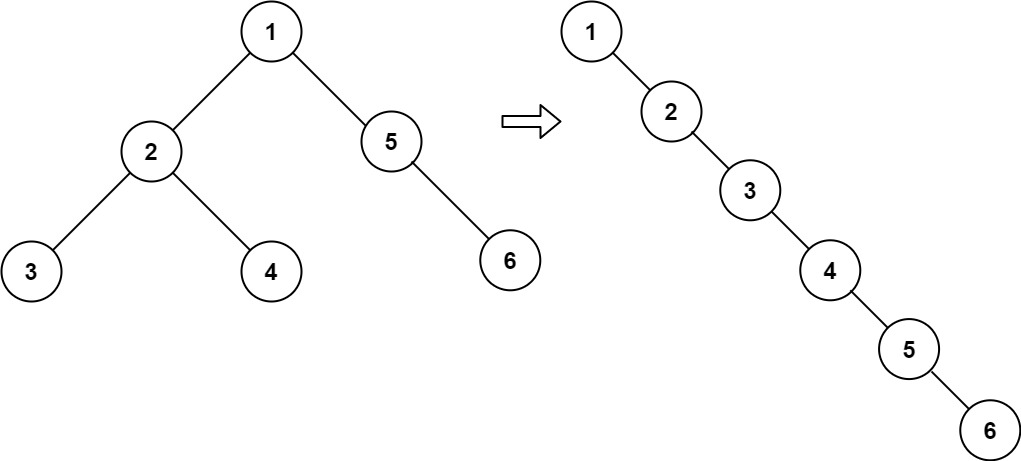
Problem overview
The method flatten receives the root of a binary tree and rewires it in place into a "linked list" built from the same nodes. Every node's right pointer must point to the next node, every left pointer must be null, and the nodes must appear in preorder: a node, then its left subtree, then its right subtree. The method returns nothing; the caller keeps using the same root.
In the first example the tree is [1,2,5,3,4,null,6]: node 1 has children 2 and 5, node 2 has children 3 and 4, and node 5 has a right child 6. Its preorder is 1, 2, 3, 4, 5, 6, so after flattening, 1 points right to 2, 2 to 3, and so on up to 6. An empty tree stays empty, and a single node stays a single node.
Approach: build the list from the back
A natural idea is to collect the nodes in preorder and then link them. That works but needs an extra array of n nodes. The lesson avoids it by building the list backwards.
Visit the tree in the mirrored order of postorder: right subtree, then left subtree, then the node. That is exactly the preorder sequence reversed. Keep a pointer, lastNode, to the head of the list built so far. When the visit reaches a node, everything that comes after it in preorder is already linked, and lastNode is the first of those nodes. So the node only has to point right at lastNode, clear left, and become the new lastNode.
Take a node 1 with left child 2 and right child 3. The visit goes 3, 2, 1. Node 3 points to null (nothing is after it) and becomes the head. Node 2 points to 3 and becomes the head. Node 1 points to 2. The list is 1, 2, 3, which is the preorder of that tree.
Step by step
- Reset
this.lastNodetonullat the start offlatten. It stands for the head of the list built so far, which is empty. Storing it onthislets every recursive call share it. TypeScript wants each property declared, so the class gets the linelastNode: any;. - Call
this.dfs(root)to flatten the whole tree. - Declare
dfsaboveflattenwith one parameter,root. It rewires nodes and returns nothing. - Base case. A
nullnode has nothing to flatten, so return. - Recurse on the right subtree first. Its nodes are the last ones in preorder, so they must be linked before anything that points at them.
- Recurse on the left subtree. When this returns,
lastNodeis the first node of the left subtree, which is exactly the node that followsrootin preorder. - Point
root.rightatthis.lastNode. That links the node to what follows it. If the left subtree was empty,lastNodeis the head of the right part, which is also correct. - Set
root.lefttonull. The left subtree is now reachable through therightchain, so nothing is lost. - Record
rootinthis.lastNode. It is the head of the part of the list built so far.
The solution in TypeScript
class Solution {
    lastNode: any;
    dfs(root) {
        if (!root) {
            return;
        }
        this.dfs(root.right);
        this.dfs(root.left);
        root.right = this.lastNode;
        root.left = null;
        this.lastNode = root;
    }

    flatten(root) {
        this.lastNode = null;
        this.dfs(root);
    }
}
TypeScript details worth knowing:
- Properties must be declared. Assigning
this.lastNodewithout thelastNode: any;line makes the compiler report that the property doesn't exist onSolution.anyis used because the parametersrootare untyped here, so a precise node type isn't available. - Untyped parameters are
any. With the compiler settings of these lessons,rootwithout an annotation is allowed and has typeany, soroot.rightis accepted. Types are erased when the code compiles to JavaScript anyway, so the program behaves the same with or without them. - State on
this. The helper reads and writes one shared value across all recursive calls. Becauseflattenresets it tonullfirst, callingflattenagain on the sameSolutionobject starts clean. - Order of the assignments.
root.right = this.lastNodemust come beforethis.lastNode = root. Swapped, the node would point to itself.
Complexity
Time: O(n). Each node is visited once, and each visit does a few pointer assignments.
Space: O(h), where h is the height of the tree, for the recursion. No array of nodes is created. A tree shaped like a long chain has h = n, and a very deep one can overflow the call stack.
Edge cases and common mistakes
- An empty tree.
rootisnull,dfsreturns at once and nothing changes. - A single node.
root.rightbecomesnull(the value oflastNode),root.leftis alreadynull, and the node is unchanged. - Doing left first. If
dfs(root.left)ran beforedfs(root.right), the nodes would be linked in an order that is no longer preorder, becauselastNodewould hold the wrong head whenrootis linked. - Forgetting
root.left = null. The list would still be reachable throughrightpointers, but leftoverleftpointers would break the requirement and any check that follows both pointers. - Not resetting
lastNode. On a second call, the last node of the new list would point at the head of the previous result. - Returning something. The task changes the tree in place. The caller reads the result by following
rightfrom the original root.
Testing
[1,2,5,3,4,null,6]becomes the chain 1, 2, 3, 4, 5, 6.- An empty tree stays empty.
[0]stays[0].- Node 1 with left child 2 and right child 3 becomes 1, 2, 3, with every
leftequal tonull.