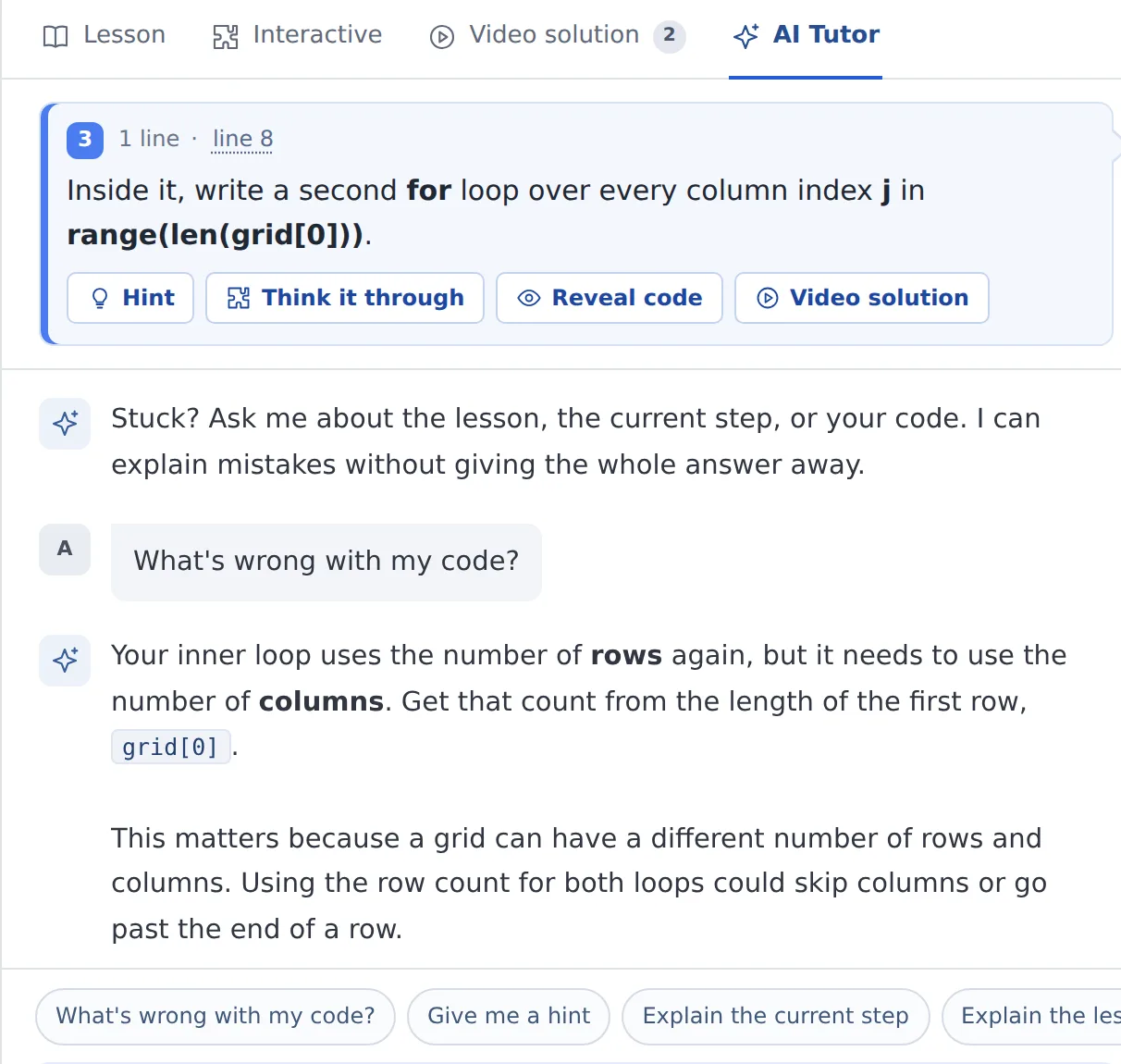
Given a grid of integers grid and an integer target, return how many cells of the grid are equal to target.
A grid is a list of rows, and each row is a list of integers.
Example 1:
Input: grid = [
  [1, 2, 3],
  [4, 2, 6],
  [2, 8, 2]
], target = 2
Output: 4
Explanation: 2 appears once in the first row, once in the second row and twice in the third row: 1 + 1 + 2 = 4.
Example 2:
Input: grid = [
  [-1, 5],
  [5, -1]
], target = -1
Output: 2
Explanation: The two cells with -1 are in different rows, and each one counts.
Example 3:
Input: grid = [
  [7, 8, 9]
], target = 4
Output: 0
Explanation: No cell is equal to 4.
Constraints:
gridhas at least 1 row and 1 column, and every row has the same number of values.- Every value and
targetis an integer between -1000 and 1000; they can be negative.
Free plan: 30 tutor messages. Premium is unlimited.
Saved
Ctrl + Enter to check