Problem overview
The method numberOfSubmatricesWithAllOnes receives an m x n matrix mat of 0s and 1s, as an int[][]. It returns how many rectangular blocks of cells, of any height and width, contain only 1s. Every block counts, including overlapping ones and single cells.
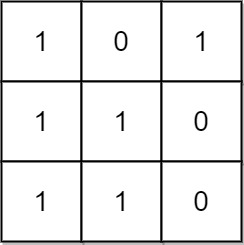
For mat = [[1,0,1],[1,1,0],[1,1,0]] the answer is 13. There are six single cells holding a 1, and the larger blocks bring the total to 13: two blocks of size 1x2, three of size 2x1, one of size 2x2 and one of size 3x1.
Approach: fix the top and bottom rows, then count along the columns
Checking every rectangle independently means choosing its top row, bottom row, left column and right column, and then scanning its cells. That is too much work. The lesson cuts it down in two steps.
Fix a pair of rows. Choose a top row upRow and a bottom row downRow. Every rectangle in this horizontal slab spans exactly those rows. A column can be part of such a rectangle only if it holds a 1 in every row of the slab. Keep an array fullCol with one entry per column: 1 if the column is all ones within the slab so far, otherwise 0.
Count along the columns. With fullCol known, a rectangle of this height is just a stretch of consecutive 1s in fullCol. A run of length L contains L * (L + 1) / 2 such stretches. The code gets this total without a formula. While scanning left to right, it keeps currLength, the length of the run ending at the current column, and adds it to the answer at every column. A run of length L then adds 1 + 2 + ... + L, because the stretches that end at the column in position k of the run have widths 1 to k.
The slab grows downward one row at a time. When downRow moves down, any column with a 0 in the new row is switched off for good. It stays off for all taller slabs with the same top row, so fullCol never needs to be rebuilt within one top row. It is reset to all ones when upRow changes.
Here is the first example. With upRow = 0 and downRow = 0, fullCol is [1,0,1], which adds 1 + 0 + 1 = 2. For downRow = 1 the second row [1,1,0] switches off column 2, leaving [1,0,0], which adds 1. For downRow = 2 it stays [1,0,0] and adds 1. So top row 0 gives 4. Top row 1 gives 3 + 3 = 6, and top row 2 gives 3. The total is 4 + 6 + 3 = 13.
Step by step
- Start the counter
matCountat 0. - Create
fullColwith one entry per column,mat[0].length, and fill it with 1s. A newint[]starts with zeros, so the fill is needed. - Loop over the top row
upRowfrom 0 to the last row. - Reset
fullColto all ones. A new top row starts a new slab, and columns switched off for an earlier top row must be allowed again. - Loop over the bottom row
downRowfromupRowdown to the last row. Starting atupRowincludes slabs that are one row tall. - Loop over the columns and, for each one, look at the cell in the new row.
- Switch off columns with a zero. If
mat[downRow][col]is 0, setfullCol[col]to 0. - Prepare the run length. Declare
currLengthas 0 before scanningfullCol. - Scan
fullColleft to right with an enhancedforloop. Its variable holds each entry's value, 0 or 1, not its index. - Extend the run on a 1 by adding one to
currLength. - Break the run on a 0 by setting
currLengthback to 0. - Add the run length to
matCountat every column, which counts the rectangles ending at that column. - Return
matCountafter all the loops.
The solution in Java
class Solution {
    public int numberOfSubmatricesWithAllOnes(int[][] mat) {
        int matCount = 0;
        int[] fullCol = new int[mat[0].length];
        Arrays.fill(fullCol, 1);

        for (int upRow = 0; upRow < mat.length; upRow++) {
            Arrays.fill(fullCol, 1);

            for (int downRow = upRow; downRow < mat.length; downRow++) {
                for (int col = 0; col < mat[0].length; col++) {
                    if (mat[downRow][col] == 0) {
                        fullCol[col] = 0;
                    }
                }

                int currLength = 0;
                for (int col : fullCol) {
                    if (col == 1) {
                        currLength++;
                    } else {
                        currLength = 0;
                    }
                    matCount += currLength;
                }
            }
        }

        return matCount;
    }
}
The Java details worth a closer look:
- Dimensions of an
int[][].mat.lengthis the number of rows, andmat[0].lengthis the length of the first row, which is the number of columns. The constraints guarantee at least one row and column, somat[0]exists. Arrays.fill(array, value)sets every element of a one-dimensional array to the value. The first call is redundant, since the loop resetsfullColbefore it is used. It does no harm.- The enhanced
forloop.for (int col : fullCol)gives the values and copies each intocol. Assigning to it would not change the array. The earlier plain loop also used the namecol, but that variable's scope ended with its loop, so the name can be used again. intis big enough. The largest answer comes from a 150 by 150 matrix of 1s: (150 * 151 / 2)² = 128,255,625. That fits in anint, whose maximum is about 2.1 billion.
Complexity
Let the matrix have m rows and n columns.
Time: O(m² * n). There are about m² / 2 pairs of (upRow, downRow), and each does O(n) work: one pass to update fullCol and one to count runs. With m and n up to 150, that is a few million steps, which is fast. Choosing all four sides and scanning each rectangle would be O(m² * n² * m * n).
Space: O(n), for fullCol alone.
Edge cases and common mistakes
- A single cell.
[[1]]gives 1 and[[0]]gives 0. - A single row.
[[1,1,1]]gives 6, which is 1 + 2 + 3.[[1,0,1]]gives 2, because the zero breaks the run. - A full matrix.
[[1,1],[1,1]]gives 9: four 1x1, two 1x2, two 2x1 and one 2x2. - Not resetting
fullColfor each top row. A zero found in an earlier slab would keep its column switched off, and the count would come out too small. - Not resetting
currLengthfor each slab. It must start at 0 before every scan offullCol, or runs would leak from one slab into the next. - Adding
currLengthonly when a run ends. A run of lengthLcontributesLrectangles at its last column but also contributes at every earlier column. The addition must happen at every column. - Treating
fullColas the matrix row. It describes the whole slab, not justdownRow. A column is on only if every row in the slab has a 1 there.
Testing
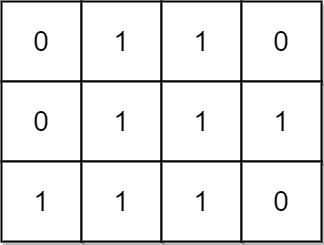
[[1,0,1],[1,1,0],[1,1,0]]gives13.[[0,1,1,0],[0,1,1,1],[1,1,1,0]]gives24.[[1]]gives1.[[1,1],[1,1]]gives9.[[1,1,1]]gives6.