Problem overview
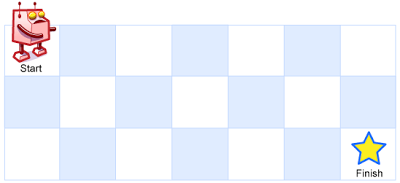
The function uniquePaths(grid) receives a grid of n rows and m columns. A robot starts in the top-left cell and wants to reach the bottom-right cell, moving only down or right. A cell holding 0 is free and a cell holding 1 is an obstacle the robot can't enter. The function returns the number of different paths.
In the example the grid is 3 by 3 with a single obstacle in the middle:
0 0 0
0 1 0
0 0 0
The robot can go right, right, down, down along the top and right edges, or down, down, right, right along the left and bottom edges. Any path through the center is blocked, so the answer is 2. The notes allow grids up to 100 by 100, and say the answer fits in 32 bits.
Approach: count the ways to arrive at each cell
Enumerating every path would take far too long on a 100 by 100 grid, since the number of routes grows explosively. Count them cell by cell instead. Let dp[i][j] be the number of paths from the start (0, 0) to the cell (i, j).
The robot enters a cell either from the cell above it or from the cell to its left. Those two groups of paths are disjoint, so for a free cell dp[i][j] = dp[i-1][j] + dp[i][j-1]. An obstacle cell has no paths through it, so it stays 0, and the zero flows into its neighbors' sums automatically.
The recurrence needs a top and a left neighbor, so the first row and the first column are handled separately. A cell in the first column can only be reached by moving straight down, which is possible only if no obstacle lies above it. The same holds for the first row and moving right.
For the example the finished table is:
1 1 1
1 0 1
1 1 2
The bottom-right cell holds the answer, 2. The cell at the bottom right gets 1 from above and 1 from the left.
Step by step
- Read the dimensions:
n := len(grid)andm := len(grid[0]). Every row has the same length. - Create
dpas annbymmatrix of zeros with the providedmakeMatrix. - Fill the first column. Loop
ifrom 0 ton - 1. Ifgrid[i][0]is an obstacle,break: nothing below it can be reached through this column, and those cells keep 0. Otherwise setdp[i][0] = 1, since exactly one path goes straight down. - Fill the first row the same way with
j, breaking at the first obstacle and settingdp[0][j] = 1before it. The cornerdp[0][0]is written twice with the same value, which is harmless. - Fill the rest. Loop
ifrom 1 andjfrom 1. Rows go in increasing order and so do columns, so the top and left neighbors are always done before the cell that needs them. - Skip obstacles. Only when
grid[i][j]is 0 apply the recurrence. Otherwise the cell keeps its 0. - Return
dp[n-1][m-1].
The solution in Go
func uniquePaths(grid [][]int) int {
    n := len(grid)
    m := len(grid[0])
    dp := makeMatrix(n, m)
    for i := 0; i < n; i++ {
        if grid[i][0] == 1 {
            break
        }
        dp[i][0] = 1
    }
    for j := 0; j < m; j++ {
        if grid[0][j] == 1 {
            break
        }
        dp[0][j] = 1
    }
    for i := 1; i < n; i++ {
        for j := 1; j < m; j++ {
            if grid[i][j] == 0 {
                dp[i][j] = dp[i-1][j] + dp[i][j-1]
            }
        }
    }
    return dp[n-1][m-1]
}
Go details worth a closer look:
- A grid is a slice of slices.
[][]intis a slice whose elements are slices, solen(grid)is the number of rows andlen(grid[0])the number of columns of the first row. Rows are allowed to differ in length in Go, which is why the lesson states that they don't. makeMatrixallocates each row withmake, which zero-fills it. Allocating only the outer slice would leave nil rows, and indexing into one panics.breakinsideforends the loop, not the function. Because the assignmentdp[i][0] = 1comes after theif, a blocked cell never reaches it, so noelseis needed.ifwithout parentheses. The condition has no parentheses, and the braces are required even around a single statement.- No overflow worries.
intis 64 bits here, comfortably above the 32-bit bound the notes give for the answer. A 100 by 100 grid with no obstacles would have about more than 10^58 paths, but the guarantee excludes such inputs.
Complexity
Each cell is visited a constant number of times, so the time is O(n * m). The table has n * m cells, so the space is O(n * m). Because a row depends only on the row above, a single row of length m would be enough if memory mattered.
Edge cases and common mistakes
- Obstacle on the start. The first loops break at index 0 and write nothing, so all of
dpstays 0 and the answer is 0. - Obstacle on the finish. The cell is never filled, stays 0, and the function returns 0.
- Obstacle in the first row or column. Everything past it in that line must stay 0. Setting all of the first row to 1 without the
breakwould count paths that pass through the obstacle. - A single cell. A free
[[0]]gives 1 and a blocked[[1]]gives 0. The loops over the interior simply don't run. - Mixing up
nandm.ncounts rows and goes with the first index ofgridanddp. Swapping them is a common source of index-out-of-range panics on non-square grids. - An empty grid.
grid[0]would panic when there are no rows. The lesson's inputs always have at least one cell.
Testing
For [[0, 1], [0, 0]] the only route is down then right, so the answer is 1. For [[0, 0], [0, 1]] the finish is blocked, so the answer is 0. The 3 by 3 example above gives 2.