Problem overview
The function validPath receives a number of vertices n (labeled 0 to n - 1), a list of edges, a source and a destination. Each edge [u, v] connects two vertices in both directions. The function returns true when you can walk from source to destination along edges, and false otherwise.
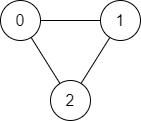
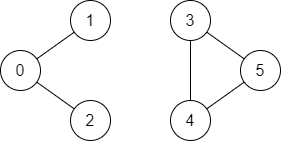
In the first example, n = 3 with edges [[0,1],[1,2],[2,0]] forms a triangle, so 0 reaches 2 directly and validPath returns true. In the second, n = 6: vertices 0, 1 and 2 form one group and 3, 4 and 5 another, with no edge between the groups. Going from 0 to 5 is impossible, so the answer is false.
Approach: explore everything reachable from the source
Asking whether a path exists is the same as asking whether destination belongs to the set of vertices reachable from source. Depth-first search (DFS) builds exactly that set. It stands on a vertex, marks it as visited, and then moves on to each neighbor that hasn't been visited yet, going as deep as it can before backing up.
The marking is what keeps the search finite. In a graph with a cycle, such as the triangle above, a search without marking would go 0, 1, 2, 0, 1, 2 and so on forever. Marking a vertex before exploring its neighbors guarantees that a neighbor leading back sees it as already visited.
Two preparations are needed. DFS asks "which vertices touch this one?" over and over, and the list of edges answers that slowly. So first convert the edges into an adjacency list: for each vertex, the list of its neighbors. And because every edge works both ways, each edge must be recorded for both endpoints.
Step by step
- Create the adjacency list
graphwithmake([][]int, n), one slice of neighbors per vertex. The inner slices start out nil, andappendworks on a nil slice. - Create
visitedas amap[int]bool. Reading a missing key givesfalse, so every vertex starts as unvisited with no setup. - Loop over
edges, naming each pairedge. - Append each endpoint to the other's list. Do it in both directions, or the search can't cross an edge backwards.
appendreturns the grown slice, so assign it back. - Call
dfsonsource, passinggraphandvisited. Afterwardsvisitedholds every vertex reachable from the source. - Return
visited[destination]. It istrueonly if the search reached that vertex. - Write
dfswith the parametersnode,graphandvisited. - Mark
nodeas visited first, before looking at neighbors, so cycles can't cause infinite recursion. - Range over
graph[node], naming each neighboradjacentNode. - Recurse only on unvisited neighbors, with
if !visited[adjacentNode].
The solution in Go
func validPath(n int, edges [][]int, source int, destination int) bool {
    graph := make([][]int, n)
    visited := make(map[int]bool)
    for _, edge := range edges {
        graph[edge[0]] = append(graph[edge[0]], edge[1])
        graph[edge[1]] = append(graph[edge[1]], edge[0])
    }
    dfs(source, graph, visited)
    return visited[destination]
}

func dfs(node int, graph [][]int, visited map[int]bool) {
    visited[node] = true
    for _, adjacentNode := range graph[node] {
        if !visited[adjacentNode] {
            dfs(adjacentNode, graph, visited)
        }
    }
}
The Go details worth knowing:
make([][]int, n)creates a slice ofnelements, each a nil[]int. That is a usable empty list, andappendallocates it on first use.- A missing map key gives the zero value. For
map[int]boolthat isfalse. This is why!visited[adjacentNode]and the finalvisited[destination]need nov, ok :=form here: "absent" and "false" mean the same thing. - Maps are reference-like. Passing
visitedtodfspasses a handle to the same map, so every recursive call marks the same set. Without the map, each call would work on its own copy of a flag. - Slices of slices are updated in place.
graph[edge[0]] = append(...)must assign back becauseappendmay return a new slice header when the slice grows. - Recursion depth. Go's stacks grow as needed, so even a single chain of 200,000 vertices, the largest the constraints allow, runs without trouble.
- The order of function declarations doesn't matter.
validPathcallsdfs, which is declared below it.
Complexity
Building the adjacency list takes O(E) for E edges. DFS marks each vertex once and looks at each neighbor list entry once, so it costs O(V + E) in total. The adjacency list, the map and the recursion stack all use O(V + E) space at most.
Edge cases and common mistakes
- Source equals destination.
validPath(1, [][]int{}, 0, 0)returnstrue, because the search marks the source immediately and zero steps is a valid path. - No edges and two vertices.
validPath(2, [][]int{}, 0, 1)returnsfalse: the search marks only the source. - Adding each edge only one way. With edges
[[1,0],[2,1]], searching from 0 to 2 only works because both directions are recorded. One direction would leave 0 with no neighbors. - Marking after the recursive call. If
visited[node] = truecame after the loop, a cycle would recurse forever. - Forgetting the visited check. Even with marking, recursing without the
ifsends the search back along the edge it just came from, so the check is what stops the repetition. - Disconnected groups. The search from the source never leaves its own group, which is what makes the second example answer
false.
Testing
n = 3, edges[[0,1],[1,2],[2,0]], source 0, destination 2 returnstrue.n = 6, edges[[0,1],[0,2],[3,5],[5,4],[4,3]], source 0, destination 5 returnsfalse.n = 3, edges[[1,0],[2,1]], source 0, destination 2 returnstrue.