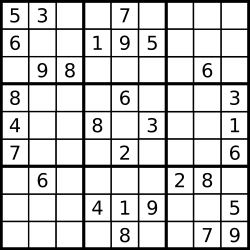
Problem overview
The method IsValidSudoku receives a 9 x 9 board as a char[][]: an array of 9 rows, each a char[] of 9 cells. A cell holds a digit from '1' to '9', or '.' when it is empty. The method returns true when no digit appears twice in the same row, the same column or the same 3 x 3 box, and false otherwise.
Only the filled cells are checked. The board doesn't have to be solvable: a board with the digits 1 to 8 in row 0 and a 9 at row 4, column 8 is valid, although the last cell of row 0 can no longer be filled. If you take a valid board and replace its top-left 5 with an 8, the board becomes invalid: column 0 and the top-left box then hold two 8s.
Approach: remember what each row, column and box has seen
You could scan the row, the column and the box of every filled cell again for each cell. On a board this small that works, but it looks at each cell many times. A better way is to visit each cell once and keep, for every row, column and box, the set of digits seen so far.
For a filled cell, ask three questions: does its row's set already hold this digit? Its column's? Its box's? If any answer is yes, the digit appears twice, so return false. Otherwise add the digit to all three sets and move on. A set answers "is it there?" in constant time, so each cell costs a constant amount of work.
That makes 27 sets: 9 for rows, 9 for columns and 9 for boxes. Every cell belongs to exactly one set of each kind.
Which box is a cell in?
The boxes are numbered left to right, then top to bottom, from 0 to 8. Dividing a row or column by 3 gives the box's own row or column (0, 1 or 2), because integer division drops the remainder. So the box number is (r / 3) * 3 + c / 3:
cell (0, 0) -> box 0
cell (0, 8) -> box 2
cell (3, 3) -> box 4
cell (4, 7) -> box 5
cell (8, 0) -> box 6
cell (8, 8) -> box 8
Step by step
- Create
rowsas an array of 9 sets:new HashSet<char>[9]. This creates only the array, with 9 empty places (null), not the sets. - Create
colsandboxesthe same way. - Fill the arrays with a loop over
ifrom 0 to 8, putting a newHashSet<char>()inrows[i],cols[i]andboxes[i]. Each row, column and box needs its own set. - Visit every cell, row by row, with two nested loops over
randc. - Read the cell into a
charnameddigit. If it is'.',continuewith the next cell: empty cells never break a rule. - Compute the box number as shown above.
- Check for a repeat. If
rows[r],cols[c]orboxes[box]already contains the digit, returnfalse. The sets hold the digits of the cells visited before this one, so finding the digit there means it appears twice. - Record the digit with
Addin all three sets. - After both loops, return
true: every filled cell was compared with the earlier ones, and no digit repeated.
The solution in C#
class Solution {
    public bool IsValidSudoku(char[][] board) {
        HashSet<char>[] rows = new HashSet<char>[9];
        HashSet<char>[] cols = new HashSet<char>[9];
        HashSet<char>[] boxes = new HashSet<char>[9];
        for (int i = 0; i < 9; i++) {
            rows[i] = new HashSet<char>();
            cols[i] = new HashSet<char>();
            boxes[i] = new HashSet<char>();
        }
        for (int r = 0; r < 9; r++) {
            for (int c = 0; c < 9; c++) {
                char digit = board[r][c];
                if (digit == '.') continue;
                int box = (r / 3) * 3 + c / 3;
                if (rows[r].Contains(digit) || cols[c].Contains(digit) || boxes[box].Contains(digit)) {
                    return false;
                }
                rows[r].Add(digit);
                cols[c].Add(digit);
                boxes[box].Add(digit);
            }
        }
        return true;
    }
}
The C# details worth knowing:
- An array of sets starts out empty.
new HashSet<char>[9]holds ninenullreferences. CallingAddon one of them throws aNullReferenceException, which is why the first loop creates the sets before the main loop uses them. char[][]is a jagged array: an array of arrays, read asboard[r][c]. A rectangularchar[,]would be read asboard[r, c]instead, and is a different type.'.'is acharliteral. Single quotes make achar, double quotes astring. Comparing acharto"."doesn't compile.- The digits stay characters. The sets hold
'5', not the number 5. That is fine here, because the code only asks whether two cells hold the same character, and never does arithmetic on them. - Integer division. With two
ints,/drops the remainder, so7 / 3is 2. The box formula relies on that. HashSet<T>lives inSystem.Collections.Generic. In a file of your own, addusing System.Collections.Generic;at the top.Addreturns abool:truewhen the item was new,falsewhen it was already in the set. That allows a shorter form,if (!rows[r].Add(digit) || !cols[c].Add(digit) || !boxes[box].Add(digit)) return false;. It works because||stops at the firsttruepart, and every digit that reaches a laterAddwas new in the earlier sets. The version above, with separateContainsandAddcalls, is easier to read.
Complexity
Time: O(81), a constant. The two loops visit 81 cells, and each cell needs three Contains calls and three Add calls, each O(1) on average.
Space: O(81), also a constant. The 27 sets together hold at most 81 digits per kind: each digit is stored once in a row set, once in a column set and once in a box set.
Edge cases and common mistakes
- Checking only the rows. Rows, columns and boxes all count. A board where a digit repeats only inside a box (two 1s at (0, 0) and (1, 1)) must return
false. - Wrong box formula.
r / 3 + c / 3maps different boxes to the same number. The row part must be multiplied by 3. - Sharing one set. If the loop forgets to create a separate set for each index, or the code uses one set for everything, valid boards come back as invalid.
- Treating
'.'as a digit. A board full of dots has many repeated'.'characters. Skipping empty cells is what keeps it valid. - Trying to solve the puzzle. The method only checks the digits already on the board. An unsolvable board with no repeated digit returns
true. - Forgetting the null sets. Creating the three arrays without filling them is a
NullReferenceExceptionon the first digit.
Testing
These results come from boards written one string per row.
- The standard puzzle (first row
53..7....) returnstrue. - The same puzzle with an 8 in the top-left corner instead of the 5 returns
false. - Row 0
12345678.plus a single 9 at row 4, column 8, returnstrue. - A board of 81 dots returns
true. - Two 1s at (0, 0) and (0, 1) (same row) return
false. - Two 1s at (0, 0) and (3, 0) (same column) return
false. - Two 1s at (0, 0) and (1, 1) (same box only) return
false.
