Problem overview
The method IsSymmetric receives the root of a binary tree and returns true when the tree is a mirror image of itself around its center. The values count, not just the shape.
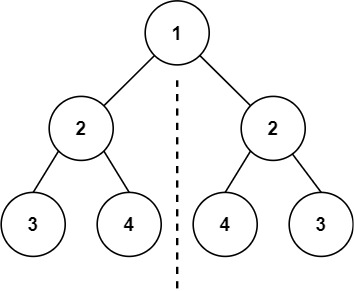
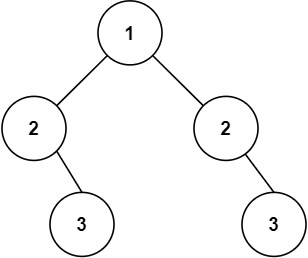
The tree [1, 2, 2, 3, 4, 4, 3] is symmetric. The two children of the root both hold 2. The left 2 has children 3 and 4, and the right 2 has children 4 and 3, which is the same pair in the opposite order. The tree [1, 2, 2, null, 3, null, 3] is not: both 2s have a 3 on their right side only, and mirroring would require one of them to have its 3 on the left.
Approach: compare two subtrees that should mirror each other
Looking at one node is not enough, so the problem is turned into a question about two nodes: do these two subtrees mirror each other? Two subtrees a and b mirror each other when:
- both are empty, or
- both exist, hold the same value, the left child of
amirrors the right child ofb, and the right child ofamirrors the left child ofb.
Crossing the children is what makes it a mirror: the outer pair is compared together, and the inner pair is compared together. A whole tree is symmetric when its left half mirrors its right half. The lesson takes a shortcut: it asks whether the tree mirrors itself, by calling the helper with the root twice. The two arguments then start at the same node, and the helper walks down one copy going left while it walks down the other going right.
The follow up in the statement asks for an iterative version as well. That version uses a queue or stack of node pairs and checks the same conditions. This lesson shows the recursive version.
Step by step
- Delegate in
IsSymmetric. ReturnDfs(root, root), which asks whether the tree mirrors itself. - Declare the helper above it:
public bool Dfs(TreeNode root1, TreeNode root2). The two parameters are nodes that should mirror each other. - Both empty. If
root1 == null && root2 == null, returntrue. Two empty subtrees always mirror each other, and this is the base case at the leaves. - Exactly one empty. If
root1 == null || root2 == null, returnfalse. Because the previous check handled the case of both being empty, at this point only one of them is, and that can't be symmetric. - Different values. If
root1.val != root2.val, returnfalse. Both nodes exist here, so reading their values is safe. - Outer pair. If
Dfs(root1.left, root2.right)is false, returnfalseright away. The inner pair needs no checking when the outer pair has failed. - Inner pair. Return
Dfs(root1.right, root2.left). Its answer is the answer for the whole pair.
The solution in C#
class Solution {
    public bool Dfs(TreeNode root1, TreeNode root2) {
        if (root1 == null && root2 == null) {
            return true;
        }
        if (root1 == null || root2 == null) {
            return false;
        }
        if (root1.val != root2.val) {
            return false;
        }
        if (!Dfs(root1.left, root2.right)) {
            return false;
        }
        return Dfs(root1.right, root2.left);
    }

    public bool IsSymmetric(TreeNode root) {
        return Dfs(root, root);
    }
}
C# details:
- Order of the checks matters. The both-null check must come before the either-null check, and both must come before any
.valaccess. Readingroot1.valwhenroot1isnullwould throw aNullReferenceException. - Short-circuit operators.
||and&&stop evaluating as soon as the result is known. Here, that means the conditions are evaluated only on references that have already been compared. - Comparing with
==on nodes.root1 == nullchecks the reference. The lesson'sTreeNodeis a class and doesn't overload==, so this test is safe. Values are compared on the integer fieldval, which is what the mirror condition needs. - Returning a recursive call. The last line returns the result of
Dfsdirectly instead of storing it in a variable and testing it.
Complexity
Time: O(n). Every node takes part in at most two pairs, once on each side of the mirror, and each pair costs constant work. The helper stops as soon as it finds a mismatch, so the worst case is a perfectly symmetric tree.
Space: O(h) for the recursion, where h is the height of the tree. For a balanced tree that is about log n, and for a chain it is n.
Edge cases and common mistakes
- A single node.
Dfs(root, root)sees equal values and then compares twonullpairs, which returntrue. A one-node tree is symmetric. - Same shape, different values.
[1, 2, 3]has a mirror shape but the children differ, so the value check returnsfalse. - Same values, wrong shape. In
[1, 2, 2, null, 3, null, 3]the values match pairwise but one side of a pair is empty and the other isn't, so the either-null check returnsfalse. - Comparing left with left. Using
Dfs(root1.left, root2.left)tests whether the two subtrees are identical, not mirrored. That would reject symmetric trees such as the first example. - Merging the two null checks. Writing only the either-null check returns
falsefor two empty subtrees, so every leaf would fail. - Only checking values level by level. The mirror condition is about positions, not just which values appear on a level.
[1, 2, 2, 3, null, 3, null], for example, has the right values on each level but is not symmetric.
Testing
[1, 2, 2, 3, 4, 4, 3]givestrue.[1, 2, 2, null, 3, null, 3]givesfalse.[1]givestrue.[1, 2, 3]givesfalse.[1, 2, 2]givestrue.