Problem overview
You get a graph with n vertices numbered 0 to n - 1, a list of edges, and two vertices, source and destination. Each edge connects two vertices and works in both directions. ValidPath returns true when you can walk from source to destination along edges, and false otherwise.
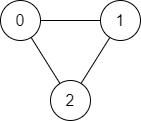
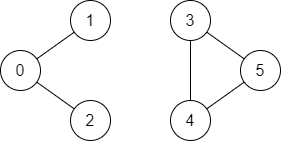
In the first example, n = 3 and the edges form a triangle: [[0,1],[1,2],[2,0]]. From 0 to 2 you can take the direct edge or go through 1, so the answer is true. In the second example the vertices 0, 1, 2 form one group and 3, 4, 5 form another, with no edge between the groups. There is no path from 0 to 5, so the answer is false.
Approach: explore everything reachable from the source
The question "is there a path?" is the same as "is the destination in the set of vertices reachable from the source?". Depth-first search (DFS) builds that set. It starts at the source, goes to a neighbour, then to a neighbour of that neighbour, and keeps going deeper. When it reaches a vertex with no unvisited neighbours it backs up and tries the next option.
Two things make this work:
- A visited set remembers which vertices the search has reached. A graph can contain cycles, like the triangle above. Without the set, the search would walk 0, 1, 2, 0, 1, 2 forever.
- An adjacency list stores each vertex's neighbours, so the search can find them without scanning the whole edge list every time.
After the search finishes, the visited set holds exactly the vertices connected to the source, and the answer is whether it contains destination.
Step by step
- Build
graphas aList<List<int>>and addnempty lists with aforloop. Indexvthen holds the neighbours of vertexv. Without the empty lists,graph[v]would be out of range. - Declare a
HashSet<int>namedvisited. It answers "have I been here?" in constant time on average. - Loop over
edgesand record every edge in both directions:graph[edge[0]].Add(edge[1])andgraph[edge[1]].Add(edge[0]). The graph is bi-directional, so a search arriving at either end must be able to cross the edge. - Call
Dfs(source, graph, visited). When it returns,visitedcontains everything reachable fromsource. - Return
visited.Contains(destination). It already is abool, so noifis needed. - Write the helper
Dfswith the currentnode, the graph and the visited set as parameters. - Mark
nodeas visited first. A neighbour that leads back to this vertex then finds it already marked. - Loop over
graph[node]. For each neighbour that is not invisited, callDfson it.
The solution in C#
class Solution {
    public bool ValidPath(int n, List<List<int>> edges, int source, int destination) {
        List<List<int>> graph = new List<List<int>>();
        for (int i = 0; i < n; i++) graph.Add(new List<int>());
        HashSet<int> visited = new HashSet<int>();
        foreach (var edge in edges) {
            graph[edge[0]].Add(edge[1]);
            graph[edge[1]].Add(edge[0]);
        }
        Dfs(source, graph, visited);
        return visited.Contains(destination);
    }

    private void Dfs(int node, List<List<int>> graph, HashSet<int> visited) {
        visited.Add(node);
        foreach (int adjacentNode in graph[node]) {
            if (!visited.Contains(adjacentNode)) {
                Dfs(adjacentNode, graph, visited);
            }
        }
    }
}
Trace the second example. The adjacency lists are: 0 has 1 and 2; 1 has 0; 2 has 0; 3 has 5 and 4; 4 has 5 and 3; 5 has 3 and 4. Starting from 0, the search visits 0, then 1 (a dead end), then 2. The visited set ends as {0, 1, 2}, which doesn't contain 5, so the result is false.
Some C# details:
- Nested lists.
List<List<int>>is a list whose elements are lists.graph.Add(new List<int>())adds a fresh, independent list each time. Adding the same list object repeatedly would make all vertices share one neighbour list. - Edges are lists, too. Here
edgesis aList<List<int>>, soedge[0]andedge[1]use the list indexer, andvarin theforeachlets the compiler infer the element typeList<int>. - Shared state.
ListandHashSetare reference types, soDfsreceives a reference to the same objects thatValidPathcreated. Adding tovisitedinsideDfsis visible to the caller. - Private helper.
private void Dfsis callable only from insideSolution. It returns nothing and communicates through the set. HashSet.Addand duplicates. Adding a value that is already present is harmless; the method just returnsfalse. The explicitContainscheck before recursing is still what prevents the endless recursion.
Complexity
Time: O(n + m), where m is the number of edges. Building the lists costs O(n + m). The search enters each vertex at most once, and it looks at every adjacency list entry once, which sums to 2m entries.
Space: O(n + m) for the adjacency lists, plus O(n) for the visited set and the recursion. The recursion depth can reach n on a graph shaped like a single long path.
Edge cases and common mistakes
- Source equals destination. The search marks the source first, so the answer is
trueeven with no edges at all, as inn = 1. - Adding each edge in one direction only. With
edges = [[1,0]],source = 0anddestination = 1, the answer must betrue. A one-directional adjacency list would givefalse. - Marking visited too late. Marking a vertex after the loop over its neighbours lets two neighbours call each other before either is marked, and the recursion never ends.
- Disconnected components. The vertices that the search never touches simply don't appear in
visited. There is no need to check them one by one. - Very deep recursion. Each recursive call uses stack space. A graph that is one long path of 200,000 vertices can exhaust the call stack and crash a recursive DFS. When the depth could be that large, keep your own
Stack<int>and loop instead, or use breadth-first search with aQueue<int>.
Testing
n = 3,edges = [[0,1],[1,2],[2,0]],source = 0,destination = 2givestrue.n = 6,edges = [[0,1],[0,2],[3,5],[5,4],[4,3]],source = 0,destination = 5givesfalse.n = 1, no edges,source = 0,destination = 0givestrue.n = 2,edges = [[1,0]],source = 0,destination = 1givestrue.