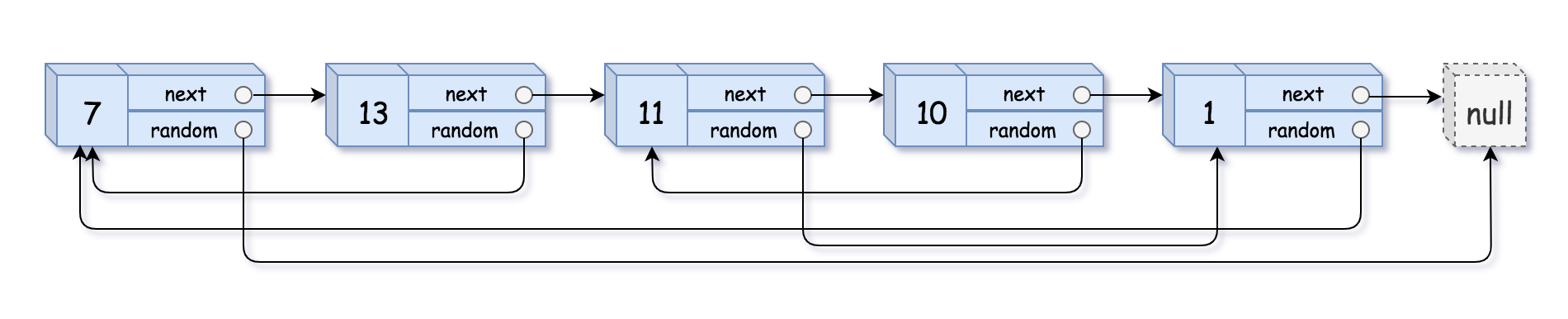


Problem overview
Each ListNode has a val, a next pointer and a random pointer that leads to any node in the list or to null. CopyRandomList(head) must return a deep copy: n new nodes with the same values, whose next and random pointers go only to other new nodes. The input list must come back unchanged, and an empty list returns null.
In the first example, [[7,null],[13,0],[11,4],[10,2],[1,0]], each node is written as [val, random_index], so the 13 has its random pointer on the first node and the 11 has it on the last. The copy must have the same shape, inside the new list.
Approach: put each copy right after its original
The usual method keeps a dictionary from each original to its copy. That uses O(n) extra space. This lesson drops the dictionary by storing the mapping in the list's own structure: each copy is inserted directly after its original node. In a list A, B, C the copies make A, A', B, B', C, C'.
Then the copy of any original X is simply X.next. To set a copy's random pointer, take the original's random target T, and the copy of T is T.next.
The algorithm has three passes:
- Interleave. Insert a value-only copy after each original.
- Set the random pointers. For each original with a random target, set its copy's random to the target's copy.
- Separate. Unweave the two lists, restoring the original and linking the copies to each other.
Step by step
- Handle the empty list. If
headisnull, returnnull. Later code readshead.next, which would fail. - Start a cursor.
nodebegins atheadand is declared withvar, which lets C# infer the typeListNode. - Loop while
node != null. Each iteration inserts one copy. - Save the successor.
nextNode = node.next, because the next line overwritesnode.next. - Make the copy.
copyNodeis a new node with the same value. Its random pointer waits until every copy exists. - Splice it in.
node.nextnow points to the copy. - Chain the copy onward.
copyNode.next = nextNode, so the interleaved chain continues. For the last original,nextNodeisnulland the last copy ends the chain. - Jump over the copy. Move
nodetonextNode. Moving tonode.nextwould land on the copy and insert copies of copies forever. - Reset the cursor to
headfor the second pass. - Loop again. This time
nodevisits only the originals, because each iteration skips the copy. - Grab the copy. It is
node.next. - Set its random. If
node.randomexists, the copy's random isnode.random.next, the copy that sits right after the target. - Jump to the next original,
copyNode.next. - Remember the new head,
head.next, before the third pass changeshead.nextback. - Reset the cursor to
head. - Loop a third time to separate the lists.
- Take the copy after
node. - Remember the next original as
copyNode.next, before any link is changed. - Link the copies. If that next original exists,
copyNode.nextbecomes its copy,nextNode.next. For the last pair, the last copy'snextis alreadynull. - Restore the original.
node.next = nextNodeundoes the interleaving, so the caller's list is unchanged. - Advance to
nextNode. - Return
newHead.
The solution in C#
class Solution {
    public ListNode CopyRandomList(ListNode head) {
        if (head == null) {
            return null;
        }

        var node = head;
        while (node != null) {
            var nextNode = node.next;
            var copyNode = new ListNode(node.val);
            node.next = copyNode;
            copyNode.next = nextNode;
            node = nextNode;
        }

        node = head;
        while (node != null) {
            var copyNode = node.next;
            if (node.random != null) {
                copyNode.random = node.random.next;
            }
            node = copyNode.next;
        }

        var newHead = head.next;
        node = head;
        while (node != null) {
            var copyNode = node.next;
            var nextNode = copyNode.next;
            if (nextNode != null) {
                copyNode.next = nextNode.next;
            }
            node.next = nextNode;
            node = nextNode;
        }

        return newHead;
    }
}
A few C# details are worth a closer look:
varis still static typing. The compiler infersListNodefrom the right-hand side, and the variable has that type for good. It must be initialized in the same statement.- Repeated names are fine.
copyNodeandnextNodeare declared in several loop bodies. Each loop body is its own scope, so the names don't clash. C# only rejects a name that is already declared in an enclosing scope. - Everything is a reference.
nextNodeandcopyNodepoint to nodes and don't copy them, so a change made throughcopyNode.nextchanges the list itself. - The
randomfield can benull, so readingnode.random.nextneeds theif. Without it, aNullReferenceExceptionfollows.
Tracing a tiny list
Take A -> B where A's random is B. After pass one: A, A', B, B'. In pass two, A's random is B, so A'.random = B.next = B'. B has no random. In pass three, with node = A, the copy is A', the next original is B, and A' is linked to B' (B.next). Then A is linked back to B. The next round, B' is linked to nothing, since its successor is null, and B.next becomes null. The result is the original A -> B and the copy A' -> B' with A'.random = B'.
Complexity
Time: O(n). Three passes, each visiting every original node once with a constant amount of work per node.
Extra space: O(1). The only extra memory is a few variables. The n new nodes are the output itself. This beats the dictionary solution's O(n) extra space, at the cost of more delicate pointer work.
Edge cases and common mistakes
- Empty list. The first
ifreturnsnullbefore anything readshead.next. - A single node. It might point its random at itself. Pass one makes
A, A', pass two setsA'.random = A.next = A', and pass three separates them again. - Setting randoms before all copies exist. The second pass must start only after the first has finished, since a random can point forward.
- Using
node.nextinstead ofnextNodein pass one. It lands on the new copy and loops without end. - Forgetting to restore the input. The caller still owns the original list, and a skipped
node.next = nextNodeleaves copies woven into it. - Reading
head.nexttoo late. After the third pass,head.nextis the original second node again, sonewHeadis captured first. - Copying the random pointer directly.
copyNode.random = node.randomwould point the copy into the original list.
Testing
[[7,null],[13,0],[11,4],[10,2],[1,0]]copies to the same pairs, and the input still has its original pointers afterward.[[1,1],[2,1]]copies to[[1,1],[2,1]].[[3,null],[3,0],[3,null]]copies to the same pairs.[]returnsnull.