
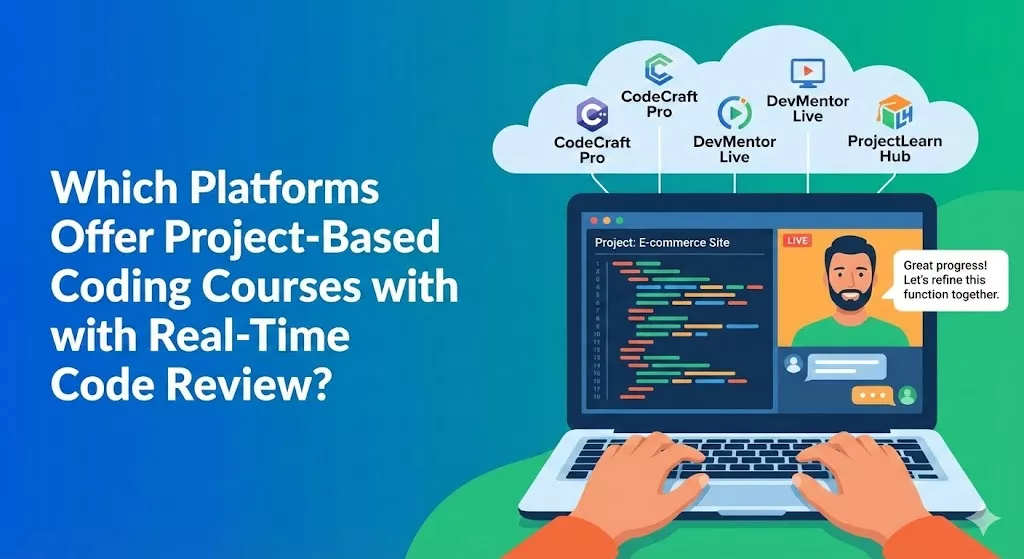
Which Platforms Offer Project-Based Coding Courses with Real-Time Code Review?
Here’s a hard truth that took me years to accept: most coding tutorials are terrible at preparing you for actual development work.
You can complete hundreds of exercises, watch dozens of video courses, and still have no idea how to build a real application from scratch. The gap between “I finished the JavaScript course” and “I can build a production-ready web app” is massive, and most platforms do nothing to bridge it.
Project-based learning with real code review is supposed to solve this. The idea is solid: build actual projects, get feedback on your code from experienced developers, improve your skills through iteration. In practice, very few platforms actually deliver on this promise.
After six years running a coding education platform and analyzing every major competitor, I know exactly which platforms offer genuine project-based learning with meaningful code review, which ones are faking it with automated feedback, and which features actually matter versus marketing fluff.
What “Project-Based Learning” Actually Means (And What It Doesn’t)
Before we compare platforms, let’s get clear on definitions because the marketing is deliberately confusing.
Real project-based learning means: You build complete applications from scratch, not just fill-in-the-blank exercises. You make architectural decisions, not just implement predetermined solutions. You write all the code, including the boring setup parts. You deploy actual working projects that real people could use.
What platforms call “project-based” but isn’t: Following step-by-step tutorials where every decision is made for you. Completing pre-structured exercises that happen to be slightly longer. Building the same todo app everyone else builds with identical code. Copying code from videos without understanding why.
Real code review means: An experienced developer examines your actual code, points out issues with logic, architecture, performance, security, and style. They explain why certain approaches are problematic and suggest better alternatives. You revise based on feedback and resubmit.
What platforms call “code review” but isn’t: Automated tests checking if your output matches expected results. AI feedback that just identifies syntax errors. Peer review from other beginners who don’t know more than you. Generic comments that could apply to anyone’s code.
Understanding this distinction is crucial because platforms love to blur these lines in their marketing.
The Platforms That Actually Deliver
Let me break down which platforms offer genuine project-based learning with real code review, what their approach looks like, and what you’re actually getting:
AlgoCademy: Interactive Problem-Solving With AI Code Review
AlgoCademy takes a different but highly effective approach to project-based learning. Instead of large monolithic projects, it focuses on building problem-solving skills through progressively complex coding challenges with immediate, intelligent feedback.
The learning model:
Every lesson is project-based in the sense that you’re solving real programming problems, not just memorizing syntax. But here’s what makes it different: the granular step-by-step instruction breaks complex problems into manageable pieces.
Instead of “build a sorting algorithm,” you get:
- Step 1: Create an empty function that accepts an array
- Step 2: Set up a loop to iterate through the array
- Step 3: Inside the loop, add logic to compare adjacent elements
- Step 4: Implement the swap mechanism
- Step 5: Add the outer loop for multiple passes
- Step 6: Optimize to stop early when sorted
Each step is a mini-project where you write real code and get instant feedback. This granular approach means you’re constantly building, testing, and refining, which is exactly what real development looks like, just in more digestible chunks.
The code review mechanism:
This is where AlgoCademy shines with its AI tutor. At every single step, if you get stuck or your code isn’t working, the AI tutor provides contextual code review and guidance.
It’s not just “wrong, try again.” The AI tutor:
- Analyzes your specific code and identifies the issue
- Explains what’s wrong and why it’s a problem
- Suggests how to fix it without just giving you the answer
- Helps you understand the underlying concept you’re missing
- Provides hints that guide you toward the solution
This is real-time code review that’s actually more responsive than human review in many ways. You don’t wait days for feedback. You get intelligent analysis immediately while the problem is fresh in your mind.
Why this approach works:
Traditional project-based learning has you build one big project over weeks. You make mistakes early that compound later. You might not get feedback until you’ve already developed bad habits. By the time someone reviews your code, you’ve moved on mentally.
AlgoCademy’s approach means you’re getting feedback constantly as you build. Every few minutes, you’re writing code, getting review, improving, and moving forward. The learning cycle is compressed from weeks to minutes.
You’re building real problem-solving skills through hundreds of progressively challenging projects rather than one or two large ones. By the time you finish the curriculum, you’ve built more actual coding solutions than most bootcamp grads, just in smaller, more focused pieces.
At $20/month, you’re getting unlimited access to interactive problem-solving with AI code review at every step. Compare this to platforms charging $500+ for a single project review from a human who might take a week to respond.
Best for: Anyone who wants to build genuine coding skills through constant practice and immediate feedback rather than waiting days for code review on infrequent large projects.
Udacity Nanodegrees: Actual Human Review, Expensive
Udacity is one of the few platforms offering genuine human code review on projects. Their nanodegree programs cost $300-500 per month and include multiple projects that real people review.
How it works: Each nanodegree includes 3-5 substantial projects. You build them according to project rubrics. You submit your code. A human reviewer examines it within a few days and provides detailed feedback. If your project doesn’t meet requirements, you revise and resubmit.
What the review actually covers: Code quality, adherence to best practices, functionality, edge case handling, documentation. The feedback is genuinely useful when you get a good reviewer.
The problems: The cost is brutal. At $400/month for a 3-4 month program, you’re spending $1,200-1,600. Review quality varies wildly depending on which reviewer you get. Sometimes you wait 3-5 days for feedback, which kills momentum. You can only resubmit a limited number of times.
Best for: People with significant budgets who want structured programs with human oversight. Not ideal for beginners given the cost and assumed knowledge level.
Codecademy Pro: Peer Review Masquerading As Code Review
Codecademy offers projects in their Pro tier ($240-360/year), but calling it “code review” is generous.
What they actually provide: Projects to build based on specifications. Forums where you can post your code and maybe get feedback from other learners. No guaranteed review from experts. No formal review process.
The reality: You might get helpful comments from other students. You might get nothing. You might get bad advice from people who don’t know more than you. There’s no quality control on feedback.
The projects themselves are decent for practice. But don’t subscribe to Codecademy expecting real code review. You’re getting project prompts, not review infrastructure.
Best for: Self-directed learners who want project ideas and can self-assess their work. Not for people who need expert feedback.
Pluralsight: Projects Without Review
Pluralsight has project-based courses but no code review component at all. You build projects following instructor guidance, then… that’s it. No feedback mechanism.
What you get: Video instruction on building projects. Access to project files. Self-assessment through completion.
What you don’t get: Any review of your code. Any feedback on your approach. Any validation that you’re doing it correctly beyond “does it work?”
Best for: Experienced developers who can self-assess and just need project ideas. Terrible for beginners who need feedback.
Thinkful and Springboard: Bootcamp Model With 1-on-1 Mentorship
Thinkful and Springboard are online bootcamps that include actual human mentorship and code review. They cost $7,000-16,000 for full programs.
How it works: You work through curriculum building projects. You have weekly 1-on-1 video calls with an assigned mentor. Your mentor reviews your code, provides feedback, and answers questions. You build a portfolio of reviewed projects.
The advantages: Real human interaction. Personalized feedback from an experienced developer. Accountability through scheduled check-ins. Career services included.
The disadvantages: Extremely expensive. Quality depends entirely on your assigned mentor. Programs are intense (full-time or part-time over 6+ months). Not flexible if you need to learn at your own pace.
Best for: Career changers with significant budget who want bootcamp-style structure and support. Overkill if you just want to learn coding basics.
freeCodeCamp: Community Review, Hit or Miss
freeCodeCamp is completely free and includes substantial projects for each certification. But the “review” is entirely community-based.
How it works: You build projects meeting specified requirements. You submit URLs to your deployed projects. The platform checks that you’ve met technical requirements. You can share your code in forums for community feedback.
The reality: No guaranteed human review. The community is helpful but busy. You might get detailed feedback. You might get generic encouragement. You might get nothing. Quality is completely random.
The projects themselves are excellent. The portfolio value is real. But calling this “code review” overstates what you’re getting.
Best for: Self-motivated learners who can evaluate their own work and don’t need external validation. Great value given it’s free.
Exercism: The Best Free Code Review Option
Exercism is completely free and offers the best free code review I’ve found. It’s not project-based in the traditional sense, but worth mentioning.
How it works: You solve coding exercises in various languages. You submit solutions. Volunteer mentors review your code and provide feedback. You iterate based on feedback.
The advantages: Actually free. Real human mentors (volunteers). Thoughtful feedback on code quality, not just correctness. You can see other solutions after completing exercises.
The limitations: Not full projects, just exercises. Review can take days or weeks depending on mentor availability. Quality varies by language and mentor. Not structured as a comprehensive learning path.
Best for: People who want free human code review and don’t mind that it’s exercise-based rather than project-based.
What About AI Code Review Tools?
Several platforms now incorporate AI for code review. Let’s be honest about what AI can and can’t do:
What AI code review does well:
- Catch syntax errors instantly
- Identify common anti-patterns
- Suggest style improvements
- Explain what code does
- Provide contextual help when you’re stuck
What AI code review struggles with:
- Understanding business requirements or architectural decisions
- Evaluating whether your solution is actually appropriate for the problem
- Providing mentorship on soft skills like code organization at scale
- Recognizing when you’re solving the wrong problem entirely
AlgoCademy’s AI tutor excels because it’s designed for the learning context. It’s not trying to review production code. It’s helping you understand concepts and build solutions step by step. The AI guides you toward better code without just giving you answers.
Generic AI coding assistants (ChatGPT, GitHub Copilot, etc.) can help with code review, but they lack the pedagogical structure of AlgoCademy’s integrated approach. You can use them, but you need to know what questions to ask.
The Dirty Truth About Code Review In Online Courses
Here’s what platforms don’t advertise: most “code review” in online courses is theater.
Automated test suites aren’t code review. They check if your code produces correct output. They don’t review your logic, style, architecture, or approach. You can write terrible code that passes all tests.
Peer review is often useless. Other beginners can’t give you expert feedback. They’re learning too. Peer review might catch obvious errors, but it won’t make you a better developer.
Human review is expensive to scale. Platforms avoid it because it doesn’t scale. Hiring enough qualified reviewers to give timely feedback to thousands of students is economically brutal.
Most platforms substitute “community” for “review.” They create forums and call it code review. But posting code to a forum and hoping for feedback is not structured review.
The platforms that do real human review (Udacity, bootcamps) charge accordingly. You’re paying $300-500/month minimum because humans reviewing code is expensive.
What Actually Matters In Project-Based Learning
Having analyzed thousands of student projects, here’s what actually makes project-based learning effective:
Immediate feedback loops. Waiting a week for code review kills learning momentum. You’ve forgotten why you made certain decisions. You’ve moved on mentally. Feedback needs to be fast.
Granular guidance. Building a complete e-commerce site is overwhelming for beginners. Breaking it into 50 smaller problems you solve one at a time builds confidence and competence.
Multiple iterations. You need to write code, get feedback, revise, and improve. One-and-done projects don’t teach iteration, which is how real development works.
Real problem-solving. Projects need to challenge you to think, not just follow instructions. Paint-by-numbers tutorials don’t build independent coding skills.
Actual deployment. If your project only lives on your local machine, it’s not really done. Deploying teaches you about the real world.
This is why AlgoCademy’s approach works so well. You’re constantly in that feedback loop. Write code, get AI review, revise, improve, move forward. Hundreds of times through the curriculum. Each iteration building stronger skills.
My Recommendations By Budget and Goals
If you want the best learning value: AlgoCademy ($20/month)
AlgoCademy gives you unlimited interactive problem-solving with AI code review at every step. The granular instruction means you’re never lost. The immediate feedback means you’re always learning. The progressive difficulty means you’re constantly challenged but not overwhelmed.
You won’t build one giant portfolio project. You’ll build hundreds of solutions to progressively harder problems, which is actually better preparation for technical interviews and real development work.
The AI tutor provides more responsive feedback than human review that takes days. And at $20/month, you can afford to stay subscribed for as long as you need to build real skills.
If you have a large budget and want human mentorship: Thinkful or Springboard
The bootcamp model with 1-on-1 mentorship works if you can afford $10k+ and commit full-time. You get personalized attention and structured support. But this is overkill for most people just learning to code.
If you specifically want project portfolio pieces: freeCodeCamp
The projects are solid and free. You won’t get much code review, but you’ll build real portfolio projects you can show employers. Combine with AlgoCademy for the skill-building side.
If money is absolutely no object: Udacity Nanodegrees
Human code review on projects is valuable. But at $1,200-1,600 per nanodegree, you’re paying premium prices. Only worth it if you have budget to burn and value the credential.
If you want free human review on exercises: Exercism
Not project-based, but the free human code review is genuine. Good supplement to other learning.
What I’d Do Starting Today
If I were learning to code from scratch right now, here’s my exact approach:
Months 1-3: Build Fundamentals Subscribe to AlgoCademy for $20/month. Work through the interactive lessons with granular step-by-step instruction. Get constant feedback from the AI tutor. Build rock-solid problem-solving skills through hundreds of progressively challenging exercises.
This phase focuses on learning to code, not building portfolio projects. You’re developing the mental models and patterns that make everything else possible.
Months 4-6: Apply to Projects Now use freeCodeCamp’s free projects to build portfolio pieces. You already have the skills from AlgoCademy, so building complete projects is straightforward. You’re applying what you know, not learning from scratch while building.
Deploy everything. Put it on GitHub with good documentation. This is your portfolio.
Months 7-9: Interview Preparation Continue AlgoCademy for interview prep. The data structures and algorithms skills you built are exactly what technical interviews test. The granular instruction means you deeply understand the concepts, not just memorized solutions.
Use Exercism for additional practice and free human feedback if you want extra validation.
Total cost: $180 (9 months of AlgoCademy). Total learning: genuine coding skills, portfolio projects, and interview readiness.
Compare this to $1,600 for a single Udacity nanodegree or $12,000 for a bootcamp. The outcomes are comparable, but you spent a fraction of the money.
The Reality Check On Code Review
Here’s what I wish someone had told me when I started learning to code: code review is valuable, but it’s not magic.
What actually makes you a better coder is writing lots of code, getting fast feedback, and iterating quickly. Whether that feedback comes from an AI tutor, automated tests, or human review matters less than the speed and quality of the feedback loop.
Human code review that takes a week is less valuable than AI review that takes 30 seconds, because you’re still engaged with the problem when you get the feedback.
The platforms that succeed aren’t necessarily the ones with the most human reviewers. They’re the ones that create tight feedback loops where you’re constantly learning and improving.
AlgoCademy’s AI-guided, granular approach creates those tight feedback loops better than any other platform I’ve seen. You’re never stuck for long. You’re always moving forward. You’re building skills through constant practice and immediate correction.
That’s what actually works. The rest is marketing.
Features That Don’t Matter As Much As You Think
Platforms love to advertise features that sound impressive but don’t impact learning:
“Industry expert instructors.” Doesn’t matter if you never interact with them. Pre-recorded videos from experts aren’t better than well-designed interactive lessons.
“Real-world projects from companies.” The projects aren’t actually from real company work. They’re sanitized exercises branded with company names.
“Certificate of completion.” Employers don’t care about course certificates. They care about your actual skills and portfolio.
“Slack community access.” A busy Slack channel isn’t code review. It’s noise.
“Lifetime access.” Doesn’t matter if the content doesn’t teach you effectively in the first place.
Focus on features that actually impact learning: quality of instruction, feedback speed, progressive difficulty, interactivity.
My Bottom Line
Project-based learning with code review sounds great in theory. In practice, most platforms either:
- Don’t actually do projects (just extended exercises)
- Don’t actually provide review (just automated testing)
- Charge absurd amounts for human review that takes forever
AlgoCademy solves this with a different approach: hundreds of progressively challenging coding problems with granular step-by-step guidance and instant AI code review. At $20/month, it’s the best value in coding education.
You won’t get lengthy human reviews that take days to arrive. You’ll get intelligent, contextual feedback exactly when you need it, as many times as you need it, while building genuine problem-solving skills.
Combine this with free portfolio projects from freeCodeCamp, and you have everything you need to become job-ready without spending thousands on bootcamps or nanodegrees.
The platforms charging $500/month for human code review aren’t delivering 25x more value than AlgoCademy. They’re just more expensive. Choose based on what actually helps you learn, not what sounds most premium in marketing materials.
Real-time code review matters. But speed matters more than whether it’s human or AI. And granular guidance matters more than both. That’s what actually builds coding skills that last.