Where to Find Coding Courses Tailored for Non-Technical Professionals?
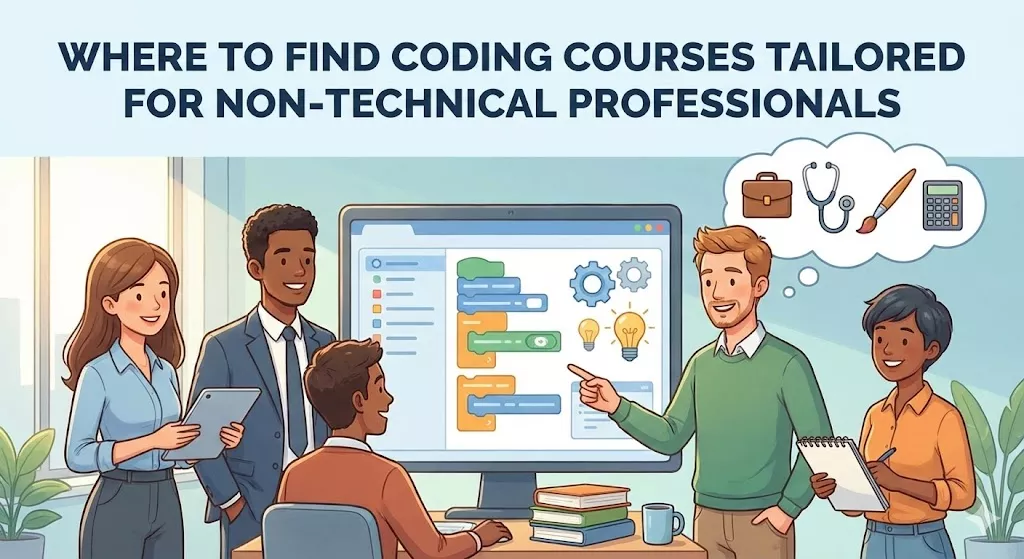
Here’s a reality that most coding courses ignore: if you’re a marketer, designer, product manager, or business professional trying to learn code, your needs are completely different from someone training to be a software engineer.
After years watching non-technical professionals approach coding education, I’ve seen a consistent problem. They enroll in courses designed for aspiring developers, get overwhelmed by concepts they don’t need (recursion, algorithms, data structures), and quit thinking they’re “not technical enough.” The course wasn’t wrong. It was just solving the wrong problem.
You don’t need to become a software engineer. You need enough coding knowledge to be more effective at your actual job. That requires completely different courses than what dominates the market. Let me show you where to find coding education actually designed for non-technical professionals, not engineers-in-training.
Why Most Coding Courses Fail Non-Technical Professionals
Before we look at solutions, let’s understand why traditional coding courses don’t work for you:
Problem 1: Wrong Goals
Traditional coding courses teach you to:
- Build applications from scratch
- Solve complex algorithmic problems
- Understand computer science theory
- Pass technical interviews
- Become a software developer
Non-technical professionals actually need to:
- Automate repetitive tasks in their workflow
- Communicate better with development teams
- Understand technical feasibility for product decisions
- Customize existing tools (no-code/low-code platforms)
- Analyze data relevant to their role
- Make informed technical decisions in their domain
These are fundamentally different goals requiring different education.
Problem 2: Irrelevant Content
Traditional courses spend time on:
- Data structures and algorithms
- Complex programming patterns
- System design and architecture
- Technical interview preparation
Non-technical professionals need:
- Practical automation with existing tools
- Understanding APIs and how systems connect
- Basic data manipulation and analysis
- Enough technical literacy to collaborate with developers
- Domain-specific technical skills (marketing automation, design systems, etc.)
Learning sorting algorithms doesn’t help a marketer automate email campaigns.
Problem 3: Wrong Assumptions
Traditional courses assume:
- You want to code full-time
- You can dedicate 20+ hours weekly to learning
- You’re comfortable with abstract thinking and logic
- Your goal is technical mastery
Non-technical professionals reality:
- Coding is a tool to enhance your primary role, not replace it
- You have 3-5 hours weekly max while doing your actual job
- You prefer practical, concrete applications over abstract concepts
- Your goal is just-enough technical literacy, not mastery
The mismatch creates frustration and failure.
What “Tailored for Non-Technical Professionals” Actually Means
Before looking at specific courses, let’s define what makes education appropriate for non-technical professionals:
Should Include:
Immediate practical applications: “Here’s how to automate your expense reports” not “here’s how arrays work.”
Domain-specific examples: Marketing examples for marketers. Design examples for designers. Product management examples for PMs.
Gentle technical ramp: Assumes zero technical background. Explains jargon. Builds confidence before complexity.
Focus on tools and platforms: Excel/Sheets automation, no-code platforms, marketing automation tools. Not building from scratch.
Time-efficient learning: Respects that you have a full-time job. Focused lessons you can complete in 15-30 minutes.
Should NOT Include:
Computer science theory: You don’t need to understand how compilers work or Big O notation.
Complex programming concepts: Skip recursion, pointers, memory management. Focus on practical scripting.
Building applications from scratch: You’re not building Instagram. You’re automating tasks or analyzing data.
Technical interview prep: You’re not interviewing for engineering jobs. Different skill set.
The Best Courses for Non-Technical Professionals by Role
Let me break down actual resources tailored to different professional roles:
For Marketers: Automation and Analytics
Google Analytics Academy (Free) analytics.google.com/analytics/academy
What it teaches: Digital analytics fundamentals. Setting up tracking. Understanding data. Making data-driven marketing decisions.
Why it’s tailored for marketers: Everything is framed around marketing use cases. You’re learning technical concepts (tracking pixels, APIs, data structures) through marketing applications.
What you’ll be able to do: Implement tracking codes. Understand technical discussions with developers about analytics. Make informed decisions about marketing technology stack.
Time commitment: 4-6 hours per course, self-paced.
HubSpot Academy (Free) academy.hubspot.com
What it teaches: Marketing automation, CRM implementation, email marketing technical setup. Practical use of marketing technology platforms.
Why it’s tailored for marketers: Teaches technical concepts through actual marketing tools you’ll use. APIs, integrations, automation workflows – all in marketing context.
What you’ll be able to do: Set up marketing automation. Integrate tools. Understand technical limitations and possibilities in marketing stack.
Zapier Learn (Free) zapier.com/learn
What it teaches: Workflow automation without coding. Connecting apps. Understanding APIs and integrations conceptually.
Why it’s good for non-technical marketers: No-code approach to automation. You’re learning technical concepts (webhooks, API calls, data formatting) through practical marketing automation.
What you’ll be able to do: Automate repetitive marketing tasks. Connect marketing tools. Understand technical possibilities without writing code.
For Product Managers: Technical Fluency
Product School (Paid, ~$2,000-4,000) productschool.com
What it teaches: Technical fluency for product managers. Understanding APIs, databases, cloud infrastructure. Speaking developers’ language.
Why it’s tailored for PMs: Focuses on “just enough” technical knowledge for product decisions. You’re not learning to code. You’re learning to evaluate technical tradeoffs.
What you’ll be able to do: Understand technical discussions in sprint planning. Ask informed questions about technical feasibility. Make better product decisions considering technical constraints.
Reforge Product Management Program (Paid, ~$2,000) reforge.com
What it teaches: Advanced PM topics including working with engineering teams, understanding technical debt, evaluating build vs buy decisions.
Why it’s tailored for PMs: Created by experienced PMs for PMs. Technical content is framed around product decisions, not engineering mastery.
Coursera “Software Product Management” Specialization (University of Alberta) coursera.org
What it teaches: Software development lifecycle from PM perspective. Agile methodologies. Technical communication.
Why it’s appropriate for non-technical PMs: Teaches software concepts from management perspective. You learn how software is built without becoming a builder.
Cost: Can audit free, certificate costs money, financial aid available.
For Designers: Design Systems and Frontend Basics
Webflow University (Free) university.webflow.com
What it teaches: Visual development. Understanding HTML/CSS concepts through visual interface. Responsive design.
Why it’s perfect for designers: Visual approach to learning technical concepts. You’re manipulating design, but learning how code structures those designs.
What you’ll be able to do: Build functional websites without writing code. Understand how design translates to code. Communicate better with developers.
Design+Code (Paid, ~$20/month) designcode.io
What it teaches: Design with code context. SwiftUI for designers. Framer. Figma to code workflows.
Why it’s tailored for designers: Teaches enough code for designers to prototype and understand implementation. Not training you to be a developer.
Scrimba “Responsive Design” Courses (Free tier available) scrimba.com
What it teaches: HTML, CSS, basic JavaScript through interactive videos.
Why it works for designers: Visual, interactive format. Focus on frontend (what designers actually care about). Projects are design-focused, not complex apps.
What you’ll be able to do: Implement your designs in code. Build simple prototypes. Understand technical constraints in your designs.
For Business Analysts: Data and Analytics
Mode Analytics SQL Tutorial (Free) mode.com/sql-tutorial
What it teaches: SQL for data analysis. Querying databases. Understanding data structures.
Why it’s perfect for analysts: Purely focused on using SQL to answer business questions. No database administration or complex optimization.
What you’ll be able to do: Pull your own data. Answer business questions directly from databases. Reduce dependence on data teams for simple queries.
DataCamp for Business (Paid, ~$25/month individual, team plans available) datacamp.com
What it teaches: Data analysis with SQL, Python, R, Excel. BI tools like Tableau and Power BI.
Why it’s tailored for business professionals: Content organized by business function. “Data Analyst” track teaches technical skills through business use cases.
What you’ll be able to do: Perform data analysis. Create visualizations. Automate reporting. Make data-driven decisions.
Google Data Analytics Certificate (Coursera, ~$300)
What it teaches: Complete data analysis workflow. SQL, spreadsheets, data visualization, R for statistics.
Why it’s good for non-technical analysts: Designed for career changers with no technical background. Teaches tools through practical business problems.
What you’ll be able to do: Full data analysis lifecycle. Pull data, clean it, analyze it, visualize it, present findings.
For Executives and Managers: Technical Literacy
Harvard Business School Online “Digital Business Strategy” (~$1,750) online.hbs.edu
What it teaches: Strategic understanding of digital technologies. How technology enables business transformation.
Why it’s appropriate for executives: Business strategy focus with technical context. You’re not learning to code. You’re learning strategic implications of technology.
MIT Sloan Executive Education (Various programs, $2,000-10,000+)
What it teaches: Digital transformation, AI strategy, technology management. Executive-level technical literacy.
Why it’s tailored for executives: Strategic level understanding. Enough technical knowledge for board-level decisions without technical depth.
Codecademy “Code Foundations” Path (Free tier available) codecademy.com
What it teaches: Absolute basics of how code works. Programming concepts at surface level.
Why it works for beginners: Gentle introduction. Interactive. No assumptions about technical background. Good for executives wanting basic literacy.
What you’ll be able to do: Understand what developers do. Follow technical conversations. Ask better questions. Not write production code.
For Everyone: General Technical Literacy
Khan Academy “Intro to JavaScript” (Free) khanacademy.org
What it teaches: Programming fundamentals through creative projects. Drawing, animations, simple games.
Why it’s non-technical-friendly: Extremely gentle pace. Visual feedback. No assumptions about technical background. Creative rather than engineering-focused.
LinkedIn Learning “Programming Foundations” Series (~$30/month) linkedin.com/learning
What it teaches: Foundational programming concepts explained for business professionals.
Why it’s appropriate: Business-oriented explanations. Practical context for non-developers. Certificates on LinkedIn profile.
Coursera “Python for Everybody” Specialization (Free to audit)
What it teaches: Python through practical data manipulation and automation tasks.
Why non-technical professionals succeed: Designed for absolute beginners. Instructor (Charles Severance) is exceptionally clear. Focus on practical applications, not computer science.
What you’ll be able to do: Automate tasks with Python scripts. Manipulate data. Build simple tools for your workflow.
For Those Discovering They Need Real Programming Skills
AlgoCademy ($20/month) algocademy.com
When this makes sense: Some non-technical professionals discover their role is evolving to require actual coding skills, not just technical literacy. Maybe you’re a PM building internal tools. Maybe you’re an analyst who needs to write custom scripts regularly. Maybe automation has become a core part of your job.
What it teaches: Genuine programming fundamentals starting from absolute zero. The first lesson literally starts with “print to console” – no assumptions about prior knowledge.
The step-by-step approach breaks everything down:
- Step 1: Understand what this concept does
- Step 2: Write the basic structure
- Step 3: Add the logic
- Step 4: Test and verify
This granular instruction makes programming accessible even if you’ve never touched code before.
Why it works for non-technical backgrounds: The AI tutor provides guidance when you’re stuck without just giving answers. This is crucial when you’re learning alone while working full-time.
Each lesson is designed to be completable in 20-30 minutes, respecting that you have an actual job and can’t dedicate hours daily.
What you’ll be able to do: Write actual code to solve real problems. Not just use tools – build tools. Automate complex workflows. Eventually understand the programming concepts that traditional courses throw at you too quickly.
The important caveat: This is for non-technical professionals whose roles are genuinely evolving to need programming skills, not for everyone. If your needs are workflow automation (use Zapier), data queries (learn SQL), or technical literacy (use the other resources listed), you don’t need this.
But if you’re hitting limitations with no-code tools and finding you actually need to write code regularly, AlgoCademy bridges the gap from complete beginner to capable programmer more gently than traditional computer science courses.
The No-Code/Low-Code Alternative
For many non-technical professionals, no-code/low-code platforms provide more value than learning to code traditionally:
Airtable Universe
What it is: Database/spreadsheet hybrid with automation capabilities.
Learning resources: Airtable’s official tutorials, YouTube channels focused on Airtable for specific professions.
Why it’s perfect for non-technical users: Visual interface. No coding required. Powerful automation. Templates for common business use cases.
Use cases: Project management, CRM, content calendars, inventory management – all without code.
Notion
Learning resources: Notion’s template gallery, community courses, YouTube tutorials.
Why non-technical professionals love it: Flexible workspace building without technical skills. Databases, automation, integrations all through visual interface.
Make (formerly Integromat) and Zapier
What they teach: Workflow automation through visual interfaces.
Why this matters: You’re learning technical concepts (APIs, data transformation, conditional logic) without writing code. Same outcomes, lower barrier.
Webflow, Framer, Bubble
For designers and marketers: Build functional websites and apps without traditional coding.
Learning curve: Still requires technical thinking but visual interface makes concepts accessible.
How to Choose Based on Your Goals
Don’t just pick popular courses. Match education to your specific needs:
Goal: Communicate Better with Developers
What you need: Technical literacy, not coding skills. Understanding of development process, technical constraints, common terminology.
Best resources:
- LinkedIn Learning “Programming Foundations” series
- Product School courses (if you’re in product/project management)
- Codecademy “Code Foundations” (free)
Time investment: 10-20 hours total for basic literacy.
Goal: Automate Repetitive Tasks
What you need: Workflow automation tools and basic scripting.
Best resources:
- Zapier Learn for no-code automation
- Python for Everybody (Coursera) for simple scripts
- Excel/Google Sheets advanced courses for spreadsheet automation
- AlgoCademy if automation has become core to your role and no-code tools are limiting
Time investment: 20-40 hours to start automating effectively.
Goal: Analyze Data for Your Role
What you need: SQL for data queries. Basic statistics. Visualization tools.
Best resources:
- Mode Analytics SQL Tutorial (free)
- Google Data Analytics Certificate (comprehensive)
- DataCamp for Business (role-specific tracks)
Time investment: 40-80 hours for job-ready data analysis skills.
Goal: Make Better Technical Decisions
What you need: Understanding of technical tradeoffs, feasibility, costs. Strategic technical thinking.
Best resources:
- HBS Online “Digital Business Strategy”
- MIT Sloan executive programs
- Reforge for product professionals
Time investment: 20-40 hours for strategic understanding.
Goal: Build Simple Tools/Websites
What you need: No-code/low-code platforms OR basic frontend skills (HTML/CSS/JavaScript).
Best resources:
- Webflow University for visual website building
- Scrimba for learning through building
- Bubble for building apps without code
- AlgoCademy if you find yourself needing custom functionality beyond what no-code tools provide
Time investment: 30-60 hours to build functional simple tools.
Goal: Your Role Is Evolving to Need Real Coding
What you need: Genuine programming skills, not just tool proficiency.
Best resources:
- AlgoCademy for structured, beginner-friendly programming fundamentals
- Python for Everybody (Coursera) for practical scripting
- Scrimba for web development if that’s your focus
Time investment: 3-6 months of consistent learning to develop genuine coding ability.
Common Mistakes Non-Technical Professionals Make
Mistake 1: Trying to Become a Developer
You don’t need to match software engineers’ skills. You need enough technical literacy for your actual role.
Fix: Define specific use cases. “I want to automate expense reporting” not “I want to learn Python.”
Mistake 2: Starting with Computer Science
Algorithms, data structures, and theory are for aspiring engineers. You need practical application skills.
Fix: Skip CS fundamentals unless your role genuinely requires them. Go straight to tools and platforms relevant to your role.
Mistake 3: Learning Languages Instead of Concepts
Learning “Python” or “JavaScript” is too broad. You need specific applications.
Fix: Learn “Python for data analysis” or “JavaScript for marketing automation” – domain-specific applications.
Mistake 4: No-Code Shame
Some professionals think no-code tools are “cheating” or not “real” technical skills.
Fix: No-code tools are technical skills. Mastering Airtable or Zapier makes you more effective than mediocre coding skills you’ll never use.
Mistake 5: Underestimating Time Requirements
“I’ll learn to code in a month” while working full-time is unrealistic.
Fix: Set realistic expectations. 3-6 months of consistent part-time learning for meaningful skills.
The Recommended Learning Path for Non-Technical Professionals
Here’s a practical path that works:
Month 1: Technical Literacy Foundations
Focus: Understanding basic concepts and terminology.
Resources:
- LinkedIn Learning “Programming Foundations” series (10-15 hours)
- Khan Academy “Intro to JS” for fun, visual learning (5-10 hours)
Outcome: You can follow technical conversations. You understand what developers do.
Month 2: Domain-Specific Tools
Focus: Learn tools specific to your role.
For marketers: Google Analytics Academy + HubSpot Academy For PMs: Product School intro courses + Agile/Scrum basics For designers: Webflow University + basic HTML/CSS For analysts: Mode SQL Tutorial + Google Sheets advanced features
Outcome: You can use technical tools relevant to your job.
Month 3: Automation and Efficiency
Focus: Automate repetitive tasks in your workflow.
Resources:
- Zapier Learn for no-code automation
- Python for Everybody (Coursera) if comfortable with basic coding
- Advanced Excel/Sheets courses for spreadsheet automation
Outcome: You’ve automated at least one recurring task. You’ve saved hours of manual work.
Months 4-6: Advanced Applications
Focus: Build on foundations with role-specific advanced skills.
Resources vary by role:
- Marketers: Marketing automation platforms, CRM technical skills
- PMs: Technical product management, API basics, database concepts
- Designers: Interactive prototyping, design systems, component libraries
- Analysts: Advanced SQL, Python for data, BI tools (Tableau, Power BI)
- If coding has become central to your role: AlgoCademy for structured programming education
Outcome: Technical skills are integrated into your daily work. You’re more effective at your primary role.
My Honest Recommendations
If you’re a marketer: Start with Google Analytics Academy (free) and HubSpot Academy (free). Then learn Zapier for automation. This gives you practical skills immediately applicable to your job.
Don’t try to learn programming from scratch unless automation is becoming a major part of your role and no-code tools are limiting you.
If you’re a product manager: Take Coursera’s “Software Product Management” specialization (can audit free). Supplement with “Grokking the System Design Interview” (Educative, ~$79) for technical fluency.
Focus on understanding enough to evaluate tradeoffs, not enough to build products yourself. If you find yourself actually needing to build internal tools or prototypes, that’s when AlgoCademy becomes relevant.
If you’re a designer: Webflow University (free) teaches you frontend concepts through visual design. This is more valuable than traditional coding courses because it matches how you think.
Add Scrimba’s frontend courses if you want to understand code, but Webflow alone makes you more effective.
If you’re a business analyst: Mode Analytics SQL Tutorial (free) then Google Data Analytics Certificate (~$300). This takes you from zero to job-ready data analysis in 3-6 months.
Skip general programming unless you find SQL and spreadsheets can’t handle your analysis needs, then consider Python-specific data analysis courses.
If you’re an executive: Don’t learn to code. Learn strategic implications of technology through HBS Online or MIT Sloan executive programs.
Your value is strategic thinking, not coding ability.
For everyone: Consider no-code/low-code tools before traditional coding. Airtable, Zapier, Webflow, and similar platforms often solve your problems faster than learning to code from scratch.
Only pursue actual programming education (like AlgoCademy) if you’ve genuinely hit the limitations of no-code tools and your role requires writing code regularly.
The Bottom Line
Coding courses for non-technical professionals should be fundamentally different from courses for aspiring developers.
You don’t need:
- Computer science theory (usually)
- Data structures and algorithms (unless role evolution requires it)
- Technical interview preparation
- To become a software engineer
You do need:
- Practical automation for your workflows
- Technical literacy to collaborate with developers
- Domain-specific technical skills
- Tools to make you more effective at your actual job
The best resources are:
- Role-specific courses (marketing, product, design, analysis)
- No-code/low-code platforms that solve problems without traditional coding
- Practical application-focused learning, not theoretical foundations
- For the minority whose roles genuinely need programming: structured beginner courses like AlgoCademy
Avoid:
- Generic “learn to code” courses designed for engineers (unless your role is evolving)
- Bootcamps (unless career-changing to engineering)
- Computer science fundamentals (interesting but usually not practical for your needs)
Choose education based on specific use cases in your role, not general “learn to code” aspirations. The goal is enhancing your current career, not changing careers entirely.
Most non-technical professionals get more value from 20 hours learning Zapier, SQL, or role-specific tools than from 200 hours learning general programming concepts they’ll never use.
Be strategic. Learn what makes you more effective at your job today, not what might theoretically be useful someday. And if you discover that what makes you more effective is actually writing code regularly, then pursue real programming education designed for beginners – but that’s the exception, not the rule.