
What Are the Differences Between Self-Paced and Live Instructor-Led Coding Courses on Major Platforms?
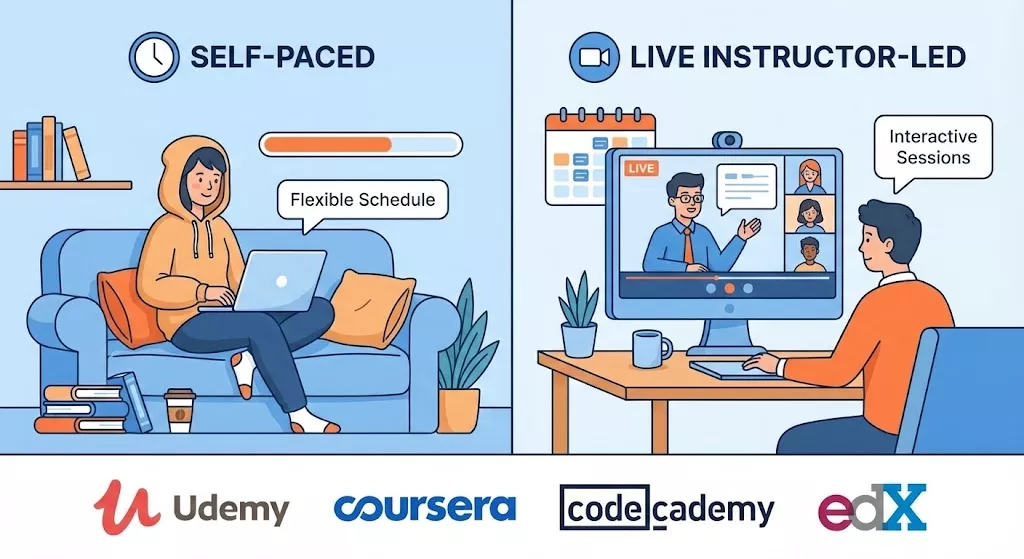
Here’s a truth that most coding education platforms won’t tell you: the distinction between “self-paced” and “live instructor-led” is often marketing theater. What they call “instructor-led” is frequently just pre-recorded videos with scheduled release dates. What they call “self-paced” sometimes has stricter deadlines than advertised live courses.
After years analyzing how people actually learn to code and watching thousands navigate these different formats, I can tell you the real differences matter way more than the labels. The question isn’t “which format is better?” It’s “which format matches how you actually learn and what constraints you’re working within?”
Let me break down what these formats actually look like on major platforms, what the real tradeoffs are, and how to choose without falling for marketing that obscures more than it reveals.
What These Terms Actually Mean (Versus What Marketing Claims)
Before we compare platforms, let’s define what these formats should mean versus what they often actually are:
True Self-Paced Learning
What it should mean:
- Start whenever you want, no waiting for cohort dates
- Learn as fast or slow as your schedule allows
- No mandatory deadlines or scheduled class times
- Access remains available as long as you’re subscribed
- Progress entirely on your own timeline
What platforms sometimes call “self-paced” but isn’t:
- “Self-paced” but with weekly deadlines that create artificial urgency
- “Self-paced” but time-limited access (course expires in 6 months)
- “Self-paced” but content releases on a schedule (drip-fed content)
- “Self-paced” but graded assignments that lock until you complete previous ones
True Live Instructor-Led Learning
What it should mean:
- Real instructor teaching in real-time via video
- Scheduled class sessions you attend live
- Ability to ask questions and get immediate answers during class
- Instructor adjusts pacing based on class comprehension
- Cohort of students learning together at the same pace
What platforms sometimes call “instructor-led” but isn’t:
- Pre-recorded videos released on a schedule
- “Instructors” who are just forum moderators, not teachers
- Live sessions that are Q&A only, not actual teaching
- One instructor for 500+ students (no real interaction possible)
- “Office hours” once a week as the only live component
Understanding these distinctions helps you evaluate what you’re actually getting.
The Real Tradeoffs Between Formats
Forget the marketing. Here are the actual differences that impact learning:
Self-Paced: The Real Advantages
Flexibility is genuine: You can learn at 2 AM on Tuesday if that’s when you have time. You can spend three hours on a concept you find difficult and five minutes on something you already understand. No one is rushing you or holding you back.
Accommodates life: Job suddenly gets busy? You slow down. Have a free week? You speed up. Travel for two weeks? Your course is still there when you return.
Review as needed: Didn’t understand recursion the first time? Watch it again. Three times. Ten times. Nobody’s judging you or moving on without you.
Cost efficiency: Generally cheaper than live courses because platforms don’t pay instructors for scheduled teaching time.
Immediate start: No waiting weeks or months for the next cohort to begin. Start learning today.
Self-Paced: The Real Disadvantages
Discipline required: No external accountability. If you don’t feel like learning today, nobody notices. This is freedom for disciplined people and a trap for those who aren’t.
No real-time help: When you’re stuck, you’re searching documentation, posting in forums, or waiting for responses. No instructor to immediately clarify.
Easy to procrastinate: “I’ll do it tomorrow” turns into “I’ll do it next week” turns into never finishing. The flexibility that helps some people destroys others.
Outdated content risk: Self-paced courses can sit unchanged for years. Technologies evolve. You might be learning deprecated approaches without realizing it.
Isolation: You’re learning alone. No classmates to struggle with, share victories with, or study alongside. Some people thrive solo. Others need social learning.
Live Instructor-Led: The Real Advantages
Immediate feedback: Question about async/await in JavaScript? Ask the instructor and get an answer now, not three days later in a forum.
Structured accountability: Class is Tuesday and Thursday at 7 PM. You show up or fall behind. This external structure helps people who struggle with self-discipline.
Adaptive teaching: Good instructors adjust based on what the class is struggling with. If everyone’s confused about closures, the instructor spends more time on it.
Cohort learning: You learn alongside others at your level. Study groups form naturally. You’re not alone when struggling.
Current content: Live courses adapt to industry changes. Instructor mentions “this approach is outdated, here’s the new best practice.”
Forced completion: The course ends on a specific date. You either keep up or get left behind. Some people need this pressure to actually finish.
Live Instructor-Led: The Real Disadvantages
Schedule constraints: Class is 7-9 PM on weeknights. Your work schedule conflicts? You’re out of luck or watching recordings (defeating the “live” benefit).
Fixed pace: Instructor moves through material at one speed. Too fast for some students. Too slow for others. Nobody gets perfectly optimized pacing.
Significantly more expensive: Paying for instructor time, cohort coordination, and scheduling infrastructure. Often 2-5x the cost of self-paced.
Delayed start: Next cohort starts in 6 weeks. You can’t begin learning until then. Motivation might fade while waiting.
Limited review: Once the instructor moves on, you’re expected to keep up. Can’t spend three days on a concept everyone else understood.
Time commitment concentration: Often requires 20-30 hours per week for duration of course. Hard to manage alongside full-time work and life.
How Major Platforms Handle Each Format
Let me break down what you actually get on different platforms:
Self-Paced Platforms
freeCodeCamp: Pure self-paced. Start anytime, learn at any speed, no deadlines ever. Completely free.
The curriculum is fixed (you progress through it linearly), but the timeline is entirely yours. You could finish the Responsive Web Design certification in a weekend or over six months. Nobody cares.
Best for: Disciplined learners who need maximum flexibility and can’t commit to schedules.
Codecademy: Self-paced with optional “streaks” to create artificial accountability. The course content itself has no deadlines, but the platform gamifies daily engagement.
You can ignore the streak feature and truly learn at your own pace, or use it for motivation.
Best for: Beginners who want polished, interactive lessons and can manage their own timeline.
Udemy: Completely self-paced. Courses are pre-recorded. Access is “lifetime” (as long as Udemy exists and keeps the course available).
Each instructor controls their content. Some update regularly. Some courses are years out of date.
Best for: Learning specific technologies from specific instructors at your own pace. Quality varies wildly.
LinkedIn Learning: Self-paced subscription model. Content is pre-recorded and updated periodically.
The platform suggests learning paths, but you’re free to ignore them and jump around.
Best for: Professionals adding specific skills without time pressure.
Coursera (Self-Paced Mode): Many Coursera courses offer self-paced enrollment. You get access to all materials immediately and work through them on your timeline.
Some courses have “suggested deadlines” but these are flexible. You can reset them if you fall behind.
Best for: University-quality content on your schedule.
Live Instructor-Led Platforms
General Assembly: True live bootcamp format. Scheduled classes multiple times per week. Real instructors teaching in real-time. Cohorts of students learning together.
The commitment is significant: part-time programs are 10-20 hours per week for 10-12 weeks. Full-time programs are 40+ hours per week for 12-13 weeks.
Cost is high: $4,000-$15,000 depending on program.
Best for: Career changers who can commit serious time and money to intensive, structured learning with real instructor interaction.
Bloom Institute of Technology (formerly Lambda School): Live classes multiple times per week. Real instructors. Cohort-based learning. Income share agreements available.
The format is intensive and structured. You’re expected to keep pace with the cohort.
Best for: People who want bootcamp structure and can commit to the full schedule but prefer deferred payment options.
Springboard: Hybrid model. Mostly self-paced content but with scheduled weekly 1-on-1 mentor calls and career coaching.
You work through materials on your own time, but have regular touchpoints with a real person who tracks your progress and provides guidance.
Best for: People who want flexibility of self-paced but need some accountability and personalized guidance.
100Devs: Free live bootcamp with scheduled classes twice a week. Real instructor (Leon Noel) teaching in real-time. Massive cohort learning together.
You can watch recordings if you miss live sessions, but the experience is optimized for live participation.
Best for: People who can commit to specific class times and want intensive bootcamp experience without the cost.
Coursera (Cohort Mode): Some specializations and degrees offer cohort-based learning with scheduled start dates, peer interaction, and sometimes live sessions.
The instructor interaction varies. Some courses have live office hours. Others just have scheduled content release.
Best for: University-style learning with more structure than pure self-paced but less than full bootcamps.
Hybrid Approaches
Thinkful: Advertises as self-paced but includes scheduled mentor sessions. You work through curriculum on your own but have 2-3 scheduled video calls per week with a mentor.
This combines self-paced content consumption with live accountability and guidance.
Scrimba: Primarily self-paced interactive videos, but they run “bootcamps” which are cohort-based learning experiences using their platform content with Discord community and weekly live sessions.
You can take courses purely self-paced, or join a bootcamp for structured experience.
Best for: People who want options depending on their current schedule and commitment level.
edX MicroMasters and Professional Certificates: Self-paced course content but some programs have optional live components like online proctored exams at scheduled times or live TA sessions.
The core learning is self-paced but assessment might have scheduled components.
The Hidden Format: Pre-Recorded Videos on a Schedule
Many platforms offer something they call “instructor-led” that’s actually pre-recorded content released on a schedule:
How it works: Week 1: Videos 1-5 unlock. Week 2: Videos 6-10 unlock. This creates artificial pacing without actual live instruction.
Why platforms do this: Creates urgency and completion pressure (good for metrics) without paying for live instructors (good for margins).
What you’re actually getting: Self-paced content with artificial time restrictions. The worst of both formats: no flexibility AND no live interaction.
How to identify this: Look for phrases like “instructor-led pacing” or “cohort-style learning” but no mention of live class times. If there are no scheduled live sessions, it’s not actually instructor-led.
Platforms that do this: Many Udacity Nanodegrees, some Coursera specializations, various bootcamp prep programs.
Should you care? If the content is good and the price reflects that it’s pre-recorded, it’s fine. But don’t pay live instructor prices for scheduled video releases.
How to Actually Choose Between Formats
Forget what marketing says is “better.” Choose based on honest self-assessment:
Choose Self-Paced If:
Your schedule is unpredictable: Work hours vary week to week. Family responsibilities are inconsistent. Travel frequently. You need the ability to learn whenever time appears.
You’re highly self-motivated: You’ve successfully completed online courses before. You can stick to personal goals without external pressure. You enjoy independent learning.
You want to move at your own speed: Some concepts take you longer to grasp. You want to spend extra time on difficult topics without feeling rushed. Or you learn quickly and want to race ahead.
Budget is limited: Self-paced is typically cheaper. If cost is a major factor, self-paced platforms offer better value.
You prefer learning solo: Group dynamics stress you out. You’d rather struggle alone and research answers than ask in front of classmates.
Choose Live Instructor-Led If:
You struggle with self-discipline: Past attempts at self-paced learning resulted in abandoned courses. You need external accountability to follow through.
Your schedule can accommodate it: You can commit to specific class times for the program duration. Work and life allow for this structured commitment.
You learn better with interaction: Asking questions and getting immediate answers helps you understand. You benefit from hearing classmates’ questions and the instructor’s responses.
You want networking: Learning alongside a cohort creates connections. These relationships can lead to job opportunities and professional network.
You can afford it: The higher cost fits your budget. You see value in paying more for structure and live support.
You need to finish by a specific date: Job interviews coming up. Career change deadline. External deadline that requires completion by a certain date.
Consider Hybrid If:
You want some structure but need flexibility: Scheduled mentor calls provide accountability. Self-paced content between calls allows flexibility.
You learn well independently but need guidance: You can work through materials alone but value expert feedback on your approach.
Your budget allows for moderate expense: More than pure self-paced, less than intensive bootcamps. Hybrid options often hit middle ground on pricing.
The Format That Actually Matches Your Learning Style
Beyond schedule and discipline, your learning style matters:
Visual Learners Who Need to See It Done:
Best format: Self-paced video courses where you can replay demonstrations.
Platforms like Udemy, Scrimba, and Codecademy let you watch instructors code, pause to try yourself, rewind to see again.
Live courses move forward. You can’t ask the instructor to demonstrate that CSS grid layout three more times.
Auditory Learners Who Learn by Listening:
Best format: Live instruction or self-paced with rich audio explanations.
Hearing an instructor explain concepts while answering questions from students provides context and clarity.
Pure text-based self-paced courses (like much of freeCodeCamp) might not suit you as well.
Kinesthetic Learners Who Learn by Doing:
Best format: Interactive self-paced platforms with lots of hands-on exercises.
You need to write code, not just watch videos or listen to lectures.
Platforms with interactive coding environments (Codecademy, DataCamp) serve kinesthetic learners well.
Live lectures without lots of hands-on time won’t suit you.
Social Learners Who Learn Through Discussion:
Best format: Live cohort-based programs.
You need to talk through concepts, ask questions, debate approaches with peers.
Isolated self-paced learning will feel frustrating and lonely.
Independent Learners Who Prefer Solo Work:
Best format: Self-paced with strong documentation and resources.
You’d rather read MDN docs and experiment than ask someone to explain.
Live classes with forced participation might frustrate you.
Common Misconceptions About Each Format
Let me debunk some myths:
Myth: Self-paced means easier
Reality: Self-paced requires MORE discipline, not less. Without external structure, many people never finish.
Myth: Live instruction guarantees better outcomes
Reality: A bad live instructor teaches worse than good self-paced content. Format doesn’t override quality.
Myth: Self-paced is always cheaper
Reality: Some live bootcamps have income share agreements (pay nothing upfront). Some self-paced platforms charge premium prices.
Myth: Live courses are more current
Reality: Bad live instructors teach outdated material. Good self-paced platforms update content regularly.
Myth: You learn faster with live instruction
Reality: Depends entirely on you. Some people learn faster self-paced (skip what they know, deep dive where needed). Others need live structure to maintain pace.
Myth: Self-paced means you’re alone
Reality: Many self-paced platforms have excellent communities. freeCodeCamp’s community is more active than some live bootcamps.
Myth: Live means you get personalized attention
Reality: One instructor with 50+ students can’t provide personalized attention. You get generic teaching aimed at the middle of the class.
Real Success Rates: What Actually Works
Based on analyzing completion rates and outcomes:
Self-paced completion rates: 5-15%
Most people who start self-paced courses don’t finish. The flexibility that helps some people destroys motivation for most.
Live instructor-led completion rates: 70-90%
The structure, accountability, and financial investment drive higher completion.
But completion doesn’t equal competence:
Some people “complete” by watching all videos without actually learning. Others drop out of courses but teach themselves effectively outside the course.
What actually predicts success:
Not the format. Your commitment level and learning approach.
Disciplined self-directed learners succeed with self-paced. People who need structure succeed with live instruction. Wrong match between format and learner type leads to failure regardless.
My Honest Recommendations
If you’re employed full-time and learning on the side:
Self-paced is almost certainly better. Live bootcamp schedules are designed for full-time commitment. Part-time live programs exist but add months to completion.
Platforms: freeCodeCamp (free), Codecademy (moderate cost), Scrimba (moderate cost).
If you’re unemployed or can take time off for intensive learning:
Live bootcamp format might serve you well if you have the budget. The structure and networking opportunities are valuable when you can commit fully.
Platforms: General Assembly, Springboard, or wait for free 100Devs cohort.
If you’ve failed at self-paced learning before:
Don’t try it again expecting different results. Either commit to a live program or find hybrid with accountability.
Platforms: Springboard (hybrid), Thinkful (hybrid), or 100Devs (free live).
If you’re on a tight budget:
Self-paced free resources with community support provide best value.
Platforms: freeCodeCamp, The Odin Project, MDN Web Docs.
If you’ve successfully completed self-paced courses before:
Stick with what works. Self-paced is cheaper and more flexible.
Platforms: Whatever platform has content in technologies you want to learn.
If you’re switching careers and need to finish quickly:
Live intensive bootcamp provides structure and speed. Self-paced is too easy to drag out.
Platforms: General Assembly, Bloom Institute, or wait for 100Devs.
The Format Nobody Talks About: Self-Teaching
Here’s a reality: many successful developers didn’t use either format. They self-taught through documentation, tutorials, and building projects.
This approach:
- Ultimate flexibility
- Completely free
- Requires most discipline
- Develops professional research skills
- No structured curriculum (you build your own)
Who succeeds this way: Extremely self-motivated people who enjoy research and experimentation. Often people with technical backgrounds who can transfer learning skills.
Resources for self-teaching: MDN Web Docs for reference. freeCodeCamp for project ideas. Stack Overflow for problem-solving. GitHub for reading others’ code.
This isn’t “self-paced learning.” It’s learning without any course at all.
The Bottom Line on Formats
The format debate is mostly marketing. What actually matters:
1. Quality of content Good content in any format beats poor content in the “ideal” format.
2. Match to your learning style Visual, auditory, kinesthetic, social, independent – know how you learn best.
3. Honest self-assessment of discipline Can you actually stick with self-paced? Or will you abandon it like previous attempts?
4. Budget and time constraints What can you actually afford in money and time commitment?
5. Career timeline How quickly do you need to finish? What’s the real deadline?
Don’t choose based on what sounds better. Choose based on honest answers to these questions.
For most people learning to code while working full-time: self-paced with community support (freeCodeCamp, The Odin Project) provides the best combination of flexibility, cost, and effectiveness.
For people who can commit full-time and need structure: live bootcamps (100Devs free, or paid options if budget allows) provide accountability and networking that drives completion.
The worst choice is paying for live instruction you can’t actually attend live, or committing to self-paced learning when you know you’ll procrastinate indefinitely.
Be honest with yourself. Choose accordingly. The format itself matters less than choosing the format that actually matches how you work.