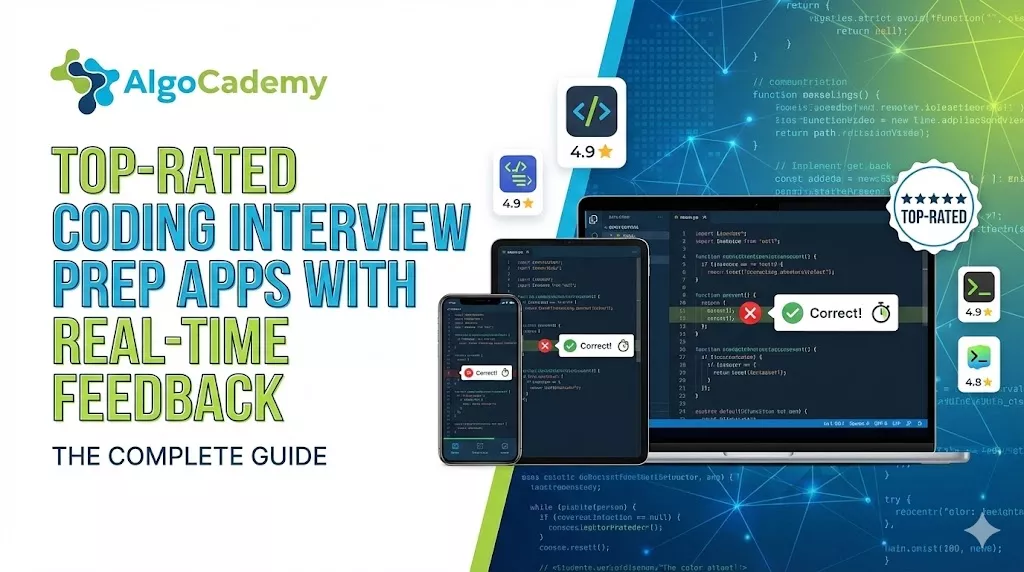
Top-Rated Coding Interview Prep Apps with Real-Time Feedback
There’s a reason why the best athletes practice with coaches watching their every move: immediate feedback accelerates learning like nothing else. The same principle applies to coding interview preparation. Platforms that tell you instantly whether your solution works, where it fails, and how it could be better produce dramatically faster improvement than those that leave you guessing.
But not all “real-time feedback” is created equal. Some platforms simply tell you pass or fail. Others analyze your code’s efficiency, suggest optimizations, point out edge cases you missed, and guide you toward better approaches. The difference between these feedback levels can mean the difference between grinding through hundreds of problems without improvement and rapidly developing genuine problem-solving skills.
In this guide, I’ll break down the best coding interview prep apps that offer meaningful real-time feedback, explain what kind of feedback each provides, and help you choose the right tools for your preparation style.
What Makes Feedback “Real-Time” and Why It Matters
Before diving into specific apps, let’s understand what separates useful real-time feedback from superficial responses.
Basic feedback tells you whether your code produces the correct output. This is the minimum bar: you submit a solution, it runs against test cases, and you see pass or fail. While necessary, this level alone doesn’t accelerate learning much because it doesn’t tell you why you failed or how to improve.
Intermediate feedback adds information about efficiency. You learn not just whether your solution works but whether it’s fast enough. Time complexity analysis, execution time comparisons, and memory usage metrics help you understand performance, not just correctness.
Advanced feedback guides your problem-solving process. This includes hints when you’re stuck, explanations of why certain approaches work better, identification of edge cases you missed, and suggestions for code improvement. This level of feedback teaches you how to think, not just how to code.
The platforms worth your time and money provide at least intermediate feedback, with the best offering advanced guidance that builds transferable skills.
Why Real-Time Feedback Changes Everything
Learning research consistently shows that immediate feedback produces faster skill acquisition than delayed feedback. When you discover an error seconds after making it, you can examine your thinking while it’s still fresh. Wait a day to review your mistakes, and the mental context that would help you understand and remember the fix is gone.
For coding interview prep specifically, real-time feedback helps in several ways:
You catch misconceptions early before they become ingrained habits. If your mental model of how recursion works is slightly off, immediate feedback reveals this the first time you try to use it, not after you’ve practiced the wrong approach dozens of times.
You learn edge cases through experience rather than memorization. When your solution fails on an empty array or a single element, you develop intuition for these cases that reading about them doesn’t build.
You calibrate your sense of “good enough.” Without feedback on efficiency, you might think your O(n²) solution is acceptable when the problem really requires O(n log n). Real-time performance feedback teaches you what interviewers expect.
You stay motivated through visible progress. Seeing tests turn green, efficiency improve, and hints become unnecessary provides the dopamine hits that keep you practicing.
Top Apps with Real-Time Feedback
AlgoCademy
AlgoCademy stands out for its approach to feedback. Rather than just telling you whether your code passes tests, the platform provides step-by-step guidance through the problem-solving process itself.
What makes AlgoCademy’s feedback unique is how it addresses the core struggle most interview candidates face: understanding solutions when they see them but struggling to develop solutions independently. The platform’s interactive tutorials don’t just check your final answer. They guide you through how to think about breaking down problems, recognizing patterns, and building solutions systematically.
The real-time feedback operates at multiple levels. At the code level, you get immediate validation of your solutions with clear error messages and test case results. At the conceptual level, the step-by-step format provides feedback on your approach before you’ve even finished coding, catching strategic errors early rather than letting you go down wrong paths.
This teaching-focused feedback fills a gap that most other platforms miss. LeetCode can tell you that your solution is too slow, but it can’t teach you how to think differently about the problem. AlgoCademy’s guided approach develops the problem-solving intuition that transfers across all problems, not just the ones you’ve practiced.
Pricing:
- Starter Plan: $19.99/month or $99.99/year (learn to code foundations)
- Pro Plan: $49/month or $249/year (full interview prep with advanced feedback)
- Lifetime: $799.99 (permanent access)
Feedback quality: Advanced. Guides problem-solving process, not just solution checking. Best for: Candidates who understand syntax but struggle to solve problems independently; those who want to develop transferable thinking skills.
LeetCode
LeetCode is the most widely used interview prep platform, and its feedback system has become the industry standard. When you submit a solution, you immediately see which test cases passed and failed, your runtime percentile compared to other submissions, and memory usage statistics.
The feedback on efficiency is particularly valuable. Seeing that your solution beats only 5% of submissions in runtime makes clear that a better approach exists, even when your code produces correct output. This calibration helps you understand what “good” looks like.
Premium subscribers get additional feedback features including the ability to debug code with breakpoints, see expected versus actual output for failed cases, and access video explanations after attempting problems.
The main limitation is that LeetCode’s feedback is reactive rather than proactive. It tells you that you failed but doesn’t guide you toward success. You might know your solution is too slow without understanding why or what alternative approach would work. This makes LeetCode more effective for candidates who already have strong problem-solving foundations.
Pricing:
- Free tier: Basic feedback with test results and runtime percentile
- Premium: $35/month or $159/year (adds debugger, video solutions, company tags)
Feedback quality: Intermediate. Strong on correctness and efficiency metrics; limited guidance on approach. Best for: Candidates with solid foundations who need extensive practice and efficiency calibration.
HackerRank
HackerRank provides real-time feedback through its integrated development environment. As you code, you can run your solution against sample test cases before submitting. This lets you iterate quickly, catching errors before they count against you.
The platform shows detailed output for failed test cases, making it clear exactly where your solution breaks. For many problems, you can see the input that caused failure, the expected output, and your actual output side by side.
HackerRank’s feedback extends beyond correctness to include code quality suggestions on some problems. The platform may flag inefficient patterns or suggest more idiomatic approaches in your chosen language.
Because many companies use HackerRank for actual technical screening, practicing on the platform provides feedback not just on your solutions but on your familiarity with the testing environment itself. Knowing how to use the interface efficiently matters when you’re under time pressure in a real assessment.
Pricing:
- Free: Full access to practice problems with real-time feedback
- Interview Prep Kit: Free structured practice with feedback
- Premium features available for companies (individual practice remains free)
Feedback quality: Intermediate. Clear test case feedback; some code quality suggestions. Best for: Candidates preparing for companies that use HackerRank for screening; those who want free practice with solid feedback.
Codewars
Codewars takes a unique approach to feedback through its community-driven model. When you solve a problem (called a “kata”), you can immediately see how other users solved the same challenge. This comparative feedback is incredibly educational.
Seeing five different approaches to a problem you just solved expands your thinking. Maybe you used a loop where someone else used recursion. Maybe your 20-line solution could be a 3-line one-liner using language features you didn’t know existed. This exposure to alternative approaches builds programming fluency that single-solution feedback can’t provide.
The platform also provides real-time test feedback as you develop solutions. You can run tests incrementally, catching errors early and refining your approach before final submission.
The ranking system (kyu levels, borrowed from martial arts) provides meta-feedback on your overall progress. Advancing through ranks gives a sense of achievement and indicates growing skill.
Pricing:
- Free: Full access to problems, solutions, and community features
- Premium ($9.99/month): Ad-free experience, additional features
Feedback quality: Intermediate to advanced. Strong comparative feedback through community solutions; standard test feedback. Best for: Developers who learn by seeing multiple approaches; those motivated by gamification and community.
AlgoExpert
AlgoExpert combines a curated problem set with video explanations that provide feedback on your approach even before you start coding. Each problem includes a detailed video walking through the thought process, multiple solution approaches, and complexity analysis.
The feedback loop works differently than pure coding platforms. You attempt a problem, then watch the video to compare your approach with the expert explanation. This comparison provides conceptual feedback that code-only platforms miss.
The code execution environment provides immediate test results with clear pass/fail indicators. You can run your code against sample cases before submitting, iterating toward a working solution.
The SystemsExpert add-on extends this feedback model to system design, where traditional automated feedback is impossible. Video explanations of design decisions provide guidance in a domain where right answers are less clear-cut.
Pricing:
- AlgoExpert: $99/year (coding problems with video explanations)
- SystemsExpert: $85/year (system design content)
- Bundle deals available for multiple products
Feedback quality: Intermediate coding feedback plus advanced conceptual feedback through videos. Best for: Visual learners who benefit from video explanations; candidates wanting curated quality over quantity.
Educative
Educative provides text-based interactive courses with embedded coding environments. The “Grokking the Coding Interview” course has become particularly popular for its pattern-based approach to interview prep.
The real-time feedback comes through integrated code widgets where you write and test solutions without leaving the lesson. Immediate test results show whether your understanding of the pattern being taught actually translates to working code.
What distinguishes Educative’s feedback is the context around it. Because problems are embedded in structured lessons about specific patterns, feedback connects directly to the concept being taught. When you fail a sliding window problem, you’re not just told you’re wrong. You’re positioned to immediately review the sliding window explanation and identify where your understanding broke down.
The platform’s text-based format means you can move at your own pace, re-reading explanations as needed. This self-paced feedback loop works well for learners who find video content too slow or too fast.
Pricing:
- Individual courses: Around $79 each
- Unlimited access: $59/month or $199/year (on sale)
Feedback quality: Intermediate technical feedback plus strong contextual feedback through integrated lessons. Best for: Learners who prefer reading to videos; those wanting pattern-based organization with immediate practice.
Interview Cake
Interview Cake built its entire model around a specific type of feedback: progressive hints. When you’re stuck on a problem, instead of immediately revealing the solution, the platform offers incremental hints that guide you toward the answer while preserving the learning opportunity.
This hint system provides feedback on your thinking before you’ve even written code. Struggling with how to approach a problem? The first hint might suggest which data structure to consider. Still stuck? The next hint might outline the general algorithm. Each hint provides just enough feedback to get you unstuck without doing all the thinking for you.
The approach recognizes something important: the moment of struggle is where learning happens. Immediately showing solutions short-circuits this process. Progressive hints keep you in the productive struggle zone longer.
Code execution feedback is standard: test cases, pass/fail results, and performance metrics. But the hint system is what makes Interview Cake’s feedback model distinctive.
Pricing:
- Full access: $249 lifetime or $39/month
Feedback quality: Advanced through hint system; standard for code execution. Best for: Candidates who frequently get stuck and need guided help; self-directed learners who want to maximize learning from each problem.
Pramp
Pramp provides feedback through a completely different mechanism: peer mock interviews. You’re matched with another candidate, take turns interviewing each other, and provide structured feedback after each session.
The real-time feedback during interviews comes from your peer’s questions, reactions, and clarifications. When your explanation confuses them, you know your communication needs work. When they spot an edge case you missed, you’ve learned something a compiler can’t teach.
Post-interview feedback is structured around specific criteria: problem-solving approach, code quality, communication, and verification. This multi-dimensional feedback addresses the full spectrum of interview skills, not just coding correctness.
The experience of giving feedback is itself educational. Evaluating someone else’s solution helps you internalize what good looks like and often reveals patterns in your own thinking.
Pricing:
- Free: Unlimited peer mock interviews
Feedback quality: Advanced for interview skills; varies based on peer quality for technical feedback. Best for: Candidates needing interview experience beyond coding; those who learn from both giving and receiving feedback.
Interviewing.io
Interviewing.io provides feedback from professional engineers who’ve conducted real interviews at top companies. This human feedback is qualitatively different from automated test results.
After each mock interview, you receive detailed feedback on your problem-solving approach, communication style, code quality, and areas for improvement. The interviewer can identify things no automated system catches: unclear explanations, missed opportunities to ask clarifying questions, or inefficient approaches that technically work but wouldn’t impress in a real interview.
The platform also provides anonymous technical interviews with real companies, where strong performance can lead to actual job opportunities. The feedback from these sessions carries extra weight because it directly reflects how real hiring processes evaluate candidates.
Pricing:
- Mock interviews: $100 to $225 per session (varies by interviewer background)
- Anonymous interviews with companies: Free if you qualify
Feedback quality: Advanced human feedback from industry professionals. Best for: Candidates close to real interviews who need professional evaluation; those who can afford premium feedback.
Exponent
Exponent provides feedback across multiple interview types: coding, system design, behavioral, and product questions. The platform combines practice problems with peer mock interviews and expert-led content.
For coding problems, you get standard real-time test feedback. The platform’s strength is extending feedback to areas where automated testing isn’t possible. System design practice includes rubrics and example solutions that let you self-evaluate your designs. Behavioral question practice includes frameworks for structuring responses.
Peer mock interviews through the platform provide human feedback similar to Pramp but within a more comprehensive preparation ecosystem.
Pricing:
- Full access: $99/month or $299/year
Feedback quality: Intermediate for coding; comprehensive coverage across interview types. Best for: Candidates preparing for full interview loops, not just coding rounds; PM and TPM candidates.
CodeSignal
CodeSignal offers both practice problems and actual assessments used by companies for hiring. The practice environment provides real-time feedback through test cases and efficiency metrics.
The General Coding Assessment (GCA) provides a standardized score that some companies accept in lieu of their own technical screens. Taking practice GCAs gives feedback on how you’d score in actual assessments, helping you identify whether you’re ready to use this pathway into interviews.
The feedback from company assessments (when you take them for real applications) tends to be limited due to legal considerations, but the practice environment provides full feedback on test results and performance.
Pricing:
- Practice: Free
- Premium features: Available through employer partnerships
Feedback quality: Intermediate. Standard test feedback; GCA scoring provides calibration. Best for: Candidates targeting companies that use CodeSignal; those wanting standardized skill measurement.
Comparing Feedback Types Across Platforms
| Platform | Test Case Feedback | Efficiency Analysis | Hints/Guidance | Human Feedback |
|---|---|---|---|---|
| AlgoCademy | Yes | Yes | Advanced (step-by-step) | No |
| LeetCode | Yes | Yes (percentile) | Limited | No |
| HackerRank | Yes | Yes | Limited | No |
| Codewars | Yes | Limited | Community solutions | No |
| AlgoExpert | Yes | Yes | Video explanations | No |
| Educative | Yes | Yes | Contextual lessons | No |
| Interview Cake | Yes | Yes | Progressive hints | No |
| Pramp | During interview | During interview | Peer guidance | Yes (peers) |
| Interviewing.io | During interview | During interview | Interviewer guidance | Yes (professionals) |
| Exponent | Yes | Yes | Frameworks | Yes (peers) |
| CodeSignal | Yes | Yes | Limited | No |
Building a Feedback-Rich Preparation System
The most effective preparation combines different types of feedback. Here’s how to structure your practice:
Foundation Phase: Guided Feedback
Start with platforms that provide guidance, not just evaluation. AlgoCademy excels here because the step-by-step approach teaches you how to think about problems before you’ve developed bad habits. The feedback guides your learning process rather than just grading your attempts.
During this phase, prioritize understanding over volume. Solving 10 problems with full comprehension beats solving 100 problems while confused. The guided feedback helps ensure you’re actually learning, not just guessing until something works.
Building Phase: Volume with Efficiency Feedback
Once foundations are solid, shift to platforms like LeetCode or HackerRank that provide efficiency feedback at scale. You need to solve enough problems to recognize patterns, and runtime percentiles help calibrate your solutions against interview expectations.
Use the efficiency feedback actively. When your solution beats only 20% of submissions, don’t move on. Figure out what better approaches exist. This calibration builds the performance intuition that interviews require.
Refinement Phase: Human Feedback
As you approach real interviews, add human feedback through mock interviews. Pramp offers this free through peer matching. If budget allows, Interviewing.io provides professional feedback that’s closer to real interview evaluation.
Human feedback catches things automated systems miss: unclear communication, missed opportunities to ask questions, nervous habits, and approach issues that technically work but wouldn’t impress. You need this feedback to perform well in actual interviews, not just solve problems alone.
Continuous: Multi-Source Feedback
Throughout your preparation, vary your feedback sources. Different platforms catch different issues. A solution that passes LeetCode’s tests might have code quality problems that Codewars’ community solutions reveal. A problem-solving approach that works technically might fail Interview Cake’s hint-free standard.
Exposing yourself to multiple feedback perspectives builds more robust skills than optimizing for any single platform’s evaluation.
Maximizing Learning from Feedback
Getting feedback is only valuable if you use it effectively. Here’s how to extract maximum learning:
Review failed test cases thoroughly. Don’t just note that you failed. Understand exactly what input caused failure and why your solution produced wrong output. This analysis builds the edge case intuition that prevents future failures.
Track efficiency feedback over time. Keep a log of your runtime percentiles across problems. Improving averages indicate growing skill. Plateaus suggest you need to learn new techniques, not just practice more.
Don’t skip to hints too quickly. When platforms offer progressive hints, struggle productively before using them. The moment before you understand something is where learning happens. Cutting that short by immediately requesting hints reduces learning.
Actually watch the video explanations. When platforms like AlgoExpert provide video solutions, watch them even when you solved the problem. Seeing expert approaches often reveals better ways than your working solution.
Implement feedback from mock interviews. When human interviewers suggest improvements, practice those specific things. Generic practice doesn’t address the specific weaknesses feedback reveals.
Cost vs. Feedback Quality Tradeoff
More expensive platforms don’t always provide better feedback. Here’s how to think about the tradeoff:
Free platforms with good feedback: HackerRank, Codewars, and Pramp all provide meaningful feedback at no cost. If budget is tight, these platforms offer solid preparation value.
Best feedback per dollar: AlgoCademy at $19.99/month (Starter) or $49/month (Pro) provides the guided, process-focused feedback that most platforms lack entirely. Interview Cake’s $249 lifetime price includes the progressive hint system that’s unique in the market.
Premium feedback: Interviewing.io’s professional mock interviews ($100 to $225 each) are expensive but provide feedback quality impossible to get elsewhere. Use these strategically near actual interviews rather than throughout preparation.
Avoid overpaying for basic feedback: Some platforms charge premium prices for feedback that’s not substantially better than free alternatives. Research what specific feedback features you’re paying for before subscribing.
Conclusion
Real-time feedback transforms coding interview preparation from frustrating guesswork into structured skill development. The platforms that provide meaningful feedback on your problem-solving process, not just your final answers, produce the fastest improvement.
For building foundational problem-solving skills, AlgoCademy’s guided approach (starting at $19.99/month) provides feedback that teaches you how to think, not just whether you’re right. For volume practice with efficiency calibration, LeetCode and HackerRank deliver strong feedback at accessible prices. For interview readiness, human feedback through Pramp (free) or Interviewing.io (premium) addresses dimensions that automated feedback can’t touch.
The best preparation combines these feedback types strategically: guided feedback early to build strong foundations, efficiency feedback in the middle to calibrate performance, and human feedback late to polish interview skills.
Don’t settle for platforms that only tell you pass or fail. Seek out feedback that helps you understand why and guides you toward better approaches. The difference in learning speed will show up in your interview results.
Choose your feedback sources deliberately, use that feedback actively, and trust that consistent practice with meaningful feedback produces consistent improvement. Your interviews will thank you for the investment.