Tips for Choosing the Right Coding Interview Prep Service for Software Engineers
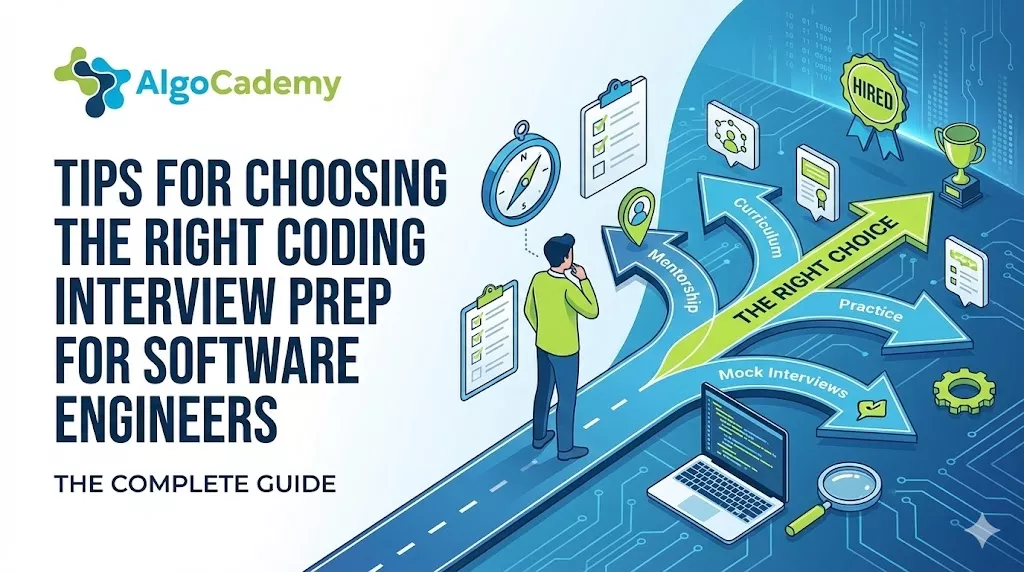
The interview prep market has exploded. A quick search returns dozens of platforms, courses, and services all promising to help you land your dream job. Some cost nothing. Others run thousands of dollars. Some focus on problem quantity. Others emphasize teaching methodology. With so many options, choosing the right service can feel as challenging as the interviews themselves.
Here’s the uncomfortable truth: the wrong choice wastes more than money. It wastes time you can’t get back. Months spent grinding on a platform that doesn’t address your actual weaknesses leaves you no better prepared than when you started. Conversely, the right service matched to your specific needs can transform your preparation efficiency.
In this guide, I’ll share the criteria that actually matter when evaluating interview prep services, questions you should ask yourself before committing, and how to match platforms to your specific situation. By the end, you’ll have a framework for making a decision you won’t regret.
Start With Honest Self-Assessment
Before evaluating any platform, you need to understand yourself. The best service for a bootcamp graduate differs from the best service for a senior engineer switching companies. The right choice for someone who learns from videos differs from the right choice for someone who learns by doing.
What’s Your Current Skill Level?
Be brutally honest here. Overestimating your level leads to choosing services that assume knowledge you don’t have. Underestimating leads to wasting time on basics you’ve already mastered.
True beginner: You’re learning to code or recently completed a bootcamp. You understand basic syntax but struggle to solve problems independently. When you see a coding challenge, you often don’t know where to start.
Intermediate: You can build applications and write working code. You understand common data structures conceptually. But interview-style algorithmic problems still trip you up, and you haven’t systematically studied problem-solving patterns.
Advanced: You have solid CS fundamentals and can solve most medium-difficulty problems. You’re preparing for interviews at competitive companies and need to sharpen skills and increase speed rather than learn from scratch.
Returning: You’ve been working as an engineer for years but haven’t interviewed recently. Your skills are real but rusty, and interview formats may have changed since you last practiced.
Each level needs different things from a prep service. Beginners need teaching and scaffolding. Advanced candidates need volume practice and optimization. Choosing a service designed for the wrong level creates frustration and wastes effort.
How Do You Learn Best?
Learning style dramatically affects which platforms work for you:
Reading-based learners absorb information best through text. They prefer written explanations they can read at their own pace, re-reading difficult sections as needed. Video content often feels too slow or too fast.
Video-based learners understand concepts better when they see and hear explanations. Watching someone work through a problem provides insight that reading solutions doesn’t capture.
Interactive learners need to do, not just consume. They learn by writing code, making mistakes, and getting feedback. Passive content consumption doesn’t stick.
Structured learners thrive with clear curricula that tell them exactly what to study next. The freedom of choosing from thousands of random problems feels overwhelming rather than empowering.
Self-directed learners prefer flexibility to explore topics in their own order. Rigid curricula feel constraining. They want access to resources and the autonomy to chart their own path.
Match your learning style to platform strengths. A video-heavy platform wastes the time of someone who learns better by reading. A massive problem database overwhelms someone who needs structured guidance.
What Are Your Constraints?
Practical constraints narrow your options:
Budget: What can you actually afford? Be realistic. A $2,000 bootcamp might be worth it if you can afford it, but it’s not worth going into debt when effective alternatives exist at every price point.
Time: How long until your interviews? Someone with six months can build foundations methodically. Someone with three weeks needs targeted, efficient preparation focused on highest-impact areas.
Hours available: Can you study full-time, or are you preparing while working a demanding job? Services requiring intensive daily commitment don’t work for everyone.
Schedule flexibility: Do you need on-demand access, or can you attend scheduled sessions? Live coaching requires calendar alignment that recorded content doesn’t.
Understanding constraints prevents choosing services you can’t actually use effectively.
Key Factors to Evaluate
With self-assessment complete, evaluate platforms against these criteria:
Does It Teach or Just Test?
This distinction separates platforms that help you improve from platforms that merely measure where you are.
Testing platforms provide problems and tell you whether you passed or failed. They assume you already know how to approach problems and just need practice applying that knowledge. If you already have strong problem-solving frameworks, testing platforms work well. If you don’t, they create frustration without growth.
Teaching platforms explain how to think about problems, not just what the answers are. They break down problem-solving into learnable skills and build those skills progressively. If you’re struggling to improve despite practice, you probably need more teaching, not more testing.
AlgoCademy exemplifies the teaching approach. The platform’s step-by-step interactive tutorials break problem-solving into granular steps:
- Step 1: Write an empty for loop to iterate through the array
- Step 2: Inside the loop, add a conditional to check our target condition
- Step 3: Inside the conditional, update the tracking variable appropriately
- Step 4: After the loop completes, return the accumulated result
This granular breakdown teaches the decomposition process that experienced engineers use automatically. You learn not just what the solution is but how to construct solutions systematically.
The integrated AI Tutor provides personalized teaching when you’re stuck. Unlike static hints, the AI Tutor understands your specific confusion and adapts explanations accordingly. If one approach doesn’t click, it tries another. This responsive teaching accelerates learning beyond what pre-written content can provide.
Compare this to platforms that present a problem and a solution with maybe a paragraph of explanation. You might understand that specific solution, but you haven’t learned the transferable process for solving similar problems independently.
Ask yourself: Am I struggling because I need more practice, or because I don’t understand how to approach problems? If the latter, prioritize teaching over testing.
What’s the Feedback Quality?
Feedback ranges from nearly useless to genuinely transformative:
Basic feedback: Pass/fail on test cases. You know whether you’re right but not why you’re wrong or how to improve.
Performance feedback: Runtime percentiles, memory usage, efficiency metrics. You know how your solution compares but not how to make it better.
Diagnostic feedback: Identification of specific issues in your approach, code, or understanding. You know what to fix.
Instructional feedback: Guidance on how to think differently, alternative approaches to consider, and specific skills to develop. You know how to improve.
Better feedback accelerates learning. Platforms with only basic feedback require you to diagnose your own problems, which is difficult when you don’t know what you don’t know. Platforms with instructional feedback guide improvement actively.
AlgoCademy’s step-by-step format enables feedback at each stage of problem-solving, not just on final solutions. When you struggle with a specific step, you get help with that step before moving forward. This catches misconceptions early rather than letting you build on flawed foundations.
How Is Content Structured?
Structure matters more than most people realize:
Unstructured databases offer thousands of problems without guidance on which to solve or in what order. This works for self-directed learners who can construct their own curricula. It overwhelms learners who need direction.
Difficulty progression organizes content from easy to hard within topics. This helps ensure you have prerequisites before attempting advanced material.
Pattern-based organization groups problems by solution technique (sliding window, two pointers, dynamic programming, etc.) rather than by data structure. This helps you recognize when familiar patterns apply to new problems.
Step-by-step scaffolding breaks individual problems into manageable pieces, teaching decomposition alongside content. This serves beginners and struggling intermediates particularly well.
Learning paths sequence topics logically, building foundational concepts before dependent ones. This prevents the confusion of encountering prerequisites you haven’t learned.
Consider what structure serves your learning. If you’re disciplined and experienced, minimal structure provides flexibility. If you need guidance, look for platforms that tell you exactly what to study and in what order.
Is There Human Interaction?
Some preparation benefits from human involvement:
Peer practice provides interview simulation with other candidates. You practice the interpersonal dynamics of interviews, not just solo problem-solving.
Professional coaching offers feedback from experienced interviewers who know what companies actually look for. This feedback quality exceeds what peers or AI can provide.
Community support gives you people to ask questions when stuck and motivation to keep going when preparation feels lonely.
Accountability from coaches or cohorts keeps you on track when self-discipline wavers.
Human interaction adds cost and scheduling complexity. Evaluate whether the benefits justify these tradeoffs for your situation.
AI-powered support like AlgoCademy’s AI Tutor provides some benefits of human interaction (personalized help, answering your questions, adapting to your confusion) without scheduling constraints or per-session costs. It’s not identical to human coaching but fills meaningful gaps that static content leaves open.
What’s the Actual Cost of Ownership?
Sticker price doesn’t tell the whole story:
Subscription duration: Monthly subscriptions let you pay only while actively preparing. Annual subscriptions reduce monthly cost but commit you for longer. Lifetime access eliminates ongoing costs but requires larger upfront investment.
Feature tiers: Many platforms offer free tiers with limited features and paid tiers with full access. Evaluate whether free tier limitations matter for your use case.
Hidden costs: Some platforms advertise low base prices but require add-ons for essential features. Understand total cost before committing.
Opportunity cost: A free platform you use ineffectively costs more than a paid platform that accelerates your preparation. Time has value, especially if you’re unemployed or preparing for interviews that could significantly increase your compensation.
Value relative to outcome: Interview prep is an investment in higher compensation. A $300 service that helps you negotiate $10,000 more in salary has excellent ROI. Evaluate cost against the potential career impact.
Consider AlgoCademy’s pricing structure:
- Starter Plan: $19.99/month or $99.99/year (programming fundamentals)
- Pro Plan: $49/month or $249/year (full interview preparation)
- Lifetime: $799.99 (permanent access)
The Starter plan at $19.99/month provides an affordable entry point to evaluate whether the platform’s approach works for you. The annual Pro plan at $249/year costs less than a single session with a professional coach while providing unlimited access. The lifetime option makes sense for those who want permanent access without ongoing payments.
Compare this to alternatives: LeetCode Premium at $159/year provides problems without teaching methodology. Professional coaching at $150+ per hour limits how much feedback you can afford. Bootcamp-style prep programs at $2,000+ represent major financial commitments.
Does It Match Your Target Interviews?
Different companies interview differently:
FAANG/Big Tech emphasizes algorithmic problem-solving with high difficulty expectations. Preparation should include hard problems and system design.
Startups often focus more on practical coding ability and culture fit than pure algorithms. Problem difficulty may be lower but breadth of evaluation may be wider.
Enterprise companies vary significantly. Some mirror Big Tech interviews. Others emphasize technology-specific skills over algorithms.
Specific technologies: Some roles require preparation in specific areas (frontend frameworks, mobile development, data engineering) beyond general algorithms.
Ensure your chosen service covers what your target companies actually evaluate. A service optimized for FAANG algorithms might over-prepare you for startup interviews or under-prepare you for system design.
Questions to Ask Before Committing
Before choosing any service, get clear answers to these questions:
Can I Try Before Buying?
Free trials, free tiers, or money-back guarantees let you evaluate fit before full commitment. Platforms confident in their value typically offer ways to experience the product first.
AlgoCademy lets you experience the step-by-step tutorial approach and AI Tutor before committing to paid plans. This trial demonstrates whether the methodology resonates with your learning style.
What Do Actual Users Say?
Marketing claims mean less than user experiences. Look for:
- Reviews from people at similar skill levels to you
- Specific outcomes (interviews passed, offers received) rather than vague satisfaction
- Honest discussion of limitations alongside strengths
- Reviews from recent users (platforms evolve; old reviews may not reflect current state)
Check AlgoCademy’s testimonials page to see what users report about their experiences. Look for testimonials from people whose situations resemble yours.
What Happens If It’s Not Working?
Understand cancellation policies and refund options. If you commit and discover the platform doesn’t fit your needs, what’s your recourse?
Monthly subscriptions provide natural exit points. Annual subscriptions and lifetime purchases typically don’t offer refunds, so confidence before commitment matters more.
How Recent Is the Content?
Interview practices evolve. Content from five years ago may not reflect current expectations. Verify that platforms maintain and update their material.
What Support Exists When I’m Stuck?
Everyone gets stuck sometimes. What resources help you get unstuck?
- AI tutoring (like AlgoCademy’s AI Tutor)
- Community forums
- Hint systems
- Solution explanations
- Human support options
Platforms that leave you entirely alone when stuck create frustrating experiences that often lead to abandonment.
Matching Platforms to Situations
Based on the criteria above, here’s how different situations map to platform choices:
For True Beginners
Primary need: Teaching and scaffolding, not just problems
Best approach: Start with AlgoCademy’s Starter plan ($19.99/month). The step-by-step tutorials teach problem decomposition explicitly rather than assuming you already know how to approach problems. The AI Tutor provides personalized help when you’re confused without judgment.
Supplement with: Khan Academy (free) for the gentlest introduction to programming concepts. freeCodeCamp (free) for additional foundational practice.
Avoid: Platforms that throw you into problems without teaching methodology. The frustration of failing problems you have no framework for approaching often causes beginners to quit unnecessarily.
For Bootcamp Graduates
Primary need: Bridge from application building to algorithmic thinking
Best approach: AlgoCademy Pro ($49/month or $249/year) addresses the specific gap bootcamp graduates face: you can build things but struggle with interview-style problems. The step-by-step approach teaches the algorithmic thinking that bootcamps typically don’t cover deeply.
Supplement with: LeetCode (free tier) for additional practice volume once you have problem-solving frameworks.
Avoid: Jumping straight into LeetCode without learning problem-solving methodology. Grinding problems without understanding how to approach them produces frustration without improvement.
For Intermediate Engineers
Primary need: Systematic coverage of patterns and volume practice
Best approach: Combine AlgoCademy Pro for pattern learning and guided problem-solving with LeetCode Premium ($159/year) for company-specific problem tags and volume practice.
Supplement with: Educative’s Grokking the Coding Interview (~$79) for pattern-based organization if you prefer text-based learning.
Avoid: Over-relying on memorization. At this level, you need transferable skills, not just memorized solutions to specific problems.
For Senior Engineers Returning to Interviews
Primary need: Rust removal and updated interview format awareness
Best approach: Start with AlgoCademy to refresh foundations and fill any gaps that have developed during years of focusing on production work rather than algorithms. The AI Tutor helps identify and address forgotten concepts quickly.
Supplement with: LeetCode Premium ($159/year) for company-specific preparation. System design resources (books, Exponent at $299/year) since senior interviews emphasize design heavily.
Consider: Interviewing.io ($100-225/session) for professional mock interviews that simulate senior-level expectations accurately.
For Career Changers Without CS Background
Primary need: Foundational teaching with extensive support
Best approach: AlgoCademy Starter ($19.99/month) to build fundamentals with the scaffolded support career changers need. The granular step-by-step approach teaches problem-solving from the ground up rather than assuming CS education.
Progress to Pro ($49/month or $249/year) once fundamentals are solid for interview-specific preparation.
Supplement with: Codecademy (free tier or ~$35/month) for language syntax learning if needed.
Budget alternative: freeCodeCamp (free) combined with AlgoCademy Starter for guided problem-solving methodology.
For Budget-Conscious Preparation
Primary need: Effective preparation at minimal cost
Best approach: AlgoCademy Starter at $19.99/month provides guided learning with AI Tutor support at an accessible price. Combine with free resources:
- LeetCode free tier for problem volume
- HackerRank (free) for structured practice tracks
- Pramp (free) for mock interviews
- NeetCode (free) for curated problem lists with video explanations
This combination provides teaching methodology, practice volume, and interview simulation for under $20/month.
For Maximum Investment
Primary need: Every advantage money can buy
Best approach: Combine:
- AlgoCademy Pro ($249/year) for methodology and AI tutoring
- LeetCode Premium ($159/year) for company-specific prep
- Educative ($199/year) for pattern-based courses
- Interviewing.io ($150/session, multiple sessions) for professional feedback
- Exponent ($299/year) for comprehensive coverage including system design
Total: ~$900/year plus interview session costs. Still far less than formal bootcamps while providing comprehensive preparation across all dimensions.
Red Flags to Avoid
Watch for warning signs when evaluating services:
Guaranteed Results
No legitimate service can guarantee you’ll pass interviews. Your performance depends on many factors beyond any platform’s control. Promises of guaranteed outcomes suggest either deception or fine print that renders the guarantee meaningless.
Pressure Sales Tactics
Artificial urgency (“price doubles tomorrow!”), high-pressure sales calls, or guilting tactics indicate a service that can’t sell on merit. Quality platforms let their value speak for itself.
No Free Trial or Samples
Services confident in their value let you experience the product before paying. Complete unwillingness to let you try anything suggests they know the experience won’t match marketing claims.
Outdated Content
If example problems reference obsolete technologies or the interface looks like it hasn’t been updated in years, the content probably hasn’t either. Interview practices evolve; preparation should reflect current expectations.
No User Reviews Outside Their Site
If the only testimonials exist on the platform’s own website with no presence on independent review sites, treat claims skeptically. Legitimate services accumulate reviews across multiple channels.
Vague Methodology Claims
“Our proven system” without explanation of what that system actually involves suggests there’s nothing distinctive about the approach. The best platforms explain their methodology because it genuinely differentiates them.
Making Your Final Decision
After evaluating options against your situation, make a decision and commit. Analysis paralysis wastes preparation time. An imperfect choice used consistently beats a perfect choice you never make.
Start Smaller If Uncertain
If you can’t decide between options, start with the lower-commitment choice. A monthly subscription lets you evaluate fit with limited risk. You can always upgrade or switch if needed.
AlgoCademy’s monthly Starter plan at $19.99 provides a low-risk way to experience whether the step-by-step methodology and AI Tutor support match your learning needs before committing to annual plans.
Give Your Choice a Fair Trial
Once you choose, commit to using the platform consistently for at least two to four weeks before evaluating. Brief exposure doesn’t reveal whether a platform truly works for you. Learning takes time; don’t abandon ship before giving the approach a chance.
Track Your Progress
Monitor whether you’re actually improving. If you’re practicing consistently but not seeing progress after a reasonable period, the platform may not fit your needs. If you’re improving steadily, stay the course.
Be Willing to Adjust
Loyalty to a platform that isn’t working wastes time. If honest evaluation reveals your choice isn’t serving your needs, switch. Sunk cost shouldn’t keep you on an ineffective path.
Conclusion
Choosing the right interview prep service comes down to matching your specific situation to platform strengths. There’s no universal “best” platform, only the best platform for your skill level, learning style, constraints, and goals.
For most software engineers, I recommend starting with AlgoCademy. The step-by-step interactive tutorials teach problem-solving methodology that other platforms assume you already have. The AI Tutor provides personalized support when you’re stuck. The granular approach builds skills progressively rather than overwhelming you with problems you have no framework for approaching.
The Starter plan at $19.99/month offers an affordable way to experience whether this approach fits your learning style. The Pro plan at $49/month or $249/year provides full interview preparation for those who find the methodology effective. Check what other users say on AlgoCademy’s testimonials page to see experiences from people in situations similar to yours.
Supplement AlgoCademy with LeetCode (free tier for volume, Premium at $159/year for company tags) once you have problem-solving frameworks. Add mock interviews through Pramp (free) or Interviewing.io (premium) as you approach real interviews.
Whatever you choose, remember that the platform is just a tool. Your consistent effort determines your outcomes. The right tool makes that effort more effective, but no tool substitutes for putting in the work.
Choose deliberately, commit fully, track honestly, and adjust as needed. Your interviews will test what you can do. The right prep service helps you maximize what that is.