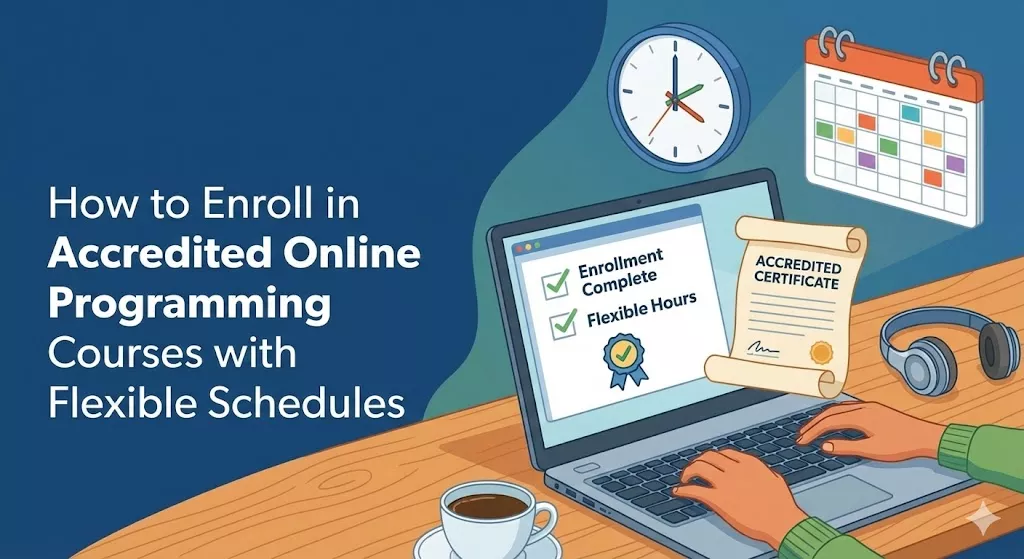
How to Enroll in Accredited Online Programming Courses with Flexible Schedules?
Let me start with something that’s going to save you a lot of confusion and potentially a lot of money: most online programming courses aren’t “accredited” in any meaningful sense, and that’s actually fine.
I’ve watched thousands of people stress about finding “accredited” coding courses because they assume it matters like it does for traditional degrees. After six years running a coding education platform and seeing what actually gets people hired, I can tell you that the accreditation question is almost always the wrong thing to worry about.
What you really want is quality education with flexible learning that fits your schedule and actually builds marketable skills. Let me explain what accreditation actually means for coding courses, which credentials employers actually care about, and how to find genuinely flexible programs that teach you to code without derailing your life.
What “Accredited” Actually Means (And Why It Probably Doesn’t Matter)
Accreditation is a formal process where educational institutions get reviewed by authorized bodies to ensure they meet quality standards. This matters tremendously for traditional universities because accreditation affects financial aid eligibility, credit transfers, and degree recognition.
For online coding courses? It’s almost completely irrelevant.
Here’s why:
Most standalone coding platforms (Codecademy, Udemy, Pluralsight) aren’t accredited because they’re not degree-granting institutions. They’re education companies offering courses and certificates. There’s no accrediting body for “online JavaScript courses.”
Tech companies hiring developers don’t ask if your coding course was accredited. They ask if you can solve technical problems, write clean code, and build actual applications. The credential matters infinitely less than the demonstrable skill.
The coding bootcamp industry created its own “accreditation” through organizations like CIRR (Council on Integrity in Results Reporting), but this isn’t the same as academic accreditation. It’s more like industry self-regulation.
When accreditation actually matters:
If you’re getting a degree (like an online Bachelor’s in Computer Science), accreditation is crucial. Regional accreditation means the degree is recognized, credits transfer, and you qualify for financial aid.
If you’re taking courses for professional licensing (which doesn’t apply to most programming jobs), accreditation might matter.
If your employer offers tuition reimbursement that requires accredited programs, it matters.
For everyone else learning to code to switch careers or build skills? Focus on quality and outcomes, not accreditation status.
The Different Types of “Accredited” Programming Education
Let me break down what actually exists in terms of formal recognition for online programming education:
Regionally Accredited University Programs
Schools like University of Illinois, Penn State, Arizona State, and others offer online computer science degrees that are fully accredited.
What this gives you: A legitimate bachelor’s or master’s degree in computer science. Transfer credits. Financial aid eligibility. The full academic experience.
The flexibility factor: Better than traditional on-campus programs, but still constrained by semester schedules, assignment deadlines, and course sequences. You can’t just learn at 2 AM on Tuesdays if that’s your free time. You’re following a structured academic calendar.
The cost: $20,000-60,000 for a full degree program. Not cheap, but comparable to traditional universities.
Best for: People who need an actual degree for career advancement or immigration purposes. People who value the comprehensive education and credential that comes with a real CS degree.
Not ideal for: People who just want to learn coding skills quickly. People on tight budgets. People who need truly self-paced learning.
Nationally Accredited Career Schools
Places like Herzing University or Purdue Global offer career-focused programming courses and degrees with national accreditation.
The difference from regional accreditation: National accreditation is generally less prestigious than regional. Credits often don’t transfer as easily. But the programs exist and are formally accredited.
The flexibility: Often more flexible than traditional universities. Many offer accelerated programs or competency-based progression where you move forward as you master material, not based on seat time.
Best for: People who need some form of official accreditation but want more flexibility than traditional universities offer.
Non-Accredited University Certificates and MOOCs
Platforms like Coursera, edX, and Udacity partner with universities to offer professional certificates and specializations. These aren’t accredited programs, but they carry the university’s name.
What you actually get: Courses designed by university faculty. A certificate with the university name on it (like “Data Science Professional Certificate from Harvard” through edX). Quality content.
What you don’t get: College credit. Formal accreditation. A degree from that university. The certificate explicitly states it’s not equivalent to university credit.
The flexibility: Excellent. Most are completely self-paced or have rolling start dates. Learn whenever you want, as fast or slow as you need.
The cost: $40-80/month for platform subscriptions, or $300-1,000 for individual certificates.
Best for: People who want university-quality content with flexible scheduling but don’t need formal accreditation. The credential carries some weight because of the university name, even though it’s not an accredited program.
Coding Bootcamps With “Accreditation”
Some bootcamps like General Assembly or Flatiron School have programmatic accreditation or state licensure as career schools. Others report outcomes through CIRR.
What this means: The bootcamp meets certain standards for curriculum, instruction, and student support. CIRR reporting means they publish verified employment outcomes.
What it doesn’t mean: You’re getting an accredited degree. The certification carries the same weight as traditional degrees.
The flexibility: Most bootcamps are NOT flexible. They’re intensive programs with fixed schedules. Full-time bootcamps are 40+ hours per week for 12-16 weeks. Part-time options exist but still have mandatory class times.
Best for: People who can commit to a structured, intensive program and value the job placement support bootcamps offer.
Not ideal for: Anyone needing truly flexible, self-paced learning.
The Best Flexible Options (Accreditation Status Listed Honestly)
Let me break down the actually flexible learning options and be completely transparent about their accreditation status:
AlgoCademy: Not Accredited, Completely Flexible, Highly Effective
AlgoCademy isn’t accredited by any formal body, and that’s completely fine because accreditation isn’t relevant to what it does.
What it actually is: An interactive coding education platform focused on computer science fundamentals, data structures, and algorithms. Designed for flexible, self-paced learning.
The flexibility: Complete. Learn whenever you want. 2 AM on Sunday? Go for it. 15 minutes during lunch breaks? Perfect. Two hours on Saturday morning? Great. There are no deadlines, no class times, no schedules to follow.
You work through lessons at your own pace. The granular step-by-step instruction means each lesson breaks down into small pieces you can complete in 10-30 minutes. Perfect for people with unpredictable schedules.
Step 1: Write an empty for loop. Step 2: Add a conditional inside the loop. Step 3: Implement the logic for the condition. Step 4: Handle the result.
Each step is small enough that you can make progress even in short sessions. The AI tutor is available 24/7 whenever you’re learning, providing instant feedback and guidance at every step.
What makes this work for flexible schedules: No synchronous requirements. You never need to be online at a specific time. No group projects that require coordinating with other learners. No instructor office hours you need to attend. The entire experience is asynchronous and self-directed.
The interactive lessons mean you’re writing real code and getting immediate feedback. You’re not waiting for instructor review or trying to coordinate peer feedback. The learning loop is completely contained: learn, practice, get feedback, improve, repeat.
The cost: $20/month. Cancel anytime. No long-term commitment required.
Why lack of accreditation doesn’t matter: Tech employers don’t ask if your coding course was accredited. They give you technical interviews where you solve coding problems. AlgoCademy’s focus on data structures and algorithms means you’re learning exactly what those interviews test.
You don’t put “AlgoCademy certificate” on your resume. You put “Proficient in Python, data structures, and algorithms” and then prove it by solving their technical interview questions. The skill matters, not the credential.
Best for: Anyone needing genuinely flexible learning. People with full-time jobs. Parents with unpredictable schedules. Night owls or early birds who learn at odd hours. Anyone who wants to build real coding skills without coordinating around a fixed schedule.
At $20/month, you can afford to learn at whatever pace works for you. Take six months if you need to. Take three if you’re moving faster. The flexibility is complete.
Coursera and edX: University Content, Flexible Scheduling, No Formal Accreditation
Coursera and edX offer courses from real universities but aren’t accredited programs themselves.
The accreditation reality: The courses are created by accredited universities (MIT, Stanford, etc.), but taking a Coursera course doesn’t give you college credit or an accredited credential. Some universities offer credit pathways for specific courses, but this is the exception, not the rule.
The flexibility: Excellent for most courses. Self-paced options let you work through material whenever you want. Some courses have fixed start dates and weekly deadlines, but many don’t.
You can audit most courses for free (no certificate). Paying gets you graded assignments and a certificate, but you’re still learning at your own pace.
Professional Certificates and Specializations: These are multi-course programs (like Google’s IT Support Professional Certificate) that typically take 3-6 months. They’re completely self-paced. You can finish faster or slower based on your schedule.
The cost: $40-80/month for subscriptions. Individual courses cost $30-100. Professional certificates cost $200-500 total if you finish in the estimated time.
Best for: People who want university-level content with flexible scheduling and don’t need formal accreditation. The certificate carries some weight because it’s associated with a recognized university or company.
freeCodeCamp: Not Accredited, Completely Free, Totally Flexible
freeCodeCamp is a nonprofit offering completely free coding education. Zero accreditation, zero cost.
The flexibility: Perfect. Completely self-paced. No deadlines. No schedules. Work through the curriculum whenever you have time.
The learning model: Read articles, watch videos, complete coding challenges, build projects. Everything builds toward certifications in various areas (Responsive Web Design, JavaScript Algorithms, Frontend Libraries, etc.).
Why lack of accreditation doesn’t matter: The certifications aren’t accredited, but they come with portfolio projects that demonstrate real skills. Employers care more about your portfolio projects than about whether the course was accredited.
Best for: Anyone on a tight budget who needs flexible learning. Self-motivated learners who don’t need external structure. People who want to build portfolio projects while learning.
WGU (Western Governors University): Actually Accredited, Competency-Based
WGU is regionally accredited and offers a genuinely flexible model for degree programs.
The accreditation: Real regional accreditation. You get an actual Bachelor’s or Master’s degree in Computer Science or Software Development.
The flexibility model: Competency-based education. You pay per 6-month term (around $3,800) and complete as many courses as you can in that term. You move forward by demonstrating mastery, not by seat time.
If you already know material, you can test out and move faster. If you need more time on something, you take it. No class times. No synchronous requirements.
The reality: More flexible than traditional universities, but you still have term deadlines and program requirements. You can’t take five years to finish if you’re paying per term. But within each term, you work at your own pace.
The cost: About $7,600/year for full-time enrollment. Less expensive than most universities for a full degree.
Best for: People who need an actual accredited degree and have some existing knowledge that lets them move quickly. People with disciplined self-study skills.
Not ideal for: Complete beginners who need lots of support. People who want to learn casually without degree requirements.
Udacity: Not Accredited, Somewhat Flexible, Expensive
Udacity offers “nanodegrees” that aren’t accredited but do include project review and mentorship.
The flexibility: Moderate. Programs are self-paced within the enrollment period (usually 3-4 months). You can work whenever you want, but you’re paying monthly ($300-500/month), so there’s pressure to finish quickly.
Some programs have mentor sessions at scheduled times, reducing flexibility.
Best for: People who want structured programs with human support and can afford the cost. The lack of accreditation matters less than the practical skills and portfolio projects.
LinkedIn Learning: Not Accredited, Very Flexible
LinkedIn Learning offers thousands of courses with zero accreditation but complete flexibility.
The model: Video-based courses. Watch whenever you want. Certificates appear on your LinkedIn profile automatically.
The cost: $30-40/month, or included with LinkedIn Premium.
The reality: The certificates aren’t accredited and don’t carry much weight with employers. But the courses can teach you useful skills if you actually apply what you learn.
Best for: People who already have LinkedIn Premium and want to add skills. Not worth subscribing to specifically for the courses unless the specific course you need is only available there.
How to Actually Enroll (Step by Step)
Since you’re looking for flexible schedules, here’s how to enroll in different types of programs:
For Self-Paced Platforms (AlgoCademy, Codecademy, etc.):
- Visit the platform website
- Create a free account
- Explore free content to see if the teaching style works for you
- Subscribe to paid tier if you want full access
- Start learning immediately
Example with AlgoCademy: Go to algocademy.com, create an account, explore some free lessons, subscribe for $20/month if it clicks, start working through the curriculum at your own pace.
No enrollment periods. No waiting. Instant access.
For MOOCs (Coursera, edX):
- Browse courses or professional certificates
- Create account
- For self-paced courses: enroll anytime and start immediately
- For session-based courses: wait for next session start date (usually weekly or monthly)
- Audit for free or pay for certificate
Flexibility tip: Look for “self-paced” or “flexible deadline” badges on courses. Avoid courses with fixed weekly deadlines if you need maximum flexibility.
For University Online Programs:
- Research programs and check accreditation
- Submit application (usually requires transcripts, sometimes test scores)
- Wait for acceptance (can take weeks or months)
- Complete enrollment paperwork
- Register for courses according to academic calendar
Reality check: This process is lengthy. Applications have deadlines. Programs have start dates. If you need to start learning now, this isn’t the path for immediate flexibility.
For Bootcamps:
- Research bootcamps and their schedules
- Submit application
- Complete interview/assessment
- Get accepted
- Wait for cohort start date
- Commit to the intensive schedule
Flexibility reality: Most bootcamps are NOT flexible. They have fixed schedules and cohort start dates. Part-time options exist but still require specific attendance times.
What I’d Actually Recommend Based on Your Situation
Let me cut through all the options and give you clear recommendations:
If you need maximum flexibility and want to actually learn to code:
Start with AlgoCademy at $20/month. The completely self-paced model means you learn when you have time. The granular instruction means you make progress even in 15-minute sessions. The AI tutor means you get help 24/7 whenever you’re learning.
Accreditation is irrelevant for learning to code. What matters is building actual skills. AlgoCademy’s focus on fundamentals, data structures, and algorithms gives you the skills that technical interviews actually test.
Supplement with freeCodeCamp’s projects (also completely flexible and free) to build portfolio pieces.
If you need an actual accredited degree:
Look at WGU for competency-based flexibility or traditional online CS programs from regionally accredited universities. Be prepared for less flexibility than non-accredited options and significantly higher costs.
Apply early because admission processes take time. Plan for semester-based schedules even in “flexible” programs.
If you want university-branded content with flexibility:
Try Coursera or edX professional certificates. You get university-associated content with self-paced learning. Not accredited, but the university name carries some weight.
If you’re completely broke:
freeCodeCamp. Zero cost, total flexibility, decent learning content, and portfolio projects.
The Questions You Should Actually Be Asking
Instead of “is this accredited?”, ask:
“Will this teach me skills employers value?” Technical skills, problem-solving ability, and portfolio projects matter more than credentials for most programming jobs.
“Does the schedule actually fit my life?” “Flexible” can mean different things. Self-paced with no deadlines? Or flexible within weekly modules? Know which you need.
“Can I afford this sustainably?” Expensive programs create pressure to finish quickly, which reduces flexibility. AlgoCademy at $20/month lets you learn at truly your own pace without financial pressure.
“What do I actually get for the money?” Human mentorship and code review justify higher costs. Video lectures don’t. Interactive learning with AI tutoring is worth more than passive content.
“Will this prepare me for technical interviews?” Many jobs require passing coding interviews testing algorithms and data structures. Does your chosen platform teach these?
The Brutal Truth About Flexible Learning
Here’s what platforms don’t tell you: truly flexible learning requires serious self-discipline.
When there are no deadlines, no class times, no external pressure, you need internal motivation. Many people who sign up for flexible courses never finish because nothing forces them to show up.
This is where AlgoCademy’s design helps. The granular lessons mean each session feels like progress. The interactive format keeps you engaged. The AI tutor prevents you from getting stuck and quitting. The structure is loose enough to be flexible but tight enough to keep you moving forward.
If you know you struggle with self-paced learning, you might actually need some structure. Part-time bootcamps with scheduled sessions or university programs with deadlines might work better, even though they’re less flexible.
Be honest with yourself about what you need to succeed.
My Bottom Line on Accreditation and Flexibility
Stop worrying about accreditation unless you specifically need a degree for career advancement or immigration. For learning to code, demonstrable skill matters infinitely more than credentials.
For maximum flexibility with effective learning, AlgoCademy at $20/month is your best option. Completely self-paced, available 24/7, with AI tutoring when you need help. No enrollment periods, no cohorts, no waiting. Start today, learn at your pace, cancel anytime.
If you need formal accreditation, WGU offers the most flexible accredited option. If you want university-branded content, Coursera and edX work well. If you’re broke, freeCodeCamp is completely free.
But for most people trying to learn programming skills while managing work, family, and life? AlgoCademy’s combination of complete flexibility, granular instruction, AI tutoring, and reasonable cost is unmatched.
Enrollment is simple: create an account and start learning. No applications, no waiting, no coordination with academic calendars. Just you, the code, and as much time as you need to build real skills.
The accreditation question is a distraction. The right question is: “Will this actually teach me to code in a way that fits my schedule?” For that, you need genuinely flexible, high-quality instruction. Accreditation doesn’t factor into the equation.