
Do Data Analysts and Data Engineers Really Need Algorithms?
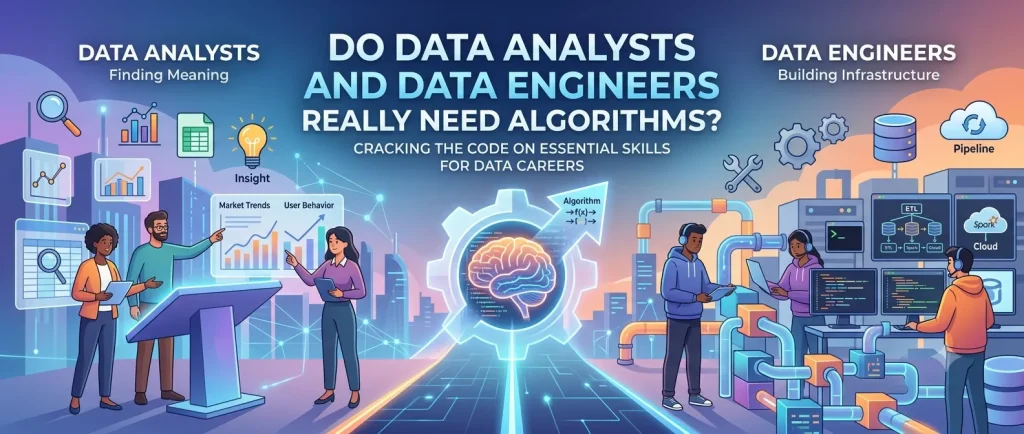
When people hear the word “algorithms,” they often think of LeetCode, coding interviews, binary trees, dynamic programming, and difficult abstract problems that rarely seem useful in everyday work.
So if you move into data analytics or data engineering, it is natural to wonder:
Do algorithms still matter in this field?
The short answer is yes, but not always in the way people expect.
Most data analysts and data engineers do not spend their day implementing complex graph algorithms or solving competitive programming problems. But they constantly use algorithmic thinking. They break vague business questions into logical steps. They design queries. They reason about performance. They estimate metrics with incomplete data. They debug misleading results. They build pipelines that need to work reliably at scale.
Algorithms may not always be mentioned explicitly, but the thinking behind them is everywhere.
Analytics Is More Than Reporting
A lot of people think data analytics is mainly about dashboards, charts, SQL queries, and reports.
That is part of the job, but good analytics goes much deeper.
A business question is often vague at first:
What is the best price for our product?
That sounds simple, but answering it requires many smaller questions:
- How many users convert at each price point?
- What is the difference between monthly and yearly subscribers?
- How long does the average customer stay?
- What is the estimated lifetime value?
- How does customer behavior differ by country, traffic source, or plan?
- Are we optimizing for short-term conversion or long-term revenue?
For example, when thinking through optimal pricing for AlgoCademy, I had to look at conversion rates, customer behavior, yearly versus monthly plans, and estimates like LTV.
That is not a “hard algorithm problem” in the LeetCode sense. But it absolutely requires algorithmic thinking.
You have to break the problem down, define the right variables, handle incomplete data, make assumptions, compare scenarios, and interpret the results carefully.
In real analytics work, the hard part is often not writing the query. The hard part is deciding what the query should actually mean.
Metrics Like Active Users and Churn Are Simple Until They Are Not
Take something like active users.
At first, it sounds easy:
Count how many users were active today.
But what does “active” mean?
Did they log in?
Did they complete a lesson?
Did they run code?
Did they visit the pricing page?
Did they spend at least five minutes in the product?
Did they do something meaningful?
For a product like AlgoCademy, a user who simply opens the website is not necessarily active in a meaningful way. A better definition might be someone who completes a tutorial, submits code, solves a challenge, or uses the AI tutor.
The same problem appears with churn.
What does churn mean?
For a subscription product, it might mean the user canceled. But for a free user, it might mean they stopped coming back. For a yearly subscriber, it might mean they did not renew. For a learning product, it might mean they stopped progressing before reaching activation.
So while calculating churn might look simple technically, defining churn correctly is much harder.
This is where algorithmic thinking helps. You are not just counting rows. You are designing a logical model of user behavior.
Cohort Analysis Is Algorithmic Thinking in Disguise
Cohort analysis is another great example.
A cohort is usually a group of users who share something in common, such as signing up in the same week or month.
Then you ask:
- How many came back after one day?
- How many came back after seven days?
- How many became paying customers?
- How many churned?
- Which cohort had better retention?
- Did a product change improve long-term behavior?
Again, this is not usually a difficult DSA problem. But it is a very algorithmic way of thinking.
You are working with sets of users across time.
For example:
- Users who signed up in January
- Users who were active in week 1
- Users who were active in week 2
- Users who upgraded
- Users who disappeared
Then you compare overlaps and differences between those groups.
In simple terms:
- Retained users = users in the cohort who are still active
- Churned users = users in the cohort who are no longer active
- Converted users = users in the cohort who became paying customers
That is set logic. It involves filtering, grouping, intersecting, subtracting, and counting.
Those are algorithmic ideas.
Why Not Just Let the Database Handle It?
Modern databases, warehouses, and analytics tools are powerful. SQL can do a lot. Tools like BigQuery, Snowflake, Postgres, dbt, Looker, and others can hide much of the complexity.
But that can also become a trap.
If you rely too much on the database to “magically” solve everything, you may not notice when your logic is wrong.
For example:
- You might count duplicate users.
- You might mix users and sessions.
- You might accidentally include test accounts.
- You might compare different time zones.
- You might calculate churn from the wrong baseline.
- You might use COUNT(DISTINCT user_id) everywhere without thinking about cost.
- You might build a query that works on small data but becomes extremely slow at scale.
The database can execute your query. It cannot decide whether your question is correct.
This is also true with AI tools.
LLMs can help write SQL, generate analysis, and summarize data. But they still need guidance. Many times, you have to steer the model toward the right calculation, the right assumptions, and the right interpretation.
Algorithmic thinking helps you notice when a result does not make sense.
It helps you ask:
- What exactly are we counting?
- What are the edge cases?
- Is this double-counting?
- Is this query efficient?
- Is this metric actually measuring what we think it measures?
That is valuable in both analytics and engineering.
At Scale, Algorithms Matter Even More
For small datasets, you can often get away with simple queries.
But once the business or dataset becomes large, performance starts to matter a lot.
Imagine doing cohort analysis for a huge product like Instagram.
You may need to estimate:
- Daily active users
- Monthly active users
- Retention by signup cohort
- Churn by region
- Unique users across devices
- Overlap between different user segments
At a smaller scale, basic SQL queries, indexes, hashes, and exact distinct counts might be enough.
At a larger scale, they may become too slow or too expensive.
This is where more advanced algorithmic ideas become useful.
For example, instead of exactly counting every unique user from raw events every time, large systems may use approximate counting methods like HyperLogLog.
HyperLogLog is useful when you need to estimate the number of unique items in a massive dataset without storing every single item. It trades a small amount of accuracy for much better memory efficiency and speed.
That kind of idea is very relevant in data engineering.
You may not implement HyperLogLog from scratch every day. But understanding why it exists helps you reason about large-scale analytics systems.
It also helps you understand why some queries are expensive, why some metrics are approximate, and why different systems make different tradeoffs.
Data Engineering Is Full of Algorithmic Tradeoffs
In data engineering, the connection to algorithms is even more direct.
Data engineers often deal with:
- Batching
- Deduplication
- Sorting
- Filtering
- Hashing
- Indexing
- Partitioning
- Streaming
- Scheduling
- Backfills
- Memory limits
- Query optimization
- Distributed processing
These are not abstract concepts. They affect real systems.
For example:
If you are deduplicating events, you need to decide how to identify duplicates.
If you are processing millions of records, you need to think about memory.
If you are partitioning a table, you need to think about access patterns.
If a pipeline takes weeks to run, you need to rethink the algorithm, not just add more compute.
Sometimes the difference between a slow pipeline and a fast one is not the programming language. It is the approach.
A better algorithm or data structure can turn a job that takes days into one that takes hours.
Do You Need LeetCode for Data Analytics and Data Engineering?
This depends on the role.
Some data engineering interviews, especially at big tech companies or high-paying startups, do ask LeetCode-style questions. But in most data roles, the focus is usually more practical.
You are more likely to need:
- Strong SQL
- Python basics
- Hash maps
- Sorting and grouping
- Arrays and strings
- Time and space complexity
- Data modeling
- Pipeline design
- System design basics
- Understanding of distributed data tools
For data analytics, you may not need advanced coding interview algorithms. But you still need algorithmic thinking to reason through metrics, funnels, cohorts, attribution, and business decisions.
For data engineering, the need is stronger because you are closer to the systems that process the data.
So the goal is not necessarily to become a competitive programmer.
The goal is to become someone who can think clearly about data, logic, scale, and tradeoffs.
The Real Value of Algorithms
The biggest benefit of learning algorithms is not memorizing solutions.
The real value is learning how to think.
Algorithms teach you to:
- Break problems into steps
- Define inputs and outputs
- Handle edge cases
- Think about efficiency
- Compare different approaches
- Understand tradeoffs
- Avoid blindly trusting tools
- Debug logic more carefully
Those skills transfer extremely well to data analytics and data engineering.
Whether you are estimating LTV, calculating churn, building a retention report, optimizing a pipeline, or designing a large-scale analytics system, the same kind of thinking applies.
You may not call it “algorithms” in the meeting.
But the thinking is still there.
Final Thoughts
Data analysts and data engineers may not need to solve difficult LeetCode problems every day.
But they absolutely benefit from understanding algorithms.
In analytics, algorithms help you structure vague business questions, define metrics correctly, and interpret data more carefully.
In data engineering, algorithms help you build faster, cheaper, and more reliable pipelines.
And at scale, algorithmic thinking becomes even more important. Counting active users, estimating churn, building cohorts, deduplicating events, and calculating unique users can all become serious engineering problems.
So no, data work is not just dashboards and SQL.
And no, algorithms are not only for coding interviews.
They are one of the foundations of clear thinking in any field that deals with data.