Comparing Coding Interview Preparation Platforms for Beginner Programmers
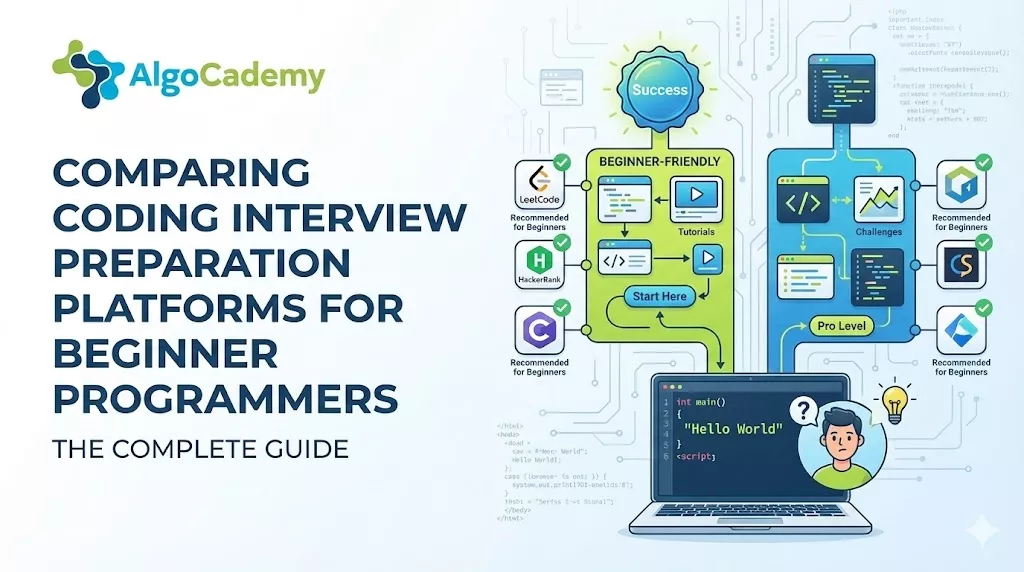
Here’s an uncomfortable truth that most coding interview platforms don’t want to acknowledge: they’re not designed for beginners. They’re designed for computer science graduates who already understand algorithms and just need practice applying them. If you’re a beginner trying to break into tech, these platforms can feel like being thrown into the deep end of a pool when you’re still learning to float.
The result is predictable. Beginners sign up for popular platforms, get crushed by problems they have no framework for approaching, and conclude that they’re “not smart enough” for programming. The problem isn’t intelligence. It’s that most platforms assume knowledge and skills that beginners haven’t developed yet.
But some platforms are genuinely built for beginners. They don’t just offer “easy” problems. They teach you how to think about problems from the ground up, breaking complex challenges into manageable steps and building your skills progressively. In this comparison, I’ll review the major interview prep platforms specifically through the lens of beginner accessibility and help you find resources that meet you where you actually are.
Why Most Platforms Fail Beginners
Before comparing specific platforms, let’s understand what makes interview prep so challenging for beginners:
The knowledge gap is invisible. Platforms assume you understand concepts like time complexity, recursion, and data structure tradeoffs. When you don’t, problems become impossible not because they’re hard but because you’re missing prerequisite knowledge the platform never taught you.
Problems require synthesis, not just recall. Interview questions combine multiple concepts in novel ways. Beginners who’ve learned about arrays and loops separately struggle to combine them under pressure. The synthesis skill requires explicit development that most platforms skip.
The jump from tutorials to problems is enormous. You might follow along perfectly with a tutorial explaining hash maps, then face a problem requiring hash maps and have no idea how to start. This gap between understanding and application trips up almost every beginner.
Feedback is evaluation, not instruction. Most platforms tell you that you’re wrong without helping you understand why or how to think differently. For beginners who don’t yet have mental models for debugging their thinking, this evaluation-only feedback produces frustration without growth.
Confidence erodes quickly. Failing problem after problem convinces beginners they can’t do this. The platforms don’t recognize that failure often indicates missing prerequisites, not lack of ability. Without proper scaffolding, talented people give up unnecessarily.
The platforms that work for beginners address these issues explicitly. They teach prerequisites, bridge the gap between understanding and application, provide instructional feedback, and build confidence through achievable progress.
Platform Comparisons for Beginners
AlgoCademy
AlgoCademy stands apart from other platforms by being explicitly designed around how beginners actually learn. Rather than presenting problems and expecting you to figure out solutions, AlgoCademy breaks the problem-solving process into granular, manageable steps that build your skills progressively.
The Step-by-Step Interactive Approach
What makes AlgoCademy genuinely different is how granular the guidance gets. Most platforms show you a problem and a final solution with maybe some explanation in between. AlgoCademy walks you through the actual construction of a solution, step by tiny step.
For example, instead of presenting a problem and expecting you to produce a complete solution, AlgoCademy might guide you through:
- Step 1: Write an empty for loop that will iterate through the array
- Step 2: Inside the loop, write an if statement to check our condition
- Step 3: Inside the if statement, update our tracking variable
- Step 4: After the loop, return the result
Each step builds on the previous one, and you verify your code works before moving forward. This granular approach means you’re never staring at a blank editor wondering where to even begin. You always have a clear next action, and you build the complete solution piece by piece.
This methodology teaches something crucial that other platforms miss: the decomposition process itself. Experienced programmers automatically break problems into steps, but this skill isn’t innate. It’s learned. AlgoCademy makes the decomposition explicit, training you to think in structured steps until it becomes natural.
AI Tutor Support
When you’re stuck between steps or confused about why something works, AlgoCademy’s AI Tutor provides personalized help. Unlike static hints that show the same text to everyone, the AI Tutor understands your specific situation and provides guidance tailored to where you’re struggling.
The AI Tutor can:
- Explain why your current approach isn’t working
- Suggest what concept you might be missing
- Provide analogies that make abstract ideas concrete
- Answer questions about the current step without spoiling future steps
- Adapt explanations to your level of understanding
This combination of granular steps and intelligent tutoring creates a learning experience closer to having a patient mentor sitting beside you than working through static course content. When you’re confused, help is immediately available. When you’re progressing well, you can move forward without interruption.
Why This Matters for Beginners
For beginners specifically, AlgoCademy’s approach solves the core problems other platforms create:
The granular steps eliminate the “blank editor paralysis” that stops beginners cold. You always know what to do next, even when the overall problem seems overwhelming.
Building solutions incrementally teaches the decomposition skill that separates successful programmers from those who struggle. You don’t just learn solutions. You learn how to construct solutions.
The AI Tutor provides the personalized instruction that self-study typically lacks. When you’re confused, you get help that addresses your specific confusion, not generic hints that may or may not be relevant.
Immediate validation at each step catches misconceptions early. You don’t practice errors for an hour before discovering your approach was wrong from step one.
Progress feels achievable because you’re completing steps constantly. Instead of failing complete problems repeatedly, you’re succeeding at steps and building momentum.
What Users Say
Reviews on AlgoCademy’s testimonials page consistently highlight how the platform helped beginners who struggled elsewhere:
- Users describe finally understanding “how to think” about problems after the step-by-step approach clicked
- The AI Tutor gets praised for providing help that actually addressed their confusion
- Many mention that AlgoCademy succeeded where months of LeetCode grinding had failed
- The granular steps helped users who felt overwhelmed by open-ended problems
- Beginners specifically call out feeling supported rather than tested
Pricing
- Starter Plan: $19.99/month or $99.99/year (programming fundamentals, perfect for true beginners)
- Pro Plan: $49/month or $249/year (full interview preparation with advanced content)
- Lifetime: $799.99 (permanent access to all content)
The Starter plan at $19.99/month provides an affordable entry point for beginners who want to build foundations before tackling interview-specific content.
Best For: True beginners who need structured guidance. Career changers without CS backgrounds. Anyone who’s struggled on other platforms and concluded they “can’t do this.” Learners who benefit from granular steps and personalized help.
Verdict: AlgoCademy is the most beginner-friendly interview prep platform available. The combination of granular step-by-step tutorials and AI Tutor support creates a learning experience that actually teaches rather than just tests. If you’re a beginner feeling overwhelmed by other platforms, AlgoCademy deserves your serious consideration.
LeetCode
LeetCode is the most popular interview prep platform, but its design prioritizes experienced programmers over beginners. Understanding its limitations helps you use it appropriately.
The Experience for Beginners
LeetCode presents problems with difficulty ratings (Easy, Medium, Hard), and beginners naturally start with Easy problems. But “Easy” on LeetCode means “easy for someone who already understands data structures and algorithms.” For actual beginners, even Easy problems can feel impossible.
The platform provides a problem statement, some examples, and a code editor. That’s it. There’s no guidance on how to approach the problem, no explanation of which concepts apply, and no scaffolding to help you build a solution. You either figure it out or you don’t.
When you’re stuck, you can look at discussion solutions, but these often assume knowledge you don’t have. Reading a solution that uses techniques you’ve never encountered doesn’t teach you those techniques. It just shows you that solutions exist.
The feedback is purely evaluative: your solution either passes all test cases or it doesn’t. When it doesn’t, you see which test case failed but not why your approach is wrong or how to think differently.
What Beginners Actually Experience
Beginners on LeetCode typically report:
- Staring at Easy problems with no idea where to start
- Reading solutions without understanding why they work
- Feeling stupid when problems that should be “easy” seem impossible
- Memorizing solutions without learning transferable skills
- Getting discouraged and quitting
This isn’t because beginners lack ability. It’s because LeetCode isn’t designed to teach the skills it tests. The platform assumes you already have problem-solving frameworks and just need practice applying them.
When LeetCode Works for Beginners
LeetCode can work for beginners who:
- Use it alongside teaching resources that explain concepts
- Have mentors or communities that provide guidance when stuck
- Approach it after building foundations elsewhere
- Use the Explore cards (structured learning paths) rather than random problems
The Explore feature organizes problems into learning sequences with brief explanations, making it more accessible than the raw problem database. Beginning here rather than with random Easy problems produces better outcomes.
Pricing
- Free tier: Most problems, community discussions, basic features
- Premium: $35/month or $159/year (company tags, video solutions, debugger)
Best For: Beginners who’ve already built foundations elsewhere and need practice volume. Those with mentors or communities providing support. Intermediate programmers preparing for specific companies.
Verdict: LeetCode is excellent for practice but poor for learning. Beginners should build foundations on teaching-focused platforms like AlgoCademy first, then use LeetCode for volume practice once they have frameworks for approaching problems.
HackerRank
HackerRank offers more structure than LeetCode, with learning tracks that introduce concepts progressively. This structure makes it more accessible to beginners, though gaps remain.
The Experience for Beginners
HackerRank organizes content into tracks covering specific skills: Python basics, data structures, algorithms, SQL, and more. Each track sequences problems from introductory to advanced, providing natural progression.
The early problems in each track genuinely start simple. A Python basics track begins with printing output and reading input before progressing to loops and conditionals. This progressive introduction helps beginners build skills incrementally.
Problem statements typically include explanations of relevant concepts, reducing the “assumed knowledge” problem that makes LeetCode frustrating. You’re not expected to already know everything. The platform teaches as it tests.
The Interview Preparation Kit provides structured paths specifically targeting technical interviews. Following these paths gives beginners a curriculum rather than random problem selection.
Limitations for Beginners
While better than LeetCode for beginners, HackerRank still has gaps:
Problems don’t break down into granular steps. You still face complete problems and must produce complete solutions. When you’re stuck partway through, there’s no guidance on the specific step where you’re struggling.
Explanations accompany problems but don’t guide you through the solving process. You learn what concepts are relevant but not how to apply them step by step.
Feedback remains primarily evaluative. You see test results but limited guidance on fixing your approach.
The difficulty ramp can feel steep. The jump from easy to medium problems sometimes assumes skill development that the easy problems didn’t provide.
Pricing
- Free: Full access to practice tracks and problems
Best For: Beginners who want free structured practice. Those preparing for companies using HackerRank for screening. Learners who can handle complete problems but want progressive difficulty.
Verdict: HackerRank is more beginner-friendly than LeetCode, with structured tracks and concept explanations that help newcomers. However, it still presents complete problems without granular step-by-step guidance. Beginners may want to build fundamentals on more supportive platforms first.
Codecademy
Codecademy focuses on teaching programming fundamentals rather than interview preparation specifically. For beginners, this foundation-building focus has both advantages and limitations.
The Experience for Beginners
Codecademy excels at introducing programming concepts to complete novices. Lessons combine brief explanations with immediate hands-on practice in an integrated code editor. You read about a concept, try it immediately, and get feedback.
The progression is genuinely gentle. Courses start with the absolute basics and build systematically. You’re not expected to have any prior knowledge.
Career paths provide structured curricula targeting specific outcomes like “Full-Stack Engineer” or “Data Scientist.” These paths sequence courses logically, providing direction for learners who don’t know what to study.
The Pro subscription includes projects that synthesize multiple concepts, bridging the gap between isolated exercises and real-world application.
Limitations for Interview Prep
Codecademy teaches programming but doesn’t specifically prepare you for technical interviews:
The content covers language syntax and general programming concepts but not the algorithmic problem-solving that interviews emphasize.
There’s limited coverage of data structures and algorithms at the depth interviews require.
Problems are educational exercises, not interview-style challenges. The format and difficulty don’t match what you’ll encounter in actual technical screens.
After completing Codecademy, you’ll know how to program but still need dedicated interview preparation.
Pricing
- Free tier: Limited course access
- Pro: $34.99/month or approximately $149/year (full library, projects, certificates)
Best For: Complete beginners who need to learn programming basics before even thinking about interviews. Those who want friendly, gentle introduction to coding.
Verdict: Codecademy is excellent for building programming foundations but doesn’t replace interview-specific preparation. Beginners might start here to learn basics, then transition to AlgoCademy for interview-focused skill development with the same supportive, step-by-step approach applied to interview problems.
freeCodeCamp
freeCodeCamp offers a comprehensive, completely free curriculum that takes learners from beginner through job-ready skills. The interview preparation sections specifically target technical interviews.
The Experience for Beginners
freeCodeCamp’s curriculum starts from zero and builds progressively. The early sections assume no prior knowledge, introducing HTML, CSS, and JavaScript from the basics.
The interview prep section covers data structures, algorithms, and common interview problem patterns. Content is organized into modules that build on each other logically.
Every piece of content is completely free. There are no premium tiers, no paywalls, and no limitations on access. This accessibility makes freeCodeCamp invaluable for budget-constrained beginners.
The community provides support through forums and chat. When you’re stuck, you can ask questions and get help from other learners and volunteers.
Certifications provide tangible goals and evidence of progress. Completing a certification requires building projects that demonstrate your skills.
Limitations for Beginners
Despite its strengths, freeCodeCamp has limitations for beginners:
The curriculum requires significant self-direction. You must maintain motivation through hundreds of hours of content without external accountability.
Problems don’t include the granular step-by-step guidance that struggling beginners need. You face challenges and must produce solutions without scaffolded support.
The interview prep content assumes you’ve completed earlier sections. Jumping directly to interview prep without foundations leads to confusion.
Explanations are briefer than some alternatives. Beginners who need extensive explanation may find the content moves too quickly.
Pricing
- Completely free
Best For: Self-motivated beginners with limited budgets. Those who want a complete curriculum from basics through interviews. Learners who can maintain discipline through long self-study.
Verdict: freeCodeCamp offers tremendous value at no cost. However, beginners who struggle with self-direction or need more supportive guidance may benefit from supplementing with platforms like AlgoCademy that provide step-by-step scaffolding and AI tutoring when stuck.
Educative
Educative provides text-based interactive courses with embedded coding practice. The “Grokking” series has become popular for interview preparation.
The Experience for Beginners
Educative’s text-based format lets you read at your own pace, re-reading confusing sections as needed. This self-paced approach works well for learners who struggle with video content that moves too fast or too slow.
The Grokking the Coding Interview course organizes problems by pattern rather than by data structure. This pattern-based approach helps beginners recognize that many problems share similar solutions, reducing the apparent complexity.
Inline code widgets let you practice immediately after reading explanations. The tight integration between learning and doing reinforces understanding.
Beginner courses exist for data structures and algorithms fundamentals, providing on-ramps for those without CS backgrounds.
Limitations for Beginners
Despite the helpful structure, Educative has beginner-specific limitations:
Even “beginner” content assumes comfort with programming basics. Complete novices may struggle.
Problems still require producing complete solutions. The pattern-based organization helps you know which approach to use, but you must execute that approach without step-by-step guidance.
The volume of text can feel overwhelming. Learners who prefer interactive or visual content may find the format challenging.
Subscriptions are required for full access, and the pricing is significant for beginners unsure of their commitment.
Pricing
- Individual courses: Around $79 each
- Unlimited access: $59/month or approximately $199/year on sale
Best For: Beginners who prefer reading to video. Those who want pattern-based organization for interview prep. Learners with programming basics who need interview-specific preparation.
Verdict: Educative provides solid content with better structure than raw problem databases. However, it doesn’t offer the granular step-by-step scaffolding that struggling beginners need. Pair it with more supportive resources for the best results.
Khan Academy
Khan Academy offers free programming courses with a particularly beginner-friendly approach. While not focused on interview prep, it provides excellent foundations.
The Experience for Beginners
Khan Academy may be the gentlest introduction to programming available. The visual, interactive format makes abstract concepts concrete. You write code and immediately see visual results, building intuition that text-based output doesn’t provide.
The progression is extremely gradual. Concepts are introduced slowly with extensive practice before moving on. Struggling learners aren’t left behind.
Everything is completely free with no premium tier. The nonprofit mission ensures accessibility for all learners.
The conversational teaching style feels supportive rather than intimidating. Mistakes are expected and welcomed as part of learning.
Limitations for Beginners
Khan Academy’s limitations are significant for interview preparation:
The content doesn’t cover interview-specific topics. You’ll learn programming basics but not data structures, algorithms, or problem-solving patterns at interview depth.
JavaScript is the primary language, which may not match your target interview language.
After completing Khan Academy, substantial additional preparation is needed for interviews.
Pricing
- Completely free
Best For: Complete beginners intimidated by other platforms. Visual learners who benefit from immediate graphical feedback. Those who want the gentlest possible introduction to programming.
Verdict: Khan Academy is perfect for absolute beginners who need a gentle on-ramp to programming. However, it’s only the first step. After building basics here, transition to interview-focused platforms like AlgoCademy that apply similar supportive approaches to interview-specific content.
Codewars
Codewars gamifies coding practice with problems across a wide range of difficulties. The beginner experience is mixed.
The Experience for Beginners
Codewars rates problems by difficulty (kyu ranks), and the easiest problems (8 kyu) start quite simple. Beginners can find accessible challenges.
After solving problems, you immediately see other users’ solutions. This comparative view teaches alternative approaches you might not have considered.
The gamification elements (ranks, honor, achievements) motivate consistent practice for many learners.
Support for many languages lets you practice in whatever language you’re learning.
Limitations for Beginners
Codewars has significant beginner challenges:
Problem quality varies because the community creates problems. Some “easy” problems are poorly specified or harder than their rating suggests.
There’s no guidance on how to approach problems. You face challenges without scaffolding, hints, or step-by-step support.
The difficulty progression isn’t smooth. You might solve several easy problems, then hit a wall with no clear path forward.
Seeing solutions after solving can become a crutch. Beginners may start looking at solutions prematurely without developing their own problem-solving skills.
Pricing
- Free: Full access to problems and solutions
- Premium: $9.99/month (ad-free, minor features)
Best For: Beginners who already have basic programming skills and want gamified practice. Those motivated by competition and rankings.
Verdict: Codewars offers accessible practice for beginners with basics already in place. However, the lack of scaffolding and variable problem quality make it challenging for true beginners. Use it for practice after building foundations elsewhere.
AlgoExpert
AlgoExpert provides curated problems with video explanations. The video format helps beginners, though other aspects are less beginner-friendly.
The Experience for Beginners
Video explanations walk through problem approaches in detail, showing how an expert thinks through challenges. This visibility into expert reasoning helps beginners understand not just what to do but why.
The curated problem set means every problem is high-quality and interview-relevant. You’re not wading through thousands of problems of varying quality.
The hints system provides progressive guidance when stuck, though hints are text-based rather than interactive.
The bounded problem set (around 200 problems) provides achievable completion, building confidence through visible progress.
Limitations for Beginners
AlgoExpert assumes foundational knowledge:
Problems don’t include granular step-by-step guidance. You watch a video, then attempt the problem as a whole.
Even with videos, the gap between understanding an explanation and producing your own solution remains.
The content assumes familiarity with data structures and algorithms. True beginners may struggle even with explanations.
There’s no AI tutor or interactive help. When stuck beyond what hints provide, you’re on your own.
Pricing
- $99/year (all problems and video explanations)
- SystemsExpert: $85/year (system design, separate product)
Best For: Beginners who’ve built foundations and learn well from video explanations. Those who want curated quality over overwhelming quantity.
Verdict: AlgoExpert’s video explanations help beginners understand problem approaches, but the platform still expects you to execute solutions without granular guidance. Use it after building fundamentals on more supportive platforms.
Comparison Summary for Beginners
| Platform | Beginner Friendliness | Step-by-Step Guidance | AI/Tutor Help | Price |
|---|---|---|---|---|
| AlgoCademy | Excellent | Granular steps | AI Tutor | $19.99-$49/month |
| LeetCode | Poor | None | None | Free-$35/month |
| HackerRank | Moderate | Limited | None | Free |
| Codecademy | Good (basics) | Moderate | None | $34.99/month |
| freeCodeCamp | Moderate | Limited | Community | Free |
| Educative | Moderate | Limited | None | $59/month |
| Khan Academy | Excellent (basics) | Moderate | None | Free |
| Codewars | Moderate | None | None | Free |
| AlgoExpert | Moderate | Limited | Hints only | $99/year |
Building a Beginner Learning Path
Based on this comparison, here’s how beginners should approach interview preparation:
Phase 1: Programming Foundations
If you’re a complete beginner, start with:
- Khan Academy for the gentlest introduction
- Codecademy for structured language learning
- AlgoCademy Starter ($19.99/month) for fundamentals with step-by-step guidance
Phase 2: Interview-Specific Skills
Once you can write basic programs, develop interview skills on:
- AlgoCademy Pro ($49/month or $249/year) for step-by-step interview prep with AI Tutor support
- This is where the granular guidance and AI tutoring make the biggest difference
Phase 3: Practice Volume
After building problem-solving frameworks, add volume practice:
- LeetCode for extensive practice
- HackerRank for additional free practice
- Return to AlgoCademy when you hit concepts you don’t understand
Phase 4: Interview Simulation
Before real interviews, practice live:
- Pramp for free peer mock interviews
- This builds communication skills and handles interview nerves
Why Granular Steps Matter for Beginners
The step-by-step approach that AlgoCademy offers isn’t hand-holding. It’s teaching a skill that experienced programmers have but beginners lack: the ability to decompose problems into manageable pieces.
When you face a problem and immediately see the solution path as a series of steps, that’s not innate talent. It’s a learned skill developed through practice. Experienced programmers acquired this skill over years of coding. AlgoCademy’s granular tutorials compress that skill development by making the decomposition explicit.
Each time you work through a problem step by step, you’re training your brain to think in steps. Eventually, you internalize this process and can decompose problems automatically. But until that internalization happens, having the steps provided scaffolds your learning without limiting your growth.
The AI Tutor adds another dimension. When you’re stuck on a specific step, getting help that addresses your specific confusion is far more valuable than generic hints or complete solutions. The AI understands where you are in the problem and provides targeted guidance that moves you forward without doing the thinking for you.
This combination of granular steps and intelligent tutoring creates the learning environment beginners actually need, not the sink-or-swim approach that benefits only those who already know how to swim.
Final Thoughts
Most coding interview platforms assume you already have skills they should be teaching. For beginners, this creates frustration, discouragement, and often abandonment of goals that were entirely achievable with proper support.
AlgoCademy breaks this pattern by meeting beginners where they are. The granular step-by-step tutorials teach problem decomposition explicitly. The AI Tutor provides personalized help when you’re stuck. The progressive difficulty builds confidence through achievable challenges.
If you’re a beginner who’s struggled on other platforms, the problem probably isn’t you. It’s that those platforms weren’t designed for beginners. Try an approach built for how beginners actually learn, with scaffolded guidance that builds skills progressively.
Check out what other beginners say on AlgoCademy’s testimonials page. Then start with the Starter plan at $19.99/month, experience the difference that step-by-step guidance and AI tutoring make, and build the problem-solving skills that will carry you through interviews and beyond.
Your journey into tech is achievable. You just need tools designed to help you succeed.