Coding Courses with Certification Recognised in Denmark: The Complete Guide
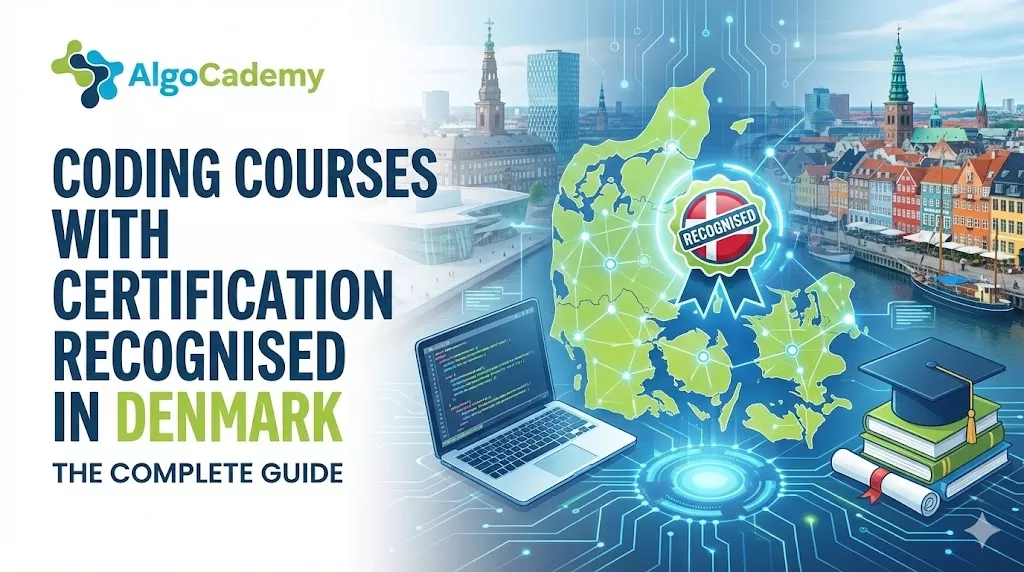
Denmark has quietly built one of Europe’s most impressive technology ecosystems. This small Nordic nation of just 5.9 million people has produced a remarkable concentration of successful tech companies—Zendesk, Unity, Trustpilot, Tradeshift, Pleo, and Lunar among them. Copenhagen has emerged as a genuine European tech hub, regularly ranked among the continent’s best cities for startups and digital innovation.
The Danish approach to technology and education reflects the country’s broader social democratic values: high-quality education accessible to all, generous student support that makes studying financially viable, and a work culture that prizes efficiency and work-life balance. The tech sector benefits from excellent digital infrastructure, near-universal English proficiency, a highly educated workforce, and a collaborative business culture that encourages innovation.
For anyone seeking to enter or advance in Danish tech, understanding which credentials carry weight is essential. The landscape includes world-class universities led by DTU (Technical University of Denmark) and the University of Copenhagen, an innovative Academy Profession (Erhvervsakademi) system offering shorter professionally-focused degrees, extensive government-funded training options, and a growing bootcamp scene. Danish employers value formal qualifications but increasingly focus on demonstrated capability, particularly in the competitive startup ecosystem.
This guide navigates Denmark’s certification landscape comprehensively, explaining which credentials employers recognise, how the education system works, what substantial government support is available, and how to build a strategic path into one of Europe’s most innovative and liveable tech markets.
Understanding Denmark’s Education System
Denmark’s education system combines accessibility, quality, and strong connections between education and industry. Understanding this structure is essential for navigating credential choices.
The Danish Qualifications Framework (DQF)
The Danish Qualifications Framework aligns Danish qualifications with the European Qualifications Framework (EQF):
| DQF/EQF Level | Danish Qualification | Description |
|---|---|---|
| 1-2 | Folkeskole | Compulsory education |
| 3 | Gymnasial uddannelse (partial) | Upper secondary (partial) |
| 4 | Gymnasial uddannelse, EUX | Upper secondary, vocational |
| 5 | Erhvervsakademiuddannelse (Academy Profession) | Short-cycle higher education |
| 6 | Professionsbachelor, Bachelor | Bachelor’s degree |
| 7 | Kandidat (Master’s) | Master’s degree |
| 8 | PhD | Doctoral degree |
The Higher Education System
Danish higher education follows the Bologna Process with some distinctive features:
Erhvervsakademiuddannelse (Academy Profession Degree):
- Duration: 2 years (120 ECTS)
- Professionally oriented
- DQF Level 5
- Can progress to Top-up Bachelor’s
Professionsbachelor (Professional Bachelor’s):
- Duration: 3-4 years (180-240 ECTS)
- Professionally oriented
- Often includes internship
- DQF Level 6
Bachelor (Academic Bachelor’s):
- Duration: 3 years (180 ECTS)
- Research-oriented
- Foundation for Master’s
- DQF Level 6
Kandidat (Master’s Degree):
- Duration: 2 years (120 ECTS)
- Research or professionally oriented
- DQF Level 7
PhD:
- Duration: 3 years
- Research degree
- Paid position in Denmark
Universities vs. University Colleges vs. Business Academies
Denmark has three main types of higher education institutions:
Universiteter (Universities):
- Research mandate
- Award Bachelor’s, Master’s, PhD
- Most prestigious for academic careers
- Examples: University of Copenhagen, DTU, Aarhus University
Professionshøjskoler (University Colleges):
- Professionally oriented education
- Award Professional Bachelor’s degrees
- Strong industry connections
- Examples: KEA, VIA University College
Erhvervsakademier (Business Academies):
- Short-cycle higher education
- Award Academy Profession degrees
- Very practical focus
- Top-up to Professional Bachelor’s possible
- Examples: Cphbusiness, IBA Erhvervsakademi
All three types award recognised qualifications within the Danish system.
Academy Profession Degrees: Denmark’s Hidden Gem
The Academy Profession (AP) degree system is often overlooked but provides an excellent pathway into tech:
Characteristics:
- 2-year programmes
- Highly practical orientation
- Mandatory internship (praktik)
- Direct job relevance
- Can continue to Top-up Bachelor’s (1.5 years additional)
IT-related AP programmes:
- Datamatiker (Computer Science)
- Multimediedesigner (Multimedia Design)
- IT-teknolog (IT Technology)
- Various specialisations
Why AP degrees are valuable:
- Faster entry to workforce than traditional degrees
- Strong practical skills
- Internship provides industry experience
- Employers value job-readiness
- Can upgrade to full Bachelor’s if desired
Vocational Education (Erhvervsuddannelser/EUD)
Denmark has a strong vocational education system:
EUD (Erhvervsuddannelse):
- Apprenticeship-based
- Combines school and workplace training
- Various IT tracks available
IT-relevant programmes:
- Data- og kommunikationsuddannelsen (Data and Communication)
- IT-supporter
- Datatekniker (Data Technician)
EUX:
- Combined vocational and academic qualification
- Provides access to higher education
Free Education and SU
Tuition:
- Free for Danish/EU/EEA students at public institutions
- Non-EU students pay tuition at universities (but some exceptions)
SU (Statens Uddannelsesstøtte): Denmark’s generous student support system provides monthly grants (not loans) to eligible students.
Danish Universities for Computer Science
Denmark has excellent computer science education across its university system.
Technical University of Denmark (DTU)
DTU is Denmark’s premier technical university, located in Lyngby near Copenhagen.
DTU Compute (Department of Applied Mathematics and Computer Science):
BSc in Software Technology (Softwareteknologi):
- Duration: 3 years
- Strong theoretical foundations
- Programming intensive
- Taught in Danish
BSc in Artificial Intelligence and Data:
- Duration: 3 years
- AI and data focus
- Growing programme
MSc programmes (many English-taught):
- Computer Science and Engineering
- Mathematical Modelling and Computation
- Autonomous Systems
- Bioinformatics and Systems Biology
- Various specialisations
Tuition:
- Danish/EU/EEA: Free
- Non-EU: ~DKK 100,000-110,000/year
Reputation: Exceptional. DTU is Denmark’s MIT—the premier technical institution. Graduates are highly sought after by Danish and international tech companies. Strong industry connections and research output.
University of Copenhagen (KU)
University of Copenhagen is Denmark’s largest and oldest university.
Department of Computer Science (DIKU):
BSc i Datalogi (Computer Science):
- Duration: 3 years
- Strong theoretical programme
- Research orientation
- Taught in Danish
MSc programmes:
- Computer Science
- IT and Cognition
- Various specialisations
- Many English-taught options
Tuition:
- Danish/EU/EEA: Free
- Non-EU: ~DKK 100,000-115,000/year
Reputation: Excellent. Strong research tradition, particularly in algorithms, programming languages, and theoretical CS. Copenhagen location provides excellent tech ecosystem access.
Aarhus University (AU)
Aarhus University is Denmark’s second-largest university.
Department of Computer Science:
BSc i Datalogi:
- Duration: 3 years
- Strong programme
- Research opportunities
MSc programmes:
- Computer Science
- IT Product Development
- Various tracks
Tuition:
- Danish/EU/EEA: Free
- Non-EU: ~DKK 90,000-100,000/year
Reputation: Excellent. Strong CS department with good industry connections in Aarhus region.
Aalborg University (AAU)
Aalborg University is known for its problem-based learning (PBL) approach.
Department of Computer Science:
Various programmes:
- Software Engineering
- Computer Science
- Medialogy (unique interdisciplinary programme)
Characteristics:
- Project-based learning
- Group work emphasis
- Industry-relevant projects
Tuition:
- Danish/EU/EEA: Free
- Non-EU: ~DKK 85,000-95,000/year
Reputation: Good, particularly known for innovative pedagogy and practical projects.
IT University of Copenhagen (ITU)
IT University of Copenhagen is Denmark’s specialised IT institution.
Programmes:
BSc programmes:
- Software Development
- Data Science
- Digital Design and Interactive Technologies
- Global Business Informatics
MSc programmes:
- Software Design
- Computer Science
- Data Science
- Games
- Digital Innovation and Management
- Various specialisations
Characteristics:
- Focused entirely on IT
- Strong industry connections
- Copenhagen tech ecosystem access
- Many English-taught programmes
- Modern facilities
Tuition:
- Danish/EU/EEA: Free
- Non-EU: ~DKK 100,000/year
Reputation: Very good and growing. The dedicated IT focus creates strong specialisation. Good reputation in Danish tech industry.
University of Southern Denmark (SDU)
SDU serves southern Denmark.
Various IT programmes:
- Computer Science
- Software Engineering
- Data Science
Reputation: Good. Regional university with solid programmes.
Roskilde University (RUC)
RUC is known for interdisciplinary approaches.
IT-related programmes:
- Computer Science (combined with other subjects)
- Interdisciplinary IT programmes
Characteristics:
- Problem-based learning
- Interdisciplinary focus
- Project work emphasis
Copenhagen Business School (CBS)
CBS offers business-IT intersection programmes.
IT-related programmes:
- BSc in Business Administration and Information Systems
- MSc in Business Administration and Information Systems
- MSc in Business Administration and E-business
Reputation: Excellent for business-oriented IT roles.
University Comparison
| University | Location | Type | Prestige | Industry Connection |
|---|---|---|---|---|
| DTU | Copenhagen area | Technical | Highest | Excellent |
| KU (DIKU) | Copenhagen | Traditional | Very High | Very Good |
| AU | Aarhus | Traditional | Very High | Very Good |
| ITU | Copenhagen | IT-focused | High | Excellent |
| AAU | Aalborg | Technical | Good | Good |
| CBS | Copenhagen | Business | High | Excellent (business) |
| SDU | Odense/regional | Traditional | Good | Good |
Academy Profession and Professional Bachelor’s
The Erhvervsakademi and Professionshøjskole system provides excellent practical pathways into tech.
Academy Profession IT Programmes
Datamatiker (AP Degree in Computer Science):
This is the most relevant AP degree for aspiring developers.
Duration: 2.5 years (150 ECTS) including internship
Curriculum typically includes:
- Programming (Java, C#, JavaScript)
- Databases
- System development
- Web development
- Electives and specialisation
- Mandatory internship (praktik)
Outcome: AP Graduate in Computer Science
Employment prospects: Very good. Datamatiker graduates are valued for practical skills and job-readiness.
Top-up option: Can continue to Professional Bachelor’s (Professionsbachelor) in 1.5 years additional.
Multimediedesigner (AP Degree in Multimedia Design):
Duration: 2 years (120 ECTS)
Focus:
- Web design
- UX/UI
- Frontend development
- Digital media
Top-up option: To Professional Bachelor’s in Web Development or similar.
IT-teknolog (AP Degree in IT Technology):
Duration: 2 years (120 ECTS)
Focus:
- IT infrastructure
- Networks
- Security
- System administration
Major Erhvervsakademi Providers
Cphbusiness (Copenhagen Business Academy):
Cphbusiness is Copenhagen’s largest business academy.
IT programmes:
- Datamatiker
- Multimediedesigner
- Various business IT
Characteristics:
- Large, established institution
- Copenhagen location
- Good industry connections
KEA (Copenhagen School of Design and Technology):
KEA combines design and technology.
IT programmes:
- Datamatiker
- Multimediedesigner
- IT-teknolog
- Web Development (Top-up)
Characteristics:
- Strong design integration
- Copenhagen location
- Good reputation
Erhvervsakademi Aarhus (EAAA):
EAAA serves the Aarhus region.
IT programmes:
- Datamatiker
- Various IT tracks
IBA Erhvervsakademi Kolding:
Regional academy with IT programmes.
UCL Erhvervsakademi og Professionshøjskole:
Serves Funen and southern Denmark.
Professional Bachelor’s Top-Up
After an AP degree, can continue to Professional Bachelor’s:
Professionsbachelor i Webudvikling:
- 1.5 years after AP
- Full Bachelor’s qualification
- Web development specialisation
Professionsbachelor i Softwareudvikling:
- 1.5 years after AP
- Software development focus
Professionsbachelor i IT-sikkerhed:
- Security specialisation
VIA University College
VIA is one of Denmark’s largest university colleges.
IT programmes:
- Software Technology Engineering
- ICT Engineering
- Various IT tracks
Characteristics:
- Professionally oriented
- Strong internship programmes
- Regional presence (Aarhus, Horsens, etc.)
AP Degree vs. University
Choose AP/Erhvervsakademi if:
- You want faster entry to workforce (2-2.5 years)
- You prefer practical, hands-on learning
- You want built-in internship experience
- You may top-up to Bachelor’s later
- You’re targeting practical development roles
Choose university if:
- You want deeper theoretical foundations
- You’re targeting research or academia
- You want maximum career optionality
- Employer specifically requires university degree
- You prefer academic environment
The practical reality:
Many Danish tech employers value AP graduates highly for practical skills. The Datamatiker qualification in particular is well-recognised. For development roles, AP can be an excellent choice, especially with the option to top-up later if needed.
Government Funding and Support
Denmark offers exceptional support for education and career development.
SU (Statens Uddannelsesstøtte)
SU is Denmark’s generous student support system.
What SU provides:
Monthly grant (not loan):
- Living at home: ~DKK 3,300/month
- Living independently: ~DKK 6,500/month (2024 rates)
Key characteristics:
- It’s a GRANT, not a loan (mostly)
- Paid monthly during studies
- Can work alongside (earning limit applies)
- Loan supplement available if needed (SU-lån)
Eligibility:
- Danish citizens
- EU/EEA citizens working in Denmark (or with Danish worker parent)
- Some permanent residents
- Enrolled in approved programme
- Progress requirements apply
For EU/EEA students:
- Can qualify with work connection to Denmark
- Typically need to work 10-12 hours/week while studying
- Very attractive once qualified
Duration:
- Up to 70 months (SU-klip) for most programmes
- Covers typical programme duration
Arbejdsmarkedsuddannelser (AMU)
AMU provides labour market training:
Characteristics:
- Short courses for employed and unemployed
- Practical skills focus
- IT courses available
- Often free or low cost
- Flexible scheduling
IT-related AMU courses:
- Various technical courses
- Certification preparation
- Specific technology training
Jobcentre and A-kasse Support
Jobcentre:
- Public employment services
- Training programmes for unemployed
- IT training may be available
A-kasse (Unemployment Insurance Funds):
- Provide unemployment benefits
- May support retraining
- Various funds for different sectors
For career changers:
- Check with jobcentre about training options
- A-kasse may fund education in some cases
- Various programmes for unemployed
Voksenuddannelse (Adult Education)
VUC (Adult Education Centres):
- Various courses for adults
- Can gain qualifications for higher education
- IT courses may be available
Åben Uddannelse (Open Education):
- Part-time higher education
- Can take single courses
- Fees apply but can be subsidised
Employer-Funded Training
Danish employers commonly invest in training:
Common practices:
- Training budgets for employees
- Certification funding
- Conference attendance
- Study leave (kompetenceudvikling)
For tech:
- Certification exam funding common
- Learning platform access
- Professional development expected
- Many companies have generous training policies
Coding Bootcamps in Denmark
Denmark has a growing bootcamp ecosystem, particularly in Copenhagen.
Hack Your Future
Hack Your Future is a notable Danish initiative.
Programme:
- Free for participants
- Targets refugees and immigrants
- 8 months part-time
- Full-stack web development
Characteristics:
- Social mission
- Volunteer-taught
- Good industry connections
- Employment focus
Cost: Free
Reputation: Good for its specific mission.
Codecademy Pro / Online Bootcamps
Various online bootcamps accessible from Denmark:
Codecademy Pro:
- Online platform
- Self-paced
- Various tracks
Coursera / edX Professional Certificates:
- University-backed
- Flexible timing
Salt (</salt>)
Salt (Swedish company) operates or has operated in Copenhagen.
Model:
- Employer-sponsored
- Free for participants
- Intensive training
- Interview guarantee
Check current availability in Denmark.
Le Wagon Copenhagen
Le Wagon has operated in Copenhagen.
Programmes:
- Web Development
- Data Science
Characteristics:
- Global curriculum
- Intensive format
- Career services
Cost: ~DKK 50,000-60,000
Check current operations in Copenhagen.
Ironhack (Remote/Europe)
Ironhack offers remote programmes accessible from Denmark.
Founders of Tomorrow
Founders of Tomorrow focuses on entrepreneurship and tech.
Not a traditional bootcamp but relevant for tech entrepreneurship.
Corporate Training Programmes
Some companies offer training pathways:
Graduate programmes:
- Many Danish tech companies have graduate schemes
- Include training and development
- Paid positions
Consultancy academies:
- Companies like Netcompany have internal academies
- Train and hire graduates
Bootcamp Recognition in Denmark
The Danish context:
Denmark values formal qualifications, but the tech sector is pragmatic. The market is smaller than larger European hubs, which can mean credentials matter somewhat more.
Bootcamp certificates are NOT:
- Danish formal qualifications
- Equivalent to AP or university degrees
- SU eligible
- Formally recognised in DQF
Bootcamp certificates CAN:
- Demonstrate practical skills
- Provide portfolio projects
- Connect to hiring networks
- Lead to employment, especially at startups
Best approach in Denmark:
Consider AP degrees (Datamatiker) first—officially recognised, SU eligible, includes internship. Bootcamps can supplement for those needing faster paths or with existing credentials.
The honest assessment:
Danish employers generally value formal qualifications. However, the tech industry, particularly startups and international companies, focuses on capability. Portfolio and demonstrated skills can overcome credential gaps.
Vendor Certifications
International vendor certifications are recognised in Denmark, complementing formal qualifications.
Amazon Web Services (AWS)
AWS certifications are valued in Denmark.
AWS Certified Cloud Practitioner
- Entry-level certification
- Foundation for cloud careers
- Cost: ~DKK 800-1,000
AWS Certified Solutions Architect – Associate
- Most popular certification
- Strong demand
- Cost: ~DKK 1,200-1,500
Professional and Specialty certifications
- Advanced credentials
Danish market value: Strong. Cloud adoption growing rapidly in Denmark. Many Danish companies use AWS.
Microsoft Azure
Microsoft certifications are relevant in Danish enterprise.
Azure Fundamentals (AZ-900)
- Entry certification
Azure Developer Associate (AZ-204)
- Developer focus
Azure Solutions Architect Expert
- Senior credential
Danish market value: Strong in enterprise. Microsoft has significant presence in Denmark. Public sector and large organisations often Microsoft-based.
Google Cloud Platform (GCP)
Google Cloud certifications are growing.
Professional certifications:
- Cloud Architect
- Data Engineer
- ML Engineer
Danish market value: Growing. GCP expanding in Denmark.
Kubernetes and Cloud Native
CKA (Certified Kubernetes Administrator)
- Container orchestration
- Good demand
CKAD (Certified Kubernetes Application Developer)
- Developer Kubernetes skills
Danish market value: Good. Container adoption growing in Danish tech.
Cybersecurity Certifications
CISSP:
- Senior security certification
- Valued in Denmark
CEH (Certified Ethical Hacker):
- Penetration testing
CompTIA Security+:
- Entry-level security
Danish market value: Growing with cybersecurity focus. Financial services sector significant.
Agile/Scrum
Scrum certifications (PSM, CSM):
- Agile methodology
- Widely used in Denmark
SAFe certifications:
- Scaled agile
- Enterprise environments
Danish market value: Good. Agile widely adopted in Danish companies.
Certification Funding
Through employers: Many Danish employers fund certifications. Ask about professional development budgets.
Tax treatment: Employer-funded certifications typically tax-advantaged.
Immigration and Work Permits
Denmark offers various pathways for tech professionals.
EU/EEA Citizens
No work permit required:
- Freedom of movement
- Right to work
- Register with local municipality
- Get CPR number (civil registration)
EU/EEA citizens can:
- Work freely
- Access SU after establishing work connection
- Eventually qualify for permanent residence
Non-EU Work Permits
Pay Limit Scheme (Beløbsordningen):
Primary pathway for well-paid tech professionals:
Requirements:
- Job offer with annual salary of at least DKK 465,000 (2024, adjusted annually)
- No education requirements
- Standard employment terms
For tech professionals:
- Salary threshold usually easily met in tech
- Quick processing (1-2 months typically)
- Straightforward pathway
Duration:
- Up to 4 years
- Renewable
Positive List (Positivlisten):
For professions in high demand:
IT-related occupations on the list often include:
- Software developers
- System architects
- IT specialists
- Check current list for specific occupations
Requirements:
- Job in occupation on the list
- Relevant education or experience
- Lower salary threshold than Pay Limit
Fast-Track Scheme:
For certified companies:
Requirements:
- Employer must be certified
- Standard employment terms
- Various tracks (Pay Limit, Positive List, etc.)
Benefits:
- Faster processing
- Simpler procedures
Startup Denmark
For entrepreneurs:
Requirements:
- Innovative business idea
- Approved by expert panel
- Sufficient funds
For tech startups:
- Can establish business in Denmark
- 2-year initial permit
Student Permit
For those wanting to study then work:
Student permit (Opholdstillatelse til studerende):
- For enrolled students
- Can work alongside studies (20 hours/week, full-time during summer)
Post-study:
- Can apply to change to work permit
- Job seeker permit available for graduates (up to 6 months)
Green Card (Discontinued)
Note: Denmark’s Green Card scheme has been discontinued. Not currently available.
Permanent Residence
After meeting requirements (typically 8 years, reduced to 4 with conditions):
- Danish language requirements
- Employment requirements
- Self-support requirements
Danish Citizenship
After meeting residence requirements:
- Danish language test (Prøve i Dansk 3)
- Various other requirements
- Dual citizenship now allowed
Credential Recognition
For immigration:
- SIRI (Danish Agency for International Recruitment and Integration) handles permits
- Qualifications assessed as part of application
For employment:
- Most tech employers assess credentials themselves
- Well-known universities advantaged
- Practical skills demonstration often sufficient
The Skills Gap: What Certifications Miss
Here’s the critical insight that applies across Denmark’s tech market: credentials demonstrate education, but employers need capability.
Danish tech culture combines respect for formal qualifications with pragmatic focus on what you can do. The startup ecosystem particularly values demonstrated skills.
Technical Interviews in Denmark
Danish tech companies use various assessment methods:
Major tech companies (Zendesk, Unity, Trustpilot):
- Technical interviews
- Coding challenges
- System design questions
- Multiple rounds
- Often English-language
Consulting firms (Netcompany, NNIT, Trifork):
- Technical assessments
- Case discussions
- Multiple interview rounds
- Cultural fit important
Startups:
- Technical interviews
- Portfolio reviews
- Practical assessments
- Cultural fit crucial
These interviews test abilities that credentials don’t develop:
- Breaking down unfamiliar problems
- Thinking algorithmically
- Implementing solutions under pressure
- Communicating technical concepts
- Debugging and troubleshooting
Where AlgoCademy Fills the Gap
AlgoCademy addresses exactly this gap between credentials and interview-ready capability.
What makes it different:
AlgoCademy’s AI-powered tutoring develops problem-solving ability, not just knowledge. When you’re stuck, the AI doesn’t just give you the answer. It asks guiding questions. It helps you break down problems. It builds the thinking patterns that transfer to any coding challenge.
Why this matters in Denmark:
Technical interviews determine outcomes. Your credentials get you interviews. Problem-solving ability gets you offers. Many well-credentialed candidates fail at this stage.
Competition includes DTU and DIKU graduates. You’re competing against graduates from excellent Danish technical institutions. Problem-solving skills differentiate candidates.
Danish tech salaries justify preparation. Junior developers earn DKK 35,000-45,000/month. Senior engineers at top companies earn DKK 55,000-80,000+ monthly. Improving interview performance significantly impacts career trajectory.
The ecosystem rewards capability. Copenhagen’s growing startup scene particularly values demonstrated skills over credentials alone.
How to use AlgoCademy:
AlgoCademy offers a 7-day free trial on their annual plan. Here’s how to integrate it with your Danish credential journey:
During formal education: Spend 20-30 minutes daily on AlgoCademy alongside your university, AP degree, or bootcamp studies. Build problem-solving skills while earning credentials.
After earning credentials: Use AlgoCademy intensively during job search. Your credentials got you in the door. Problem-solving skills close the deal.
For career changers: Start AlgoCademy early in your transition. The problem-solving foundation accelerates everything else.
The combination of recognised Danish credentials plus demonstrated problem-solving ability is far more powerful than either alone.
Cost Comparison (DKK)
Understanding the full financial picture helps make informed decisions.
Free and Very Low Cost Options
| Option | Cost | Time | Notes |
|---|---|---|---|
| freeCodeCamp | DKK 0 | Self-paced | Online curriculum |
| CS50 (Harvard via edX) | DKK 0 (audit) | 10-20 hrs/week | World-class intro |
| Public university (EU/EEA) | DKK 0 | 3-5 years | Tuition free |
| Erhvervsakademi (EU/EEA) | DKK 0 | 2-2.5 years | Tuition free |
| Hack Your Future | DKK 0 | 8 months | For refugees/immigrants |
| AMU courses | DKK 0 or low | Varies | Labour market training |
Low to Mid Cost Options
| Option | Cost | Time | Notes |
|---|---|---|---|
| AWS certifications | DKK 800-2,500 | 1-3 months | Per certification |
| Azure certifications | DKK 800-1,800 | 1-3 months | Per certification |
| Online courses | DKK 500-3,000 | Varies | Various platforms |
| Åben Uddannelse | DKK varies | Part-time | Single courses |
Higher Cost Options (Bootcamps/Private)
| Option | Cost | Time | Notes |
|---|---|---|---|
| Le Wagon (if operating) | DKK 50,000-60,000 | 9-24 weeks | Check availability |
| International bootcamps (remote) | DKK 40,000-70,000 | 3-6 months | Various options |
| Private business schools | DKK 50,000-150,000/year | Varies | Check specific programmes |
Non-EU University Fees
| Option | Cost | Time | Notes |
|---|---|---|---|
| DTU (non-EU) | DKK 100,000-110,000/year | 2-5 years | Technical master’s |
| KU (non-EU) | DKK 100,000-115,000/year | 2-5 years | Research university |
| ITU (non-EU) | DKK 100,000/year | Varies | IT-focused |
| AU (non-EU) | DKK 90,000-100,000/year | Varies | Traditional university |
Living Costs
Copenhagen:
- Accommodation: DKK 5,000-10,000/month (expensive, competitive)
- Living expenses: DKK 5,000-8,000/month
- Total: DKK 10,000-18,000/month
Aarhus:
- Accommodation: DKK 4,000-7,000/month
- Living expenses: DKK 4,000-7,000/month
- Total: DKK 8,000-14,000/month
Odense/Aalborg:
- Accommodation: DKK 3,500-6,000/month
- Living expenses: DKK 4,000-6,000/month
- Total: DKK 7,500-12,000/month
Important: Copenhagen housing is competitive. Start searching early for student accommodation.
Total Cost Estimates
3-year university (EU/EEA student with SU):
- Tuition: DKK 0
- Living (Copenhagen): DKK 360,000-650,000 total
- SU support: ~DKK 230,000 total (grant portion)
- Net cost after SU: DKK 130,000-420,000
2.5-year AP degree (EU/EEA student with SU):
- Tuition: DKK 0
- Living (Copenhagen): DKK 250,000-450,000 total
- SU support: ~DKK 160,000 total (grant portion)
- Net cost after SU: DKK 90,000-290,000
Bootcamp (3 months, Copenhagen):
- Tuition: DKK 50,000-60,000
- Living: DKK 30,000-55,000
- Total: DKK 80,000-115,000
ROI Considerations
Highest ROI credentials:
- Free public education (EU/EEA)
- SU-supported study
- AP degree (Datamatiker) with top-up option
- Employer-sponsored programmes
Key insight:
For EU/EEA citizens, Denmark offers exceptional educational value. Free tuition plus SU grants makes high-quality education remarkably affordable. Consider paid options carefully against free alternatives.
Certification Paths by Career Goal
Different roles value different credentials in the Danish market.
Full-Stack Web Developer
Strong paths:
- Datamatiker (AP degree) – excellent practical path
- University degree + practical experience
- Bootcamp + strong portfolio
- Career change with existing degree + intensive training
Important skills:
- JavaScript ecosystem (React, Node.js)
- Databases
- Git and deployment
- Problem-solving ability
Interview preparation:
- AlgoCademy for technical interviews
- Portfolio projects
Danish market notes:
- Strong demand in Copenhagen
- Consulting firms hire actively
- Startups value practical skills
Backend Developer
Strong paths:
- University degree
- Datamatiker AP degree
- Strong programming fundamentals
Danish market notes:
- Java significant in enterprise
- C# (.NET) strong presence
- Python growing
- Node.js in startups
Frontend Developer
Strong paths:
- Multimediedesigner AP degree
- Web Development Top-up
- University degree with frontend focus
- Portfolio demonstrating skills
Danish market notes:
- React dominant
- TypeScript increasingly expected
- UX awareness valued
DevOps / Cloud Engineer
Strong paths:
- Technical background + cloud certifications
- IT-teknolog AP degree
- AWS/Azure certifications
- Kubernetes certifications
Danish market notes:
- Growing demand
- Azure strong in enterprise/public sector
- AWS popular in startups
- Container adoption growing
Data Scientist / Data Engineer
Strong paths:
- University degree in quantitative field
- Master’s often expected
- ITU Data Science programme
- Strong statistics/ML knowledge
Important skills:
- Python
- SQL
- Machine learning
- Statistics
Danish market notes:
- Growing demand
- Strong at companies like Unity, Trustpilot
- Master’s often expected for senior roles
UX Designer
Strong paths:
- Multimediedesigner AP degree
- ITU design programmes
- KEA design programmes
- Portfolio essential
Danish market notes:
- Strong design culture in Denmark
- Scandinavian design tradition
- Good opportunities
Career Changers
Best starting path:
- Datamatiker AP degree (2.5 years, SU eligible)
- Jobcentre training if unemployed
- Problem-solving skills via AlgoCademy
- Portfolio development
Danish-specific advice:
- Check jobcentre/A-kasse options first
- AP degree excellent for career change
- SU makes longer education viable
- Network in Danish tech community
Regional Considerations
Denmark’s tech market is concentrated but has regional characteristics.
Copenhagen (Greater Copenhagen/Hovedstaden)
Characteristics:
- Denmark’s dominant tech hub
- ~70%+ of Danish tech jobs
- Startup concentration
- International companies present
- Highest salaries
- Highest living costs
- Most competitive housing market
Major presence: Zendesk, Unity, Trustpilot, Pleo, Lunar, Vivino, Too Good To Go, Maersk (digital), Danske Bank (tech), Nordea (tech), Netcompany, NNIT, numerous startups
Areas:
- Copenhagen inner city: Various tech offices
- Ørestad: Some tech presence
- Lyngby (DTU area): Tech/research
- Malmö (Sweden): Øresund region, accessible from Copenhagen
Credential considerations:
- Most competitive market
- Skills often prioritised
- International standards
- Best opportunities
Salary range (approximate):
- Junior: DKK 35,000-45,000/month
- Senior: DKK 50,000-75,000+/month
Aarhus
Characteristics:
- Second-largest city
- Growing tech scene
- Strong university influence (AU)
- More affordable than Copenhagen
- Good quality of life
- Growing startup ecosystem
Major presence: Growing startup scene, regional offices, some tech companies
Credential considerations:
- Good opportunities
- Less competitive than Copenhagen
- Credentials valued
- Local network helpful
Salary range:
- Junior: DKK 32,000-40,000/month
- Senior: DKK 45,000-65,000/month
Odense
Characteristics:
- Third-largest city
- Robotics hub (Universal Robots origin)
- Growing tech presence
- More affordable
- SDU influence
Major presence: Robotics companies, growing tech ecosystem
Credential considerations:
- Specific strengths in robotics
- Growing opportunities
- Lower cost alternative
Aalborg
Characteristics:
- Northern Jutland
- AAU influence
- Specific tech clusters
- Most affordable major city
Credential considerations:
- Regional market
- AAU network important
- Specific opportunities
Øresund Region (Copenhagen-Malmö)
Cross-border opportunities:
- Copenhagen and Malmö connected
- Can live in Malmö, work in Copenhagen (or vice versa)
- Exchange rate considerations (DKK vs SEK)
- Both markets accessible
Remote Work
Trends:
- Remote work increasingly accepted
- Many Danish companies offer hybrid
- Can access Copenhagen salaries from elsewhere
- Work-life balance emphasis supports flexibility
Considerations:
- Danish work culture traditionally valued collaboration
- Hybrid models common
- Full remote possible at some companies
Language Considerations
Danish language is important but the tech sector is relatively English-friendly.
When Danish Is Important
- Most Danish companies (at least helpful)
- Client-facing roles
- Public sector positions
- Consulting with Danish clients
- Long-term career advancement
- Social integration
- Smaller companies outside Copenhagen
When English May Suffice
- International companies
- Copenhagen tech companies with international teams
- Startups targeting global markets
- Specialised technical roles
- Short-term positions
The Danish Reality
English proficiency:
- Danes speak excellent English
- Tech meetings often in English when internationals present
- Documentation may be in English
- Many international teams
Danish benefits:
- Full integration into workplace
- Career advancement easier
- Social connections
- Understanding culture fully
- Client interactions
- Many companies prefer Danish
Recommended Approach
For maximum opportunities in Denmark:
- English is often sufficient initially in tech
- Danish shows commitment and aids integration
- Learning Danish opens additional doors
- Recommended for long-term residence
Danish language learning:
- Free Danish courses for residents (Sprogcenter)
- Various language schools
- Duolingo (basics)
- Similar to Norwegian and Swedish
Common Mistakes to Avoid
Ignoring Free Options
Denmark offers free education at public institutions for EU/EEA students. SU provides substantial support. Don’t pay unnecessarily for bootcamps when excellent free options exist.
Overlooking AP Degrees
The Datamatiker and other AP degrees are excellent pathways often overlooked by internationals. They provide official recognition, SU eligibility, mandatory internship, and strong employment outcomes.
Underestimating Copenhagen Costs
Copenhagen is expensive, and housing is competitive. Budget realistically and start housing search early.
Not Using SU
If eligible for SU, use it. It’s primarily a grant, not a loan. Very generous by international standards.
Ignoring Danish Language
While English can suffice in tech, Danish ability significantly aids career advancement and integration. More important for long-term success.
Not Networking
Denmark’s smaller market makes networking important. Professional relationships matter for opportunities.
Underestimating Interview Preparation
Danish tech interviews assess technical capability. AlgoCademy preparation is important.
Missing the Internship Opportunity
Danish programmes often include mandatory internship (praktik). This is valuable—take it seriously as it often leads to employment.
Building Your Certification Strategy
Step 1: Define Your Goal
What role? Which city? What timeline?
Research job listings on:
- Jobindex
- IT-Jobbank
- The Hub (startup jobs)
- Company career pages
Note:
- Required qualifications
- Preferred skills
- Language requirements
Step 2: Assess Your Starting Point
EU/EEA citizen:
- Free education at public institutions
- SU available with work connection
- Consider Datamatiker or university
Non-EU considering Denmark:
- Tuition fees apply at universities
- Pay Limit scheme for workers
- Consider study pathway
- Calculate true costs
Danish resident:
- Full SU eligibility
- Free education
- Maximum support available
Career changer:
- Check jobcentre/A-kasse options
- Datamatiker excellent option (SU eligible)
- AMU courses for quick skills
Step 3: Choose Wisely
Prioritise:
- Free options (public institutions)
- SU-eligible programmes
- Officially recognised qualifications
- Programmes with internship components
Be cautious of:
- Expensive options when free alternatives exist
- Non-recognised credentials when recognised available
- Programmes without proven employment outcomes
Step 4: Prepare Properly
For all paths:
- Develop problem-solving skills with AlgoCademy
- Prepare for technical interviews
- Build portfolio demonstrating capabilities
- Network in Danish tech community
- Consider Danish language learning
Step 5: Maintain and Expand
- Keep skills current
- Continue professional development
- Build professional network
- Develop Danish language ability
Resources for Denmark
Government Resources
- Optagelse.dk (university admissions)
- UG.dk (education guide)
- SU.dk (student support)
- Workindenmark.dk (work in Denmark)
- SIRI (immigration)
- Jobnet (public employment service)
Job Search
- Jobindex
- IT-Jobbank (IT-specific)
- The Hub (Nordic startup jobs)
- Jobnet
- Company career pages
Tech Community
- Meetup.com Denmark Tech
- Copenhagen Tech
- GOTO Copenhagen (conference)
- Copenhagen Developers
- [Various tech meetups]
Vendor Certification Resources
Learning Platforms
Problem-Solving and Interview Prep
- AlgoCademy (AI-tutored problem-solving)
- LeetCode
- HackerRank
- Codewars
Danish Language Resources
- Speak Danish (free courses for residents)
- Studieskolen
- Duolingo Danish
- Various language schools
Getting Started This Week
If You’re in Denmark Exploring Options
- Research Datamatiker and university programmes at optagelse.dk and ug.dk.
- Check SU eligibility at su.dk if considering longer studies.
- If unemployed, contact jobcentre about training opportunities.
- Start free learning. Try freeCodeCamp or CS50 to confirm interest.
- Try AlgoCademy’s free trial. AlgoCademy offers 7 days free on annual plan. Build problem-solving skills from day one.
- Attend local tech meetups to network and understand the market.
If You’re an EU/EEA Citizen Considering Denmark
- Research free education options. University and AP degrees are free for EU.
- Understand SU requirements (need work connection—10-12 hours/week typically).
- Research housing early. Copenhagen is competitive.
- Consider Øresund region. Malmö offers cheaper living with Copenhagen access.
If You’re Non-EU Considering Denmark
- Research Pay Limit scheme. DKK 465,000 salary threshold (2024).
- Consider study pathway. Student permit → job seeker period → work permit.
- Calculate full costs. Tuition fees for non-EU at universities.
- Research Positive List for your occupation.
If You’re Unemployed in Denmark
- Contact jobcentre. Access training and support.
- Check A-kasse options if member.
- Explore AMU courses for quick skills.
- Apply for Datamatiker if longer training viable.
If You’re a Career Changer in Denmark
- Explore Datamatiker programme. Excellent for career change (2.5 years, SU eligible, internship included).
- Check jobcentre options for funded training.
- Consider AMU courses for quick skill additions.
- Begin problem-solving practice with AlgoCademy.
- Network in tech community. Relationships matter in Danish job market.
- Consider Danish language if not already proficient.
The Bottom Line
Denmark offers excellent opportunities in technology, combining a growing tech ecosystem with exceptional quality of life. Copenhagen has established itself as a significant European tech hub, producing companies like Zendesk, Unity, and Trustpilot, while offering the work-life balance and social benefits that characterise Scandinavian societies.
The most important insight: Denmark values credentials and capability, with generous support making credentials accessible.
Free education at public institutions for EU/EEA students, combined with SU grants, makes high-quality education remarkably affordable. The Academy Profession system (Datamatiker) provides an excellent 2.5-year pathway with built-in internship. These options should be seriously considered before paying for alternatives.
AlgoCademy addresses what credentials miss: the practical problem-solving ability that employers test in interviews and need on the job. Danish tech companies conduct technical assessments, and credentials alone don’t guarantee success. Combined with appropriate Danish credentials, strong problem-solving skills create a profile that opens doors and succeeds once through them.
Danish work culture emphasises work-life balance, flat hierarchies, and collaborative approaches. The tech scene benefits from Scandinavian efficiency and design sensibility. While smaller than Stockholm’s, Copenhagen’s ecosystem is vibrant and growing.
The challenges are real: Copenhagen is expensive, housing is competitive, and Danish language ability matters for full integration. But for those who navigate these challenges, Denmark offers a compelling combination of career opportunity, quality of life, and the famous Danish hygge.
Choose your path wisely, maximise the free and funded options available, invest in integration (including Danish language), and develop the skills that credentials alone don’t provide.
Held og lykke! (Good luck!)