
Scaling AI-Generated Coding Tutorials Without Reading Every Line
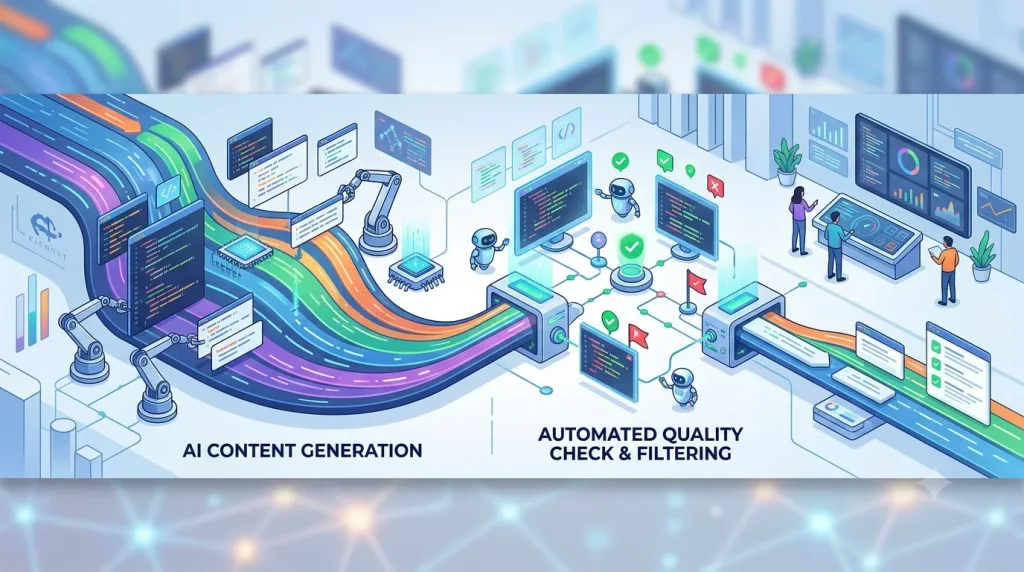
Or: is it actually possible to trust an agent at volume, or are we just lying to ourselves?
Here’s the wall every team building with AI agents eventually hits. Generation scales. Review doesn’t.
An agent can produce ten tutorials, fifty code examples, and two hundred test cases in an afternoon. You cannot read all of that carefully in an afternoon — not if “carefully” means anything. So you’re left with three bad options: review everything (and become the bottleneck your agent was supposed to remove), review nothing (and ship whatever the model felt like generating), or review a random sample and hope.
None of these are good enough for a product where the content is the product — where a subtly wrong explanation of why an algorithm is O(n log n) instead of O(n²) doesn’t just embarrass you, it teaches someone the wrong mental model right before a job interview.
So: is it actually possible to run agents at high output volume without a human checking everything? Yes — but not in the way that pitch decks imply. You don’t get to zero human review. What you get, if you build it right, is human review time that stops scaling with content volume. That’s the real goal, and it’s achievable. Here’s how.
The honest framing first
“AI agents that don’t need review” is the wrong goal. It invites exactly the failure mode you’re afraid of: trusting output because checking it is annoying. The right goal is decoupling reviewer time from output volume — building a system where 10x more tutorials doesn’t mean 10x more of your hours, because the cheap, mechanical 90% of verification is automated, and your attention is reserved for the 10% that actually requires judgment.
This is genuinely achievable for code-heavy content in a way it isn’t for, say, marketing copy or legal text. And that’s worth sitting with for a second, because it’s actually good news for exactly the kind of product you’re building.
Why code tutorials are the best case for this, not the worst
Most people assume AI-generated content is scariest when it’s technical — one wrong line and the whole thing is broken. It’s actually the opposite. Code is one of the few content types with executable ground truth. A blog post about leadership doesn’t have a test suite. A piece of code does.
- Does it compile / run?
- Does it produce the correct output for a given input?
- Does it run within the claimed time/space complexity?
- Does it handle the edge cases a human would think to probe?
Every one of these is a yes/no question a machine can answer without a human reading a single line of the explanation. That’s a structural advantage. The unverifiable part of a tutorial — is the explanation pedagogically sound, does it build the right intuition, does it match your house style — is a much smaller surface area than “is the code correct,” and it’s the part you should be spending your limited human attention on.
The mistake is treating all of it as equally unverifiable and therefore equally in need of a human. It isn’t.
The core principle: verify the system, not the artifact
The instinct when output volume gets scary is to read more output. The actual fix is to stop reviewing artifacts one at a time and start reviewing (and hardening) the process that produces them, once, so it produces trustworthy artifacts by construction.
Concretely: instead of reading 50 generated tutorials, you write a spec, a rubric, and a verification harness once, review those carefully, and then let the harness check all 50 outputs against them automatically. Your review effort becomes O(1) relative to content volume instead of O(n). This is the same shift that made unit testing possible for software teams — you stopped manually clicking through the app after every change and started writing tests that click through it for you.
The layered verification stack
No single check catches everything. What works is a funnel: cheap, fast, deterministic checks first, catching the majority of failures for pennies; expensive, judgment-based checks last, reserved for what survives. Think of it as a five-layer filter between “agent output” and “goes live.”
 agent output
     │
     ▼
[1] Constrain generation   — reduce variance before it happens
     │
     ▼
[2] Deterministic checks   — execute, test, lint, profile (fast, cheap, objective)
     │
     ▼
[3] Self-correction loop   — agent sees failures, fixes, retests (before a human ever looks)
     │
     ▼
[4] LLM-judge pass         — different model/persona scores against a rubric
     │
     ▼
[5] Golden-set + risk-weighted human sampling — the last, smallest, highest-leverage filter
     │
     ▼
 published tutorial
Layer 1 — Constrain generation before it happens
The cheapest bug is the one that never gets generated. A rigid template (problem statement → constraints → walkthrough → solution → complexity analysis → test cases → hints ladder) plus a written style guide gives the model far less room to wander than an open-ended “write a tutorial about X.” Structured, schema-like output isn’t just easier to parse — it’s easier to check, because a checker knows exactly where the complexity claim lives and where the code block lives instead of hunting for them in free text.
Layer 2 — Deterministic, execution-based checks
This is where code content has an unfair advantage, and where most of your review burden should actually disappear. For every tutorial:
- Run the solution code against the stated test cases, plus a set of adversarially generated edge cases (empty input, single element, duplicates, max constraints, off-by-one boundaries).
- Verify the complexity claim empirically, not by trusting the prose. Run the solution at increasing input sizes and fit the growth curve — if the tutorial claims O(n log n) but wall-clock time scales quadratically, that’s a hard, automatic catch, not something you’d notice skimming an explanation. Something as simple as this catches a real and common class of LLM error:
import time

def measure_growth(fn, sizes, gen_input):
    times = []
    for n in sizes:
        data = gen_input(n)
        start = time.perf_counter()
        fn(data)
        times.append(time.perf_counter() - start)
    # rough ratio check: doubling n should ~2x time for O(n),
    # ~4x for O(n^2), ~2x*log-factor for O(n log n), etc.
    ratios = [times[i+1] / times[i] for i in range(len(times) - 1)]
    return ratios
- Lint and type-check for style consistency with your house conventions.
- Diff against a plagiarism/duplication check so you’re not accidentally shipping a near-copy of an existing solution write-up on the web (this also protects you legally and on SEO).
All of this is objective, fast, and requires zero human judgment. If it fails, it goes back to the agent, not to you.
Layer 3 — Let the agent fix its own failures before you see them
The highest-leverage move in an agentic pipeline is closing the loop before a human is in it: generate → run the Layer 2 checks → feed failures back to the agent → regenerate → retest. Most surface-level errors (a broken import, a wrong test case, a mismatched complexity claim) get resolved in one or two of these cycles without costing you a minute. You should almost never be the first person to see a failing test case — the agent should have already tried to fix it and either succeeded or escalated.
Layer 4 — LLM-as-judge, with real teeth
Execution catches correctness. It doesn’t catch quality: does the explanation actually build intuition, or does it just narrate the code? Does it leak the answer before the hint ladder is supposed to? Does it match the “problem-solving skills, not syntax memorization” framing you want, rather than reading like generic LeetCode-solution boilerplate?
A second pass, using a different model or a distinctly different prompt/persona than the one that generated the content, scored against an explicit written rubric, catches a meaningful chunk of this. Two things matter for this to actually work:
- The rubric has to be specific and checkable (“does the explanation state the key insight before showing code: yes/no,” not “is this good?”). Vague rubrics produce vague, rubber-stamp judgments.
- The judge should not be the same model/prompt that generated the content. A model grading its own homework tends to share the same blind spots as the model that made the mistake — same training data, same habits, same things it doesn’t think to question. Use a different model, a strongly adversarial persona (“find the pedagogical flaw”), or both.
Layer 5 — Golden sets and risk-weighted human sampling
This is where the actual, irreducible human time goes, and the goal is to spend it where it buys the most.
- Keep a small golden set — 15-30 tutorials you’ve hand-verified as excellent — and re-run them through the pipeline every time you change a prompt, model, or template. If a canary starts scoring worse, you’ve caught silent drift before it reaches new content, which is the failure mode that’s easiest to miss otherwise.
- Sample for human review, but weight by risk, not flatly. A brand-new topic category (say, your first flow-network tutorial) deserves a full read. The fortieth “two-pointer technique” tutorial in a well-established, low-variance category doesn’t need the same scrutiny once you’ve established the pattern holds. Flat 5%-of-everything sampling under-reviews the risky 5% and over-reviews the safe 95%.
- Every failure that reaches Layer 5 should get fed back into Layer 1-2 as a new automated check. If a human catches something, ask “could a deterministic check have caught this?” before assuming it’s inherently unautomatable. Your automated layer should get stricter over time, not stay static.
What this looks like end to end for a tutorial pipeline
- Spec once, by hand. You write (or heavily edit) the outline: learning objective, difficulty, prerequisite concepts, the specific insight the tutorial needs to land. This is the highest-leverage 10 minutes in the whole pipeline — get this right and everything downstream inherits it.
- Agent generates the explanation, solution code, starter/stub code, test cases, and a graduated hint ladder, following your template.
- Deterministic harness executes the solution against generated test cases (including adversarial edge cases), verifies the complexity claim empirically, lints, checks style, checks for near-duplication against existing content.
- Self-correction loop — failures go back to the agent automatically; you never see the first draft’s bugs.
- LLM judge scores the surviving draft against your written pedagogy rubric using a different model/persona than the generator.
- Golden-set regression check runs automatically any time the pipeline itself changes.
- You review: new topic categories the first time, anything flagged by layers 2-4 that the agent couldn’t self-resolve after N attempts, and a risk-weighted sample of everything else.
Volume can go up 10x without step 7 going up 10x, because steps 3-6 are absorbing the load.
Where this breaks — the honest failure modes
Building this stack is not a substitute for understanding where it’s weak:
- “It runs” is not “it’s right.” Passing tests only proves the code satisfies the test cases you thought to write. A solution can pass every test and still teach the wrong generalizable approach, or be correct but explained in a way that builds a brittle mental model. Execution checks are necessary, not sufficient.
- A judge model can share blind spots with the generator, especially if it’s the same model family under a thin persona. Treat judge agreement as weaker evidence than judge disagreement — when your judge flags something, that’s a strong signal; when it doesn’t, that’s weaker reassurance than it feels like.
- Random sampling misses rare-but-severe issues. A 5% random sample will reliably catch a bug that appears in 30% of outputs and will reliably miss one that appears in 2% of outputs, no matter how “thorough” 5% sounds. Risk-weighting fixes some of this; it doesn’t eliminate the fundamental math.
- Silent drift is the sneakiest failure mode. A prompt tweak, a model upgrade, a template change — any of these can quietly shift quality without tripping any single check. This is the entire reason a golden set with regression tracking earns its keep; without one, drift accumulates invisibly until a customer notices before you do.
- Automation complacency compounds. The moment the pipeline feels trustworthy is exactly the moment people stop reading its output critically — including you. Treat the pipeline’s own error rate as something you actively track and budget against, the way an SRE team tracks an error budget, rather than something you assume is fine because it was fine last month.
What still genuinely needs a human, no matter how good the pipeline gets
Be honest about the residual, because pretending otherwise is how quality erodes quietly:
- Curriculum-level judgment — does this tutorial belong here in the sequence, does it assume something the learner hasn’t seen yet, is the difficulty curve right across a whole track. This is a systems-level call the model doesn’t have visibility into.
- “Does this actually teach understanding vs. pattern-matching” — the deepest form of pedagogical quality is hard to reduce to a rubric, because it’s precisely the thing a rubric-following model is most likely to fake convincingly.
- Brand voice and positioning consistency at the level of “does this feel like us,” which is a much fuzzier target than any checklist.
- Anything genuinely novel — the first tutorial in a new topic area has no golden-set precedent and no established pattern for the judge to check against. Novelty is exactly where automated checks are weakest, because they’re all calibrated against what’s come before.
The goal isn’t to shrink this list to zero. It’s to shrink everything outside this list to near-zero, so the time you do spend reviewing is spent entirely on things that actually need a human brain.
Implementing this in a Claude Code–style workflow
If you’re running this with Claude Code specifically, the pipeline above maps fairly directly onto its primitives, and it’s worth using the right one for the right job rather than cramming everything into prompt instructions:
- Hooks for anything that must never be skipped. A
PostToolUsehook that runs your test suite and linter automatically after every file edit is deterministic — it fires whether or not the model “remembers” to run it, which a plain instruction in a prompt orCLAUDE.mdcan’t guarantee. Reserve hooks for the checks you genuinely cannot afford to have skipped. - Subagents for the verification passes themselves, especially anything that produces a lot of intermediate noise you don’t want cluttering your main session — a test-runner subagent that executes the full suite and reports back only the failures, or a “critic” subagent running the Layer 4 judge pass with its own distinct system prompt and persona, isolated from the generator’s context.
CLAUDE.mdfor your house style and rubric — the template structure, the pedagogy rules, the “always include an edge-case test for X” conventions — so the generator agent is constrained before it ever produces a first draft, not corrected after the fact.- A golden-set check as its own script or slash command, run against the canary set any time you touch a prompt, template, or model choice, so drift shows up before it reaches new content rather than after a customer finds it.
None of this requires exotic infrastructure. It’s the same discipline as a CI/CD pipeline for code, applied to content that happens to be generated by a model instead of typed by a person — and if you already think in graphs and test cases, this is a very natural extension of muscles you already have.
The actual answer
Is it possible to run AI agents at high output volume without a human checking everything? Yes, if “everything” means every line of every artifact. No, if it means zero human judgment anywhere in the loop — and you shouldn’t want that version anyway, because the failure modes that survive a good verification stack are exactly the ones that require a human to catch.
The realistic, achievable target is a pipeline where 90%+ of what could go wrong is caught by execution, deterministic checks, and a second model before you ever see it — and where your remaining review time goes to the 10% that’s genuinely about judgment: curriculum fit, pedagogical depth, brand voice, and the first instance of anything new. That’s not a compromise version of “agents you can trust.” For a domain with executable ground truth like code, it’s about as close to the real thing as currently exists.