Which Coding Education Providers Offer Free Trial Periods or Demo Classes?
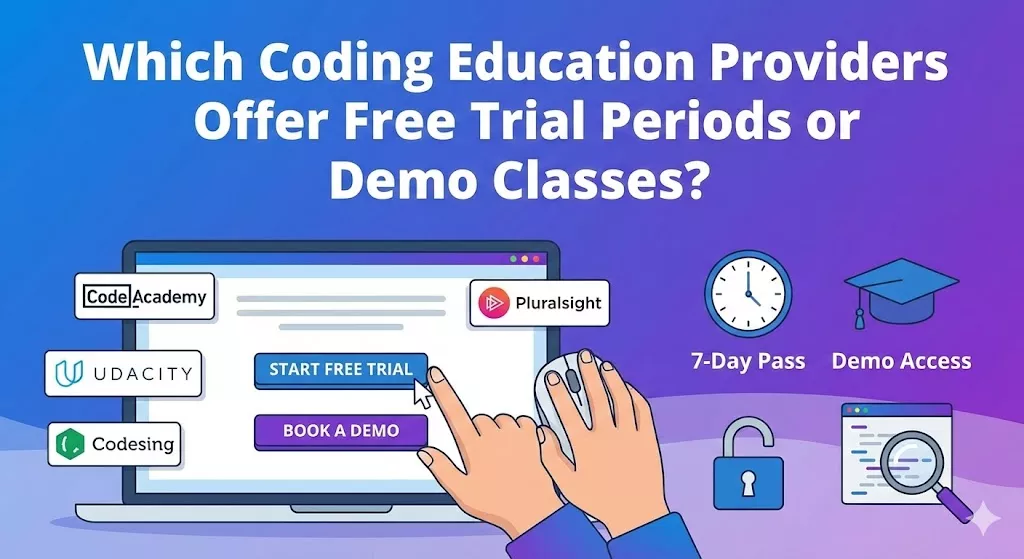
I’m going to save you hours of research right now: most coding platforms offer some kind of free access, but what they call “free trials” or “demos” varies wildly and is often deliberately misleading.
After years analyzing coding education platforms, I’ve seen every trick in the book. Some platforms give you genuinely useful free access that lets you evaluate if their teaching works for you. Others give you just enough to collect your email address before hitting you with aggressive upsell tactics.
Let me break down exactly what each major platform offers for free, what you actually get versus what the marketing promises, and how to evaluate whether a platform is worth paying for without wasting time on fake “trials” that are just sales funnels.
What “Free Trial” Actually Means (And What It Should Mean)
Before we dive into specific platforms, let’s clarify what different types of free access actually mean:
True free trial: Full access to the paid platform for a limited time (7-30 days typically). You can evaluate everything before deciding to subscribe. Credit card usually required, automatically converts to paid unless you cancel.
Freemium model: Permanent free tier with limited content. Some lessons or features free forever, full access requires subscription. No credit card needed. No time pressure.
Free demo/sample lessons: A few handpicked lessons available for free. Enough to see teaching style but not enough to make real progress. Usually no credit card required.
Free audit: Access to course content (videos, readings) but no graded assignments, certificates, or projects. Common on university platforms like Coursera and edX.
Fake “free trial”: Requires credit card immediately, charges you instantly, or gives you such limited access it’s worthless. Just a psychological trick to get you committed.
Understanding these distinctions helps you avoid wasting time on platforms that aren’t serious about letting you evaluate their offering.
The Platforms With Genuinely Useful Free Access
freeCodeCamp: Completely Free Forever
freeCodeCamp doesn’t offer a free trial. It offers everything for free, permanently.
What you get:
Entire curriculum. All certifications. All projects. All learning materials. Forever. No payment ever required.
The catch:
There is no catch in terms of cost. The tradeoff is that you’re entirely self-directed. No AI tutor. No personalized help. You’re working through materials independently with community support via forums.
How to try it:
Visit freecodecamp.org, create account, start learning. That’s it.
Why this works:
You can evaluate whether self-directed, project-based learning works for you without spending anything. The certification projects (tribute pages, technical documentation, portfolio sites) give you real portfolio pieces while learning.
Best for:
Self-motivated learners who want to test whether coding interests them before investing money. People who learn well from written tutorials and don’t need constant feedback. Anyone wanting to build a portfolio while learning for free.
Codecademy: True Freemium Model
Codecademy has a permanent free tier that gives you access to basic courses.
What’s free forever:
Introductory courses in most popular languages (Python, JavaScript, HTML/CSS, SQL, etc.). Basic interactive lessons. The code editor experience. This is substantial enough to learn fundamental programming concepts.
What requires Pro ($240-360/year):
Full course access, projects, quizzes, certificates, career paths. The free tier gets you started but not through complete learning paths.
The trial for Pro:
Codecademy offers a 7-day free trial of Pro. Full access to everything. Credit card required. Converts to paid unless canceled.
How to evaluate:
Start with the free tier. If you like the teaching style and want more, try the 7-day Pro trial. This two-stage approach lets you test without committing payment info immediately.
Why Codecademy’s free tier works well:
The interactive lessons genuinely teach programming basics. You’re writing code from day one, getting instant feedback, and building muscle memory. The interface is clean and removes friction from learning.
Best for:
Absolute beginners who want to see if interactive coding lessons click for them. The free tier is substantial enough to complete basic courses in multiple languages before deciding to pay.
Coursera: Free Audit Option
Coursera offers free auditing on most courses, which is one of the most generous trial models available.
How audit works:
Access all course videos and readings for free. No graded assignments. No certificate. No deadlines. You can audit indefinitely.
What costs money:
Graded assignments, certificates, projects. Full course with assessment costs $40-80. Specializations and Professional Certificates cost $200-500.
The trial option:
Coursera offers 7-day free trials on paid courses and specializations. Credit card required. Full access during trial including graded work.
The smart approach:
Audit a course first. Watch all the lectures. If you like it and want the certificate or graded work, then start a paid trial or subscription. This way you evaluate before committing payment info.
Why this is excellent:
You get university-level content from institutions like Stanford, Michigan, and Google for free. The courses are often taught by actual professors. The quality is genuinely high, especially for computer science fundamentals.
Best for:
People who want university-level content and don’t mind video-based learning. Anyone who learns well from lectures and wants to thoroughly evaluate before paying for certification.
edX: Similar Audit Model
edX works almost identically to Coursera and was founded by Harvard and MIT.
What’s free:
Audit access to course videos and content from universities worldwide. Many courses from MIT, Harvard, Berkeley available completely free.
What costs money:
Verified certificates ($50-300 depending on course). Professional certificates ($200-1000). MicroMasters programs (university credit pathways).
Trial approach:
Start with free audit. Upgrade if you want certification and graded work. Some courses offer financial aid for certificates.
The value proposition:
Some of the best computer science courses available online are on edX. MIT’s “Introduction to Computer Science and Programming Using Python” is entirely free to audit and is excellent quality.
Best for:
People exploring university-created content before committing to paid certificates. Self-directed learners who don’t need interactive exercises.
Pluralsight: 10-Day Free Trial
Pluralsight offers a 10-day free trial with full access to their entire library.
What you get:
Complete access to 7,000+ courses. All features. Skill assessments. Learning paths. The whole platform unlocked.
The requirement:
Credit card required. Trial converts to paid ($300-450/year) unless canceled.
The reality:
10 days isn’t long enough to thoroughly evaluate a platform you’d use for months. But it’s enough to see if the video-heavy teaching style works for you and whether the content quality justifies the price.
How to maximize the trial:
Pick a learning path related to your goals. Complete several courses in that path. Test the skill assessments. See if you’re actually retaining information or just passively watching.
Best for:
Working developers who want to evaluate whether Pluralsight’s extensive library justifies the cost. People who can dedicate time to binge-test the platform over 10 days. Set a calendar reminder to cancel if it doesn’t click.
DataCamp: Limited Free Tier Plus Trial
DataCamp offers both a limited free tier and paid trials.
Free tier:
First chapter of most courses. Interactive exercises for data science topics. Code editor with R, Python, and SQL. Enough to evaluate the teaching style and interactivity.
Paid trial:
Varies (sometimes 7 days, sometimes longer promotional trials). Full access when trialing.
The value:
DataCamp excels at interactive data science education. If your goal is data analysis, machine learning, or data engineering, the interactive format is excellent.
The catch:
Expensive at $300+/year. Make sure the data science focus matches your goals before subscribing. If you want general web development, other platforms serve you better.
Best for:
People specifically interested in data science who want to test whether interactive exercises work better than video lectures for learning Python, R, and SQL.
Platforms With Freemium Interactive Models
Several platforms offer substantial free tiers for interactive learning:
AlgoCademy: Free tier with introductory lessons using step-by-step interactive exercises. No credit card required. Subscription unlocks full curriculum.
SoloLearn: Generous free mobile app with most course content available. Interactive lessons. Community features. Premium tier removes ads.
Exercism: Completely free coding exercises with volunteer mentor code review. Not comprehensive courses, but excellent practice with real feedback.
These freemium models let you genuinely test the platform before deciding to pay for advanced content.
The Platforms With Misleading “Free” Offers
Let me call out platforms whose free offerings are basically useless:
Lambda School / Bloomtech: Not Actually Free
Despite past marketing about “free until you get a job,” Bloomtech now has upfront costs and ISA complications. There’s no meaningful free trial.
The reality:
You’re committing to an intensive program with significant financial obligations. No casual trial period exists.
Skip if:
You want to test whether coding interests you. This is a full commitment, not a trial.
App Academy: Income Share After Completion
App Academy offers deferred tuition models but not free trials.
The model:
Pay nothing upfront. Pay $31,000 (or percentage of income) after getting a job. No trial period to test the curriculum.
The reality:
This is a financial commitment, not a try-before-you-buy situation. You’re accepted into a cohort and committed to the full program.
Platforms With Fake Trials
Some platforms offer “trials” that are just aggressive sales tactics:
Red flags:
- Require credit card immediately and charge you before trial ends
- “Free trial” is actually just 3 sample lessons
- Constant upsell popups during “trial”
- Trial only unlocks ability to buy courses, not actual content access
- Automatically enroll you in yearly subscription at trial end
How to spot these:
Read reviews. Check Reddit for complaints. If the free offering feels more like a sales funnel than genuine evaluation opportunity, it probably is.
How to Actually Evaluate a Platform During Free Trial
Don’t waste your trial period. Here’s how to evaluate effectively:
Day 1: Test the Teaching Style
For interactive platforms:
Jump into actual lessons immediately. Write code. Get feedback. Does the interactive format work for you? Do you understand the explanations? Are the exercises too easy, too hard, or appropriately challenging?
For video platforms (Pluralsight, Coursera, edX):
Watch several full lessons, not just intros. Can you stay focused through 10-15 minute videos? Do you understand the explanations? Are you absorbing information or just passively watching?
The teaching style matters more than the content coverage. A platform with great content but a teaching style that doesn’t click with you won’t help you learn.
Day 2-3: Assess the Difficulty Progression
Work through several consecutive lessons in one topic. Does the difficulty ramp feel appropriate? Are you challenged but not overwhelmed? Or are you either bored by simplicity or drowning in complexity?
Good platforms introduce new concepts gradually. Each lesson builds on previous ones. Bad platforms have random difficulty spikes that leave you confused.
Day 4-5: Test Getting Stuck
Deliberately try lessons above your current level. What happens when you don’t understand something?
Good platforms:
Provide contextual help (hints, alternative explanations, community support). Give you paths forward without just showing the answer. Have documentation that actually helps.
Bad platforms:
Leave you hanging. Forum-only help that takes days. Or worse, immediately show the solution without helping you understand why it works.
This reveals whether the platform supports independent learning or just guides you through predetermined paths.
Day 6-7: Evaluate Long-Term Viability
Ask yourself:
- Can I see myself using this for 3-6 months?
- Does the content depth match my goals?
- Is the pricing sustainable for how long I need to learn?
- Are there enough advanced topics to grow into?
- Do I actually retain what I’m learning, or just complete lessons?
For expensive platforms ($300-500/year):
Make very sure the content justifies the cost. Can you afford 6-12 months of subscription? Will the content remain relevant that long? Are there cheaper alternatives that serve you equally well?
The Questions You Must Answer Before Paying
Before your trial ends or before subscribing to a platform, answer these honestly:
Does the teaching style actually work for me?
Not “is this teaching style good?” but “does it work for how I personally learn?” Video lectures work for some people, interactive exercises for others, project-based for others. Know yourself.
Am I making actual progress or just consuming content?
This is crucial. Some platforms make you feel productive (watching videos, completing simple exercises) without building real skills. Can you write code independently after the trial, or only complete guided exercises?
Is the help system adequate when I get stuck?
Getting stuck is inevitable. Platforms with good support systems are worth way more than those where you’re on your own. Check whether help is available (forums, documentation, tutoring) and whether it’s actually useful.
Does the platform teach what I actually need?
Platforms focused on fundamentals serve different goals than platforms teaching specific frameworks. Platforms for data science differ from web development platforms. Match the platform to your actual goals, not what sounds impressive.
Can I afford this sustainably?
A $20/month platform you can afford for a year beats a $500/year platform you cancel after two months because it’s too expensive. Learning to code takes months, not weeks. Choose pricing you can sustain.
My Recommendations by Learning Style and Budget
If you want to test whether coding interests you at all:
Start with: freeCodeCamp (completely free)
Why: Zero financial commitment. Comprehensive enough to determine if programming clicks with you. The projects give you portfolio pieces if you continue.
Also try: Codecademy’s free tier for interactive lessons, or audit a Coursera course for university-quality instruction.
If you learn best with interactive exercises and immediate feedback:
Try: Codecademy’s free tier first, then their 7-day Pro trial
Why: The interactive format is polished and effective. The free tier gives you genuine evaluation time. The Pro trial shows you whether the full curriculum justifies the cost.
Also consider: DataCamp’s free tier if you’re specifically interested in data science.
If you prefer video lectures:
Try: Coursera or edX on audit (free)
Why: University-quality content from actual professors. Audit lets you evaluate thoroughly before paying. Some of the best computer science courses available online.
Also try: Pluralsight’s 10-day trial if you want professionally produced content for working developers and can evaluate quickly.
If you’re specifically interested in data science:
Try: DataCamp’s free tier
Why: Specialized data science content with interactive exercises. The free first chapters let you test multiple courses. If the style works, the paid version is comprehensive.
Also consider: Coursera’s data science specializations (audit free, pay for certificate).
If you’re on a very tight budget:
Use: freeCodeCamp + Codecademy free tier + Coursera auditing + Exercism
Why: This combination gives you project-based learning, interactive exercises, university content, and code review all for free. You can learn to code without spending anything.
Upgrade when: You can afford paid platforms that accelerate learning, but only after confirming free resources work for you.
If you have budget and want comprehensive support:
Try: Coursera Professional Certificates or university specializations
Why: Structured learning paths with graded assignments. University backing adds credibility. Can audit before paying to evaluate thoroughly.
Alternative: If you need human mentorship and can afford $10k+, consider bootcamps, but understand these don’t offer meaningful trial periods.
The Smart Trial Strategy
Here’s how to maximize trial periods without wasting time:
Week 1: Free Tiers Only
- Try freeCodeCamp
- Use Codecademy free tier
- Audit a Coursera course
- Test DataCamp free tier (if interested in data science)
This gives you multiple teaching styles to compare without entering payment info anywhere.
Week 2: Deep Dive on Top Choice
Based on week 1, identify which teaching style works best for you. If it’s interactive learning, dive deeper into free interactive platforms. If it’s video-based, audit more university courses.
Week 3: Trial Paid Features (If Needed)
If you’re convinced a paid platform is right, start the trial:
- For Codecademy: Start 7-day Pro trial
- For Pluralsight: Start 10-day trial
- For Coursera: Try a paid specialization trial
Decision Point:
By end of week 3, you have enough experience to make an informed decision. Subscribe to what works, cancel what doesn’t. You’ve tested teaching styles thoroughly without gambling money on unknown platforms.
The Platforms Worth Trying, Ranked by Trial Quality
Based on how well the trial/free tier lets you evaluate the platform:
Tier 1 – Excellent Free Access:
- freeCodeCamp – Everything free forever
- Coursera/edX – Full courses free to audit
- Codecademy – Substantial free tier plus 7-day Pro trial
- Exercism – Free code review from mentors
Tier 2 – Good Trial Options: 5. DataCamp – First chapter free, trials available 6. Pluralsight – 10-day full access trial 7. SoloLearn – Generous free mobile app
Tier 3 – Limited But Usable: 8. Udemy – Preview videos (not trials, but helps evaluate courses) 9. Various freemium platforms – Limited free tiers
Avoid:
- Platforms with fake trials (3 lessons called a “trial”)
- Bootcamps claiming “free” but requiring $10k+ commitments
- Platforms that charge your card during the “trial” period
The Bottom Line on Free Trials
The best approach to finding the right coding platform:
1. Start completely free
Use freeCodeCamp, Codecademy’s free tier, and Coursera auditing to test different teaching styles. This costs nothing and gives you genuine evaluation across interactive, project-based, and video formats.
2. Identify what works for you
After trying free options, you’ll know whether you prefer:
- Interactive exercises (Codecademy, DataCamp)
- Video lectures (Coursera, edX, Pluralsight)
- Project-based learning (freeCodeCamp)
- Text-based tutorials
3. Trial paid versions strategically
Only start paid trials after you know which teaching style works. Don’t waste trials testing whether you like video vs. interactive. Use trials to evaluate whether the paid version justifies the cost.
4. Commit to one platform
Once you find what works, commit for at least 3-6 months. Platform-hopping wastes time. Depth beats breadth when learning to code.
Avoid common mistakes:
- Starting multiple paid trials simultaneously (you can’t evaluate them all properly)
- Choosing platforms based on marketing instead of whether the free tier worked
- Signing up for expensive platforms ($400+/year) without thorough free evaluation
- Falling for “free trial” scams that are just 2-3 lessons
My honest recommendation:
Start with the completely free options (freeCodeCamp, Codecademy free tier, Coursera audit). Spend 2-3 weeks genuinely trying them. This costs nothing and gives you informed opinions about what teaching style works for you.
Then, based on what clicked:
- If interactive exercises worked best: Try Codecademy Pro trial or DataCamp
- If video lectures worked best: Subscribe to Coursera Plus or continue auditing free
- If project-based worked best: Continue with freeCodeCamp (it’s free!) or supplement with paid options
The generous free access available today means you never need to gamble on expensive platforms without testing them first. The platforms confident in their teaching offer substantial free tiers. The ones with misleading “trials” are trying to trap you into paying before you realize the content doesn’t deliver.
Choose platforms that respect your time and money by offering real evaluation opportunities. Start free, upgrade when convinced, and never feel pressured by artificial time limits or aggressive sales tactics.
The right platform is the one whose teaching style works for how you learn, whose content matches your goals, and whose pricing you can sustain for the 6-12 months you’ll need to build real coding skills. Free trials and free tiers exist to help you make that decision informed, not rushed.