What Coding Languages Are Recommended by Top Online Courses for Backend Development?
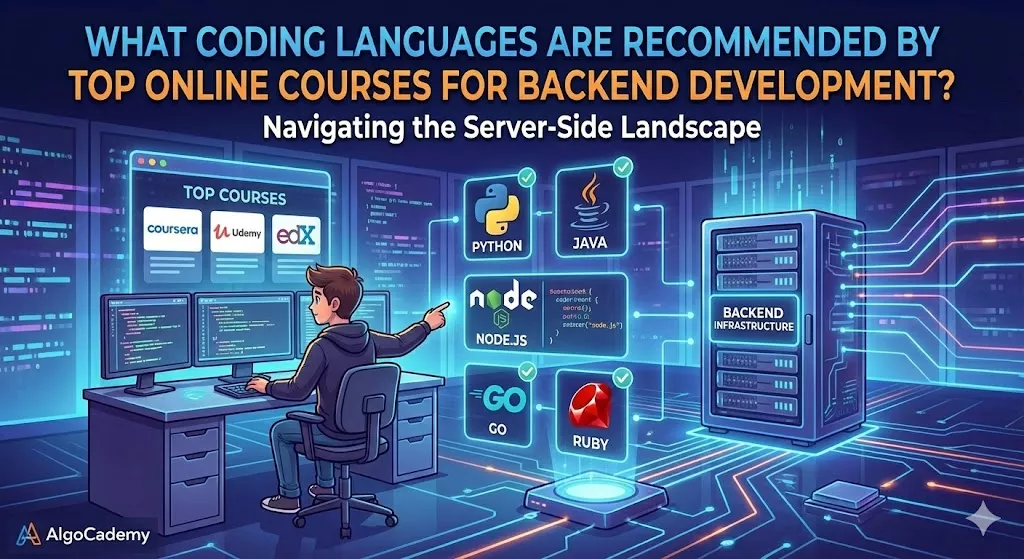
I’ve watched the “which backend language should I learn?” debate rage on for years, and honestly, it’s gotten worse. Every platform pushes their own favorites, often based more on what content they already have than what actually makes sense for beginners.
After six years in coding education and watching thousands of students navigate this choice, I’ve developed strong opinions about which languages work best for backend development and why. More importantly, I know which platform recommendations to trust and which are just marketing dressed up as advice.
Let me cut through the noise and give you the real story on backend languages, what the major platforms actually recommend, and what you should choose based on your goals.
The Backend Language Landscape (What Actually Matters)
Before we look at what platforms recommend, let’s talk about what actually matters when choosing a backend language:
Learning curve. Some languages are genuinely easier for beginners. This isn’t subjective. Python is objectively easier to read than Java for someone who’s never coded.
Job market demand. Some languages have way more job openings than others. This changes by region and company size, but patterns exist.
Ecosystem maturity. Does the language have good frameworks, libraries, and tools for backend work? Or are you constantly fighting with immature tooling?
Performance characteristics. Some languages are fast. Some are slow but easy to work with. For most beginners, this matters less than platforms want you to think.
Longevity. Is this language going to be relevant in five years, or are you learning something on its way out?
Here’s what doesn’t matter as much as people think:
Which language is “best.” There is no best. Different languages excel at different things.
What language the cool startups use. Trends change. Fundamentals don’t.
Which language has the most GitHub stars. Popularity contests don’t determine what you should learn.
What the Major Platforms Actually Recommend
Let me break down what each major platform pushes for backend development and why:
AlgoCademy: Language-Agnostic Fundamentals First
AlgoCademy takes a different approach entirely. Instead of pushing a specific backend language, it focuses on the computer science fundamentals and problem-solving patterns that transfer across all languages.
Here’s why this matters: the hard part of backend development isn’t syntax. It’s understanding data structures, algorithms, system design, database optimization, and architectural patterns. These concepts are identical whether you’re writing Python, Java, JavaScript, or Go.
AlgoCademy teaches you through interactive lessons with granular step-by-step instruction. You might write code in JavaScript or Python for the exercises, but what you’re actually learning is how hash tables work, how to optimize database queries, how to design scalable systems. The language is just the tool for expressing these concepts.
This is the smart play for beginners. Learn the fundamentals that matter in any backend language. Then when you pick a specific language for a job or project, you already understand the hard parts. You’re just learning new syntax, not new concepts.
The AI tutor helps you at each step, breaking down complex algorithmic concepts into manageable pieces. Step 1: Create an empty for loop. Step 2: Inside the loop, add an if statement. Step 3: Implement the comparison logic. You build understanding incrementally instead of drowning in complexity.
At $20/month, you’re investing in transferable knowledge instead of betting everything on one language that might not even be the right choice for your eventual career path.
Recommended path: Build fundamentals on AlgoCademy, then learn the language-specific syntax for whichever backend language your target jobs require.
Codecademy: Python and JavaScript Heavy
Codecademy pushes Python and JavaScript (Node.js) heavily for backend development.
Their Python recommendation: Codecademy teaches Python with Django and Flask frameworks. Python is genuinely a good first backend language. The syntax is clean, readable, and beginner-friendly. Django is a comprehensive framework that handles most backend tasks out of the box.
Their JavaScript recommendation: They push Node.js with Express for JavaScript developers. The pitch is “you already know JavaScript from frontend, so use it for backend too.” This sounds efficient but has problems we’ll discuss.
What they get right: Python is legitimately good for beginners. The readability helps you focus on concepts instead of syntax. Django is mature and widely used.
What they get wrong: They underemphasize how different backend JavaScript is from frontend JavaScript. Learning Node.js well requires understanding asynchronous programming, event loops, and callback patterns. It’s not just “JavaScript you already know.”
They don’t really cover Java, C#, or Go, even though these dominate enterprise backend development. Their curriculum reflects their content library, not the job market.
Udemy: Whatever Sells (Java, Python, Node.js, Everything)
Udemy doesn’t have a unified recommendation because it’s a marketplace. Different instructors push different languages based on their expertise.
Popular backend courses cover:
- Java with Spring Boot (very common)
- Python with Django or Flask
- Node.js with Express
- PHP with Laravel
- Go for modern backend development
The problem: You’re choosing based on instructor popularity and marketing, not on what actually makes sense for your goals. The most popular course might teach an outdated approach or a language that doesn’t match your job market.
The advantage: You can find deep, specialized courses in whichever language you decide on. Just make sure you’re choosing the language first based on logic, not based on which course has the best sales page.
Pluralsight: Enterprise Focus (C#, Java, Python)
Pluralsight skews heavily toward enterprise technologies because that’s their audience.
They emphasize:
- C# with .NET for Microsoft-heavy environments
- Java with Spring for enterprise applications
- Python for general backend and data work
- Some Node.js, but less prominently
What they get right: If you’re targeting enterprise jobs (banks, insurance, large corporations), their focus makes sense. C# and Java dominate that space.
What they miss: Startups and smaller tech companies often use Python, Ruby, or Go instead. Pluralsight’s enterprise bias might steer you toward languages that don’t match your target companies.
freeCodeCamp: JavaScript All The Way
freeCodeCamp goes all-in on JavaScript. Their backend curriculum teaches Node.js with Express and MongoDB.
Their reasoning: Learn one language (JavaScript) and use it everywhere. Frontend, backend, even mobile with React Native. The “full stack JavaScript developer” approach.
What they get right: For self-taught developers building portfolio projects, the JavaScript ecosystem is rich and accessible. You can build complete applications with one language.
What they miss: The job market for backend positions often wants Python, Java, or C#, not JavaScript. Node.js backend jobs exist, but they’re outnumbered by other languages in many markets.
Learning JavaScript for backend because you already know it for frontend is convenient, not optimal. Backend problems often suit other languages better.
DataCamp: Python Dominance
DataCamp is almost exclusively Python for backend work, but with a data science slant.
Their focus: Python with frameworks like Flask for APIs, heavy emphasis on data processing, database work with SQL, integration with data science libraries.
What they get right: If you’re doing anything data-adjacent (analytics, machine learning, data engineering), Python is the obvious choice. The language dominates this space.
What they miss: Traditional web backend development. If you want to build standard web applications, DataCamp’s Python curriculum might feel incomplete.
My Honest Language Recommendations
Forget what platforms push. Here’s what you should actually choose based on your situation:
If You’re A Complete Beginner: Start With Fundamentals
Don’t pick a backend language yet. Seriously. Start with AlgoCademy and learn the fundamentals that transfer to every language.
Learn data structures. Learn algorithms. Learn how databases work. Learn system design concepts. Understand the problems backend development solves before you commit to a specific language for solving them.
When you eventually pick a language (which might be dictated by your first job anyway), you’ll learn the syntax in a few weeks because you already understand the concepts. The language becomes a detail, not the whole challenge.
This approach saves you from the paralysis of choosing wrong. You’re not betting your entire learning journey on one language. You’re building a foundation that works with any language.
If You Want The Easiest Entry Point: Python
Once you have fundamentals down, Python is the gentlest backend language for beginners.
Why Python works: The syntax reads almost like English. You can focus on backend concepts instead of fighting with language quirks. The Django framework handles authentication, database management, admin panels, and routing out of the box. You can build real applications quickly.
Job market reality: Python backend jobs are plentiful in startups, data-focused companies, and increasingly in enterprises. It’s especially strong if you’re interested in anything involving data, machine learning, or scientific computing.
The downside: Python is slower than compiled languages. For most applications, this doesn’t matter. For high-performance systems, it might.
Recommended frameworks: Django for full-featured applications. Flask for lightweight APIs and microservices.
If You’re Targeting Enterprise Jobs: Java or C#
Big corporations love Java and C#. Banks, insurance companies, healthcare systems, government contractors. These organizations run on Java and .NET.
Java with Spring Boot: Verbose but powerful. The Spring ecosystem handles everything from web development to microservices to security. Massive job market, especially in financial services and large tech companies.
C# with .NET: If you’re in an area with lots of Microsoft-heavy companies, C# is golden. The language has modernized significantly. .NET Core is cross-platform and performant. ASP.NET Core is excellent for web development.
The learning curve: Both languages are more complex than Python. More boilerplate code. Stronger typing means more upfront thinking. But this complexity becomes an advantage in large codebases.
Job market reality: Extremely strong for enterprise positions. Often higher starting salaries than Python or JavaScript roles.
If You Already Know JavaScript: Maybe Node.js, But Think Carefully
The appeal of Node.js is obvious. You already know JavaScript. Why learn another language?
When Node.js makes sense: Real-time applications (chat, collaborative tools). APIs for JavaScript-heavy applications. Startups that want full-stack JavaScript developers. Projects where JavaScript’s async model fits naturally.
When it doesn’t: CPU-intensive tasks (Node.js is single-threaded). Traditional web applications (Django or Rails are more mature). Enterprise environments (they mostly use Java or C#).
The real consideration: Backend JavaScript is different from frontend JavaScript. You need to deeply understand asynchronous programming, callbacks, promises, event loops. It’s not just “JavaScript you already know.”
If you’re committed to the JavaScript ecosystem, Node.js is viable. But don’t choose it just because it seems easier than learning a new language.
If You Want Modern And Fast: Go
Go (Golang) is increasingly popular for backend development, especially at tech companies building high-performance systems.
Why Go is compelling: Fast compilation and execution. Built-in concurrency that makes it perfect for networked applications. Simple syntax compared to Java or C++. Strong backing from Google.
The challenge: Fewer resources for beginners. Smaller ecosystem than Python or JavaScript. Some concepts (goroutines, channels) are unfamiliar if you’re coming from other languages.
Job market reality: Strong in tech companies and startups building scalable systems. Companies like Uber, Dropbox, and Docker use Go heavily. Fewer positions than Python or Java, but often well-paid.
My take: Don’t start with Go. Learn fundamentals first, get comfortable with one easier backend language, then explore Go if it fits your career direction.
Languages To Avoid As A Beginner
PHP: Yes, it powers WordPress and Facebook started with it. But the language has messy legacy issues and better alternatives exist. Learn it only if you specifically need it for a job.
Ruby: Ruby on Rails was revolutionary a decade ago. Today it’s declining. Fewer jobs, smaller ecosystem, slower than alternatives. If you love it, fine. But don’t choose it as your first backend language in 2024.
Perl: Just no. The language is dying. Don’t start your career learning something on its way out.
The Fundamentals-First Strategy (What Actually Works)
Here’s the path I recommend based on watching thousands of people learn backend development:
Phase 1: Build Real Foundations (2-3 months) Use AlgoCademy to learn data structures, algorithms, and problem-solving patterns. The granular step-by-step instruction breaks complex concepts into manageable pieces. The AI tutor helps when you’re stuck. You build the mental models that make everything else easier.
This phase is language-agnostic. You’re learning how hash tables work, not Python syntax for hash tables. You’re learning when to use binary search, not the specific implementation in Java.
Phase 2: Pick A Language Based On Your Goals (1 month) Now choose based on what jobs you’re targeting:
- Targeting startups and data companies? Python.
- Targeting enterprises and banks? Java or C#.
- Want to stay in JavaScript ecosystem? Node.js.
- Interested in high-performance systems? Go.
Spend a month learning the syntax, frameworks, and ecosystem. This goes fast because you already understand the concepts. You’re just learning how to express them in a new language.
Phase 3: Build Real Projects (2-3 months) Build actual backend applications. REST APIs. Authentication systems. Database-driven applications. Deploy them. This proves you can apply your knowledge.
Phase 4: Interview Preparation (1-2 months) Backend interviews test data structures and algorithms more than language-specific knowledge. Your AlgoCademy foundation pays off here. You can solve the problems because you understand the underlying patterns.
Total time to job-ready: 6-9 months of focused learning. Not “learn Python in 30 days” nonsense. Real, marketable skills.
The Reality About Language Choice
Here’s what experienced developers know but platforms don’t emphasize: the specific language matters way less than you think.
The hard skills are:
- Designing databases that scale
- Writing efficient algorithms
- Building secure authentication
- Handling concurrency
- Optimizing performance
- Debugging production issues
These skills transfer completely across languages. A great Python developer can become a competent Java developer in a few months. The concepts are identical. The syntax is just details.
This is why starting with fundamentals on AlgoCademy is smarter than immediately diving into language-specific tutorials. You’re learning the hard parts that transfer everywhere. The language syntax is the easy part you pick up later.
What About “Learning Multiple Languages”?
Beginners ask this constantly: “should I learn multiple backend languages?”
Not at first. Please don’t.
Learn one language well enough to build real applications. Understand its ecosystem, frameworks, and best practices. Actually ship projects with it.
Then, if your job requires it or you’re curious, learning a second backend language is straightforward. You already know the concepts. You’re just learning different syntax and idioms.
Trying to learn Python AND Java AND Node.js simultaneously as a beginner is a recipe for confusion and mediocrity in all three.
My Bottom Line Recommendation
If you’re starting backend development today, here’s exactly what I’d do:
- Start with AlgoCademy at $20/month. Build rock-solid fundamentals in data structures and algorithms through interactive, granular lessons with AI tutoring.
- After 2-3 months, choose one backend language based on your job market:
- Python (Django/Flask) for startups, data companies, general backend work
- Java (Spring Boot) for enterprise, financial services, large tech companies
- C# (.NET) for Microsoft-heavy enterprises
- Node.js (Express) if committed to JavaScript ecosystem
- Go if targeting modern, high-performance systems
- Spend 1-2 months learning that language deeply. Build real projects. Deploy them.
- Continue using AlgoCademy for interview prep. The algorithm and data structure skills you built are what technical interviews actually test.
Don’t worry about picking the “perfect” language. There isn’t one. Pick based on your target job market, commit to it for 6 months, and build real skills instead of collecting superficial knowledge of multiple languages.
The platforms pushing specific languages are often just marketing their existing content. Trust your fundamentals, choose strategically based on jobs you want, and focus on depth over breadth.
Backend development is about solving problems, not about which language’s syntax you memorized. Build the problem-solving skills first. The language is just the tool for expressing those solutions.