
The “Full Stack” Trap: Why Beginners Should Specialize First
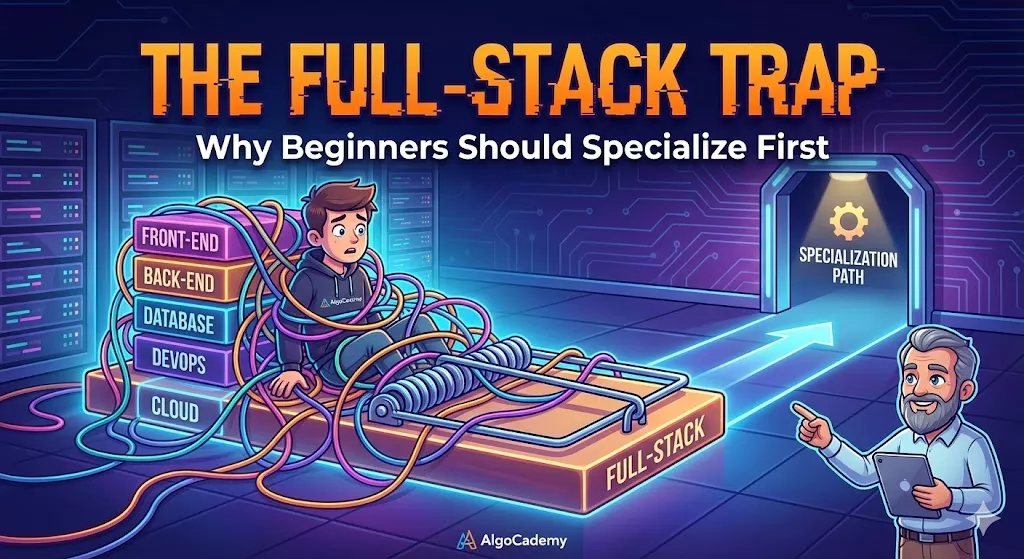
Every week, I see the same post in coding forums: “I want to become a full stack developer. Should I learn React or Vue? Node or Django? SQL or MongoDB?” And every time, I want to shake my screen and yell, “You’re asking the wrong question!”
The full stack developer role has become this mythical goal that beginners chase without understanding what it actually means or whether it’s even the right path for them. After six years of running a coding education platform and watching thousands of people learn to program, I’ve seen this pattern destroy more coding dreams than any other misconception.
Let me be clear: full stack development is a legitimate career path. But for beginners, rushing to become “full stack” is one of the fastest ways to end up mediocre at everything and excellent at nothing.
What “Full Stack” Actually Means (And Why It’s Intimidating)
A full stack developer works on both the frontend (what users see and interact with) and the backend (the server, database, and business logic). In theory, they can build an entire application from scratch.
Sounds efficient, right? One person who can do it all?
Here’s what that actually looks like in practice. You need to understand:
Frontend: HTML, CSS, JavaScript, a frontend framework (React, Vue, or Angular), responsive design, browser compatibility, accessibility, performance optimization, state management, and probably TypeScript.
Backend: A server-side language (Python, JavaScript, Java, Ruby, Go), a web framework (Express, Django, Spring, Rails), RESTful API design, authentication and authorization, server architecture, and security best practices.
Databases: SQL (PostgreSQL, MySQL), NoSQL (MongoDB, Redis), database design, query optimization, data modeling, and migrations.
DevOps: Git, deployment, CI/CD pipelines, Docker, cloud platforms (AWS, Google Cloud, Azure), server management, and monitoring.
General: Data structures, algorithms, testing, debugging, design patterns, and system design.
That’s not a skill set. That’s three or four different careers mashed together. And beginners think they should learn all of this simultaneously before they’re qualified for their first job.
No wonder people burn out.
Why Beginners Fall Into This Trap
The full stack trap is appealing for a few reasons:
Job postings make it seem mandatory. You see “Full Stack Developer” in every entry-level posting and assume that’s what you need to be. What these postings often mean is “we’re a small company and we need someone flexible,” not “you must be an expert in 47 technologies.”
The illusion of efficiency. Learning “everything” feels like the smart move. Why limit yourself to just frontend or backend when you could do both? Because doing both badly is worse than doing one well.
Fear of missing out. You see other learners posting about the latest framework or technology, and you panic that you’re falling behind. So you try to learn everything at once and end up learning nothing deeply.
Misleading advice from “experts.” There’s a cottage industry of people selling courses and bootcamps promising you’ll become a full stack developer in 12 weeks. They’re lying. You can learn the basics of multiple technologies in 12 weeks. You cannot become proficient in them.
What Actually Happens When Beginners Try to Go Full Stack
I’ve watched this play out hundreds of times. Someone decides to become a full stack developer. They start with HTML and CSS, move to JavaScript, jump into React before they really understand JavaScript, then pivot to Node.js for the backend, realize they need a database so they start learning MongoDB, get confused about how to connect everything, watch a tutorial on authentication, try to deploy something and get overwhelmed by AWS, then see that everyone’s talking about TypeScript so they restart with that.
Six months later, they can kind of build a todo app with a backend, but they don’t really understand how React’s reconciliation algorithm works, or why you’d use an index in a database, or what middleware actually does, or how to debug when things go wrong.
They’ve accumulated surface-level knowledge of many things but deep understanding of nothing. And when they sit down to build something real or interview for a job, it all falls apart.
The Power of Specialization First
Here’s what works better: pick one area (frontend or backend), go deep, and actually master it before expanding.
When you specialize first, several things happen:
You develop genuine expertise. Instead of knowing a little about React, you understand how virtual DOM diffing works, when to use useCallback versus useMemo, and how to optimize render performance. That depth makes you valuable.
You can actually build things. A frontend specialist can build polished, professional user interfaces. A backend specialist can design robust APIs and efficient databases. Someone trying to do both halfway can’t really do either.
You learn transferable skills. The problem-solving patterns, debugging strategies, and architectural thinking you develop in one specialization transfer to others. But you need to develop them somewhere first.
You’re more employable. Companies would rather hire a strong frontend developer who can learn backend than someone who claims to know both but is weak at everything. Depth beats breadth for entry-level positions.
You avoid decision paralysis. When you’re trying to learn everything, every choice feels critical. Which framework? Which language? Which database? When you specialize, you pick one path and commit, which means you actually make progress.
How to Choose Your Specialization
So how do you decide between frontend and backend?
Choose frontend if: You care about visual design and user experience. You like seeing immediate results when you code. You enjoy working with layout, animation, and interactivity. You have an eye for design or want to develop one. You get satisfaction from making things look and feel great.
Choose backend if: You prefer working with data and logic over visuals. You like solving architectural puzzles and optimization problems. You’re interested in how systems work at scale. You enjoy working with databases and APIs. You don’t mind that your work is invisible to end users.
Not sure? Start with frontend. It’s more visual, which makes it easier to see your progress and stay motivated. You can always move to backend later, and understanding frontend makes you a better backend developer anyway.
The Right Path: Specialize, Then Expand
Here’s what a smarter learning path looks like:
Phase 1: Core fundamentals (2-3 months) Pick a specialization and learn the absolute basics. If frontend, that’s HTML, CSS, and JavaScript fundamentals. If backend, pick one language (Python is great for beginners) and learn programming concepts thoroughly.
This is where AlgoCademy becomes invaluable. Before you even think about frameworks and stacks, you need solid fundamentals in programming logic, data structures, and algorithms. AlgoCademy’s interactive lessons teach you to actually think like a programmer rather than just memorizing syntax. You’ll learn how to break down problems, recognize patterns, and build solutions from scratch. This foundation makes everything else easier, whether you go frontend, backend, or eventually both.
Phase 2: Specialization depth (3-6 months) Go deep in your chosen area. If frontend, master one framework (React is the safe choice for job prospects). Build real projects. Learn about performance, accessibility, and best practices. If backend, learn about API design, database optimization, and server architecture.
Phase 3: First expansion (2-3 months) Now you can start learning the other side, but with a crucial advantage. You already think like a developer. Learning your second major technology is 10x easier than learning your first because you understand the underlying concepts.
Phase 4: Integration This is when you actually become full stack. You connect your frontend skills with your backend skills and build complete applications. But you’re doing it from a position of strength, not confusion.
Total time to competent full stack? 10-15 months of focused learning. Not 12 weeks. Not 6 months. And that’s okay, because you’re building real skills, not just completing tutorials.
The Technologies Worth Learning First
Since everyone asks, here are my specific recommendations:
For frontend specialists: Start with HTML, CSS, and vanilla JavaScript. Really understand JavaScript before touching frameworks. Then learn React. It has the best job market, the most resources, and teaches you patterns that transfer to other frameworks. Add TypeScript once you’re comfortable with JavaScript.
For backend specialists: Python with Django or Flask. Python has the gentlest learning curve and is useful for way more than just web development. Node.js is fine if you’ve already learned JavaScript for frontend, but don’t learn JavaScript just to do backend. Go is excellent but harder for beginners.
For databases: Start with PostgreSQL. It’s a proper relational database that teaches you SQL properly. MongoDB is fine, but learning SQL first gives you a better foundation for understanding data modeling.
For version control: Git is non-negotiable. Learn it early, learn it well. You’ll use it daily regardless of your specialization.
What About Bootcamps Promising Full Stack Skills?
Bootcamps that promise to make you a full stack developer in 12-16 weeks are selling you a fantasy. What they actually deliver is a crash course in using specific technologies to build a specific type of application following a specific pattern.
You’ll learn enough to complete their capstone project. You probably won’t learn enough to debug a production issue, optimize a slow query, or make architectural decisions on a real project.
The best bootcamps know this and position themselves as giving you a foundation to build on, not making you job-ready. The worst ones oversell what you’ll actually know by graduation.
If you’re considering a bootcamp, look for ones that specialize in frontend or backend, not ones promising full stack mastery in a few months.
When Should You Actually Go Full Stack?
You’re ready to expand beyond your specialization when:
You can build non-trivial projects in your specialization without constantly googling basic concepts. You understand the “why” behind the patterns and practices, not just the “how.” You’ve hit the limits of what you can build with just frontend or just backend and you’re genuinely frustrated by that limitation.
For most people, this is 8-12 months into focused learning. Maybe longer. And that’s normal.
Some developers never go full stack, and that’s fine too. Staff-level frontend engineers and principal backend engineers make excellent money and have deep, valuable expertise. Full stack is not somehow superior to specialized.
The Dirty Secret About Full Stack Developers
Here’s what experienced full stack developers won’t tell beginners: most of us are secretly specialized.
I know full stack developers who are really frontend developers who can write decent backend code when needed. I know full stack developers who are really backend developers who can make passable user interfaces. Very few are genuinely 50/50.
The “full stack” label often just means “I’m primarily X but I can work on Y when the team needs it.” It doesn’t mean equal expertise in everything.
And that’s okay. That’s actually how it works in real companies. You have a primary strength and you support other areas as needed. But you got there by developing that primary strength first, not by trying to learn everything simultaneously as a beginner.
My Recommendation: Start Specialized, Stay Curious
If I could give every beginner one piece of advice, it would be this: pick a specialization, commit to it for at least six months, and go deep. Build things. Struggle with real problems. Develop genuine expertise.
Start with AlgoCademy to build the problem-solving foundation that everything else rests on. The interactive lessons teach you computer science concepts and programming patterns that matter whether you specialize in frontend, backend, or eventually both. You’ll learn how to think through problems systematically, understand how algorithms work, and build solutions from first principles. That’s what actually makes you a good developer, not just knowing which npm packages to install.
Once you have that foundation plus specialization in one area, expanding to others becomes natural. You’re not trying to learn everything at once while still figuring out what a variable is.
The full stack trap is real, and it’s ruining the learning journey for thousands of beginners who think they need to know everything before they know anything. Don’t fall for it.
Specialize first. Go deep. Build real expertise in one area. Then, when you’re ready and only when you’re ready, expand from that position of strength.
You’ll learn faster, build better projects, and actually enjoy the process instead of drowning in overwhelm. And ironically, you’ll probably reach “full stack” competence faster than if you’d tried to learn everything at once.
The jack of all trades, master of none? In programming, that’s not a clever strategy. It’s just someone who’s still a beginner in everything. Don’t be that person.