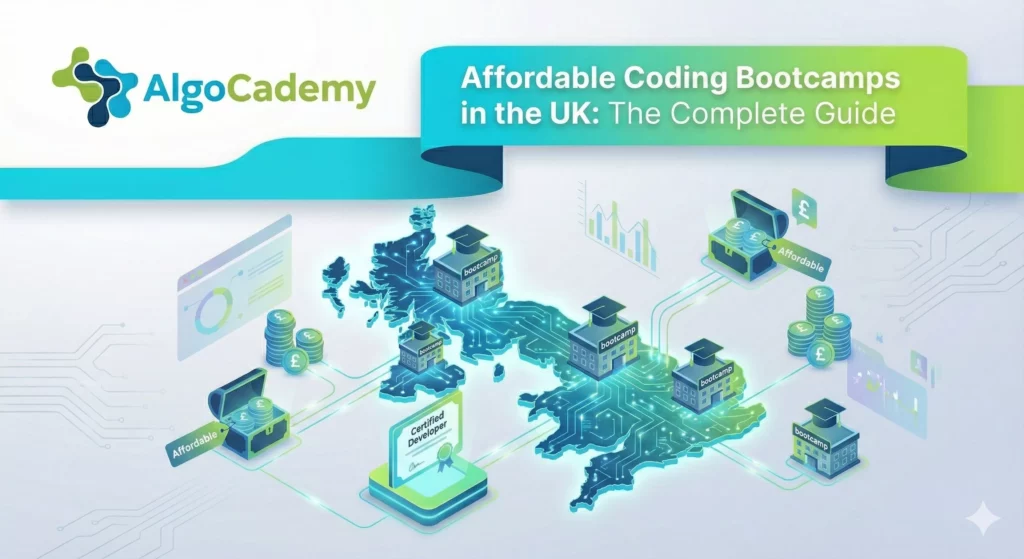
Affordable Coding Bootcamps in the UK: The Complete Guide
The promise is seductive: spend a few months learning to code, then land a job that pays £35,000 to £50,000 or more. Bootcamps advertise career transformation in 12 to 16 weeks. Success stories feature career changers who went from barista to software developer, teacher to tech lead, redundancy to six figures.
Some of these stories are real. Bootcamps have genuinely transformed thousands of careers in the UK. But the industry also has problems: inflated outcome statistics, high-pressure sales tactics, and eye-watering price tags that leave graduates with significant debt before they’ve earned their first developer salary.
The good news is that affordable options exist. Government-funded programmes, income share agreements, scholarships, and lower-cost alternatives can make coding education accessible without financial ruin. The challenge is navigating the landscape to find quality education at a price that makes sense.
This guide covers every affordable bootcamp option in the UK, explains the funding mechanisms that make them accessible, and helps you evaluate whether a bootcamp is right for your situation at all.
The UK Bootcamp Landscape in 2025
The UK coding bootcamp market has matured significantly. Early bootcamps operated with minimal oversight and variable quality. Today, the landscape includes established providers with track records, government-recognised programmes, and multiple funding options.
What UK Bootcamps Typically Offer
Intensive programmes running 12 to 16 weeks full-time, or 6 to 12 months part-time.
Career-focused curricula emphasising employable skills: web development, software engineering, data science, or cloud/DevOps.
Career services including CV support, interview preparation, and employer introductions.
Community and networking with cohort-mates who become your professional network.
Structured accountability that keeps you moving when self-study would stall.
The Cost Problem
Full-price UK bootcamps typically cost £8,000 to £15,000. For many career changers, this represents a significant financial barrier, especially when combined with living expenses during an intensive programme.
This is why understanding funding options matters so much. The sticker price often isn’t what you’ll actually pay.
Government-Funded and Subsidised Options
The UK government recognises the skills gap in technology and funds various programmes to address it. These represent the most affordable paths into coding education.
Skills Bootcamps (Department for Education)
The government’s Skills Bootcamps programme funds short, intensive courses in high-demand areas including software development, data analytics, and cloud computing.
How they work:
Skills Bootcamps are fully funded by the government for eligible participants. You pay nothing (or a small contribution if employed by a large company). Courses run 12 to 16 weeks, typically part-time to accommodate working learners.
Eligibility:
- Aged 19 or over
- Living in England
- Either employed, self-employed, or unemployed and looking for work
- Have the right to work in the UK
What’s covered:
Multiple providers deliver Skills Bootcamps in software development, including some well-known bootcamp brands. Topics include web development, software engineering fundamentals, cloud technologies, and data skills.
How to find them:
Search the Skills Bootcamp course finder for current offerings. Availability varies by region and changes regularly as new cohorts open.
The catch:
Places are limited and competitive. Not all regions have the same offerings. The curriculum is standardised, which may not match your specific goals. But the price (free) is unbeatable.
Apprenticeships
Software development apprenticeships combine employment with structured training. You earn a salary while learning, with dedicated training time built into your work week.
How they work:
You’re employed by a company and spend 80% of your time working, 20% on structured learning. The apprenticeship typically lasts 15 to 24 months, depending on the level. You earn at least the apprentice minimum wage (often more), and training costs are covered by your employer and government funding.
Levels available:
- Level 3: Junior Developer (equivalent to A-levels)
- Level 4: Software Developer (equivalent to foundation degree)
- Level 6: Digital and Technology Solutions Professional (equivalent to bachelor’s degree)
Where to find apprenticeships:
- Find an Apprenticeship (government portal)
- Company careers pages directly
- WhiteHat (now Multiverse)
- Apprenticeship training providers
Providers offering software apprenticeships:
Many bootcamp-style providers also deliver apprenticeship programmes, including Makers Academy, Northcoders, and others.
Pros:
- Earn while you learn
- No tuition debt
- Guaranteed work experience
- Often leads to permanent employment
Cons:
- Competitive to secure
- Lower salary during training
- Less intensive than bootcamps (longer timeline)
- Quality depends heavily on the employer
Institute of Coding Courses
The Institute of Coding is a consortium of universities and employers offering digital skills courses, many at reduced cost or free through various funding routes.
Their offerings include short courses, degree programmes, and professional development. Some courses qualify for government funding or offer bursaries.
University Short Courses
Many UK universities offer coding courses through their continuing education or professional development divisions. These sometimes qualify for:
- Postgraduate loans (for eligible postgraduate certificates)
- Professional and Career Development Loans
- University bursaries and scholarships
Open University offers computing courses that qualify for student finance, allowing you to spread costs and access government-backed loans.
Affordable Private Bootcamps
Beyond government-funded options, several private bootcamps offer lower costs or flexible payment options.
School of Code
School of Code is entirely free for learners. Yes, free. They’re funded by employers who hire graduates, so you pay nothing.
Programme details:
- 16-week intensive bootcamp
- Full-stack web development curriculum
- Fully remote
- Includes career support and employer matching
How it works:
You apply, go through a selection process, and if accepted, attend a full-time bootcamp at no cost. School of Code makes money by partnering with employers who hire graduates. Your success is literally their business model.
Eligibility:
Open to UK residents. The selection process assesses motivation and aptitude rather than prior experience. They actively seek diverse cohorts.
The catch:
Highly competitive. Many applicants for limited places. The full-time commitment isn’t possible for everyone.
Why it works:
The employer-funded model aligns incentives. School of Code only succeeds if you succeed, so they’re motivated to deliver quality education and support.
This is one of the best deals in UK tech education. If you can commit to full-time study, apply.
Northcoders
Northcoders is a well-established bootcamp based in the North of England with a strong reputation and multiple payment options.
Programme details:
- 13-week software development bootcamp
- JavaScript-focused curriculum
- Available in Manchester, Leeds, and remotely
- Strong focus on TDD and best practices
Pricing:
Full price is around £10,000, but multiple options reduce this:
- Skills Bootcamp funding: Some Northcoders courses are delivered as government-funded Skills Bootcamps, making them free for eligible learners.
- Income Share Agreement: Pay nothing upfront, then a percentage of salary once employed (typically 10% for 24 months, capped).
- Payment plans: Spread the cost over time.
- Scholarships: Various scholarships for underrepresented groups.
Reputation:
Northcoders has strong industry connections, particularly in the North of England. Their graduate outcomes are generally well-regarded, and they’ve been operating since 2015.
Makers Academy
Makers Academy is one of the UK’s original and most established bootcamps, known for rigorous training and strong outcomes.
Programme details:
- 16-week software engineering programme
- Focus on TDD, pair programming, and agile practices
- London-based with remote options
- Includes emotional intelligence curriculum alongside technical skills
Pricing:
Full price is approximately £12,000, but options include:
- Apprenticeships: Makers delivers software development apprenticeships where your employer pays.
- Income Share Agreement: Through partner financing, pay after you’re employed.
- Scholarships: Various diversity and access scholarships.
- Payment plans: Split the cost over time.
Reputation:
Makers has been operating since 2013 and has a strong alumni network. They’re selective about admissions, which helps maintain quality. Their emphasis on practices (TDD, pairing) rather than just technologies is distinctive.
Le Wagon
Le Wagon is a global bootcamp with a London campus, offering web development and data science programmes.
Programme details:
- 9-week (full-time) or 24-week (part-time) programmes
- Web development or data science tracks
- Project-based learning with a final project
- Global network of alumni
Pricing:
Around £8,000 to £9,000. Payment options include:
- Payment plans: Spread over several months
- Partner loans: Through financing partners
- Scholarships: Women in Tech and other diversity scholarships periodically available
Reputation:
Le Wagon has strong global brand recognition, which can help when applying to internationally-minded employers. The shorter duration (9 weeks) makes it one of the faster intensive options.
Code Institute
Code Institute offers university-accredited coding programmes, which opens up student finance options.
Programme details:
- Diploma in Full Stack Software Development
- University-credit bearing (through University of the West of Scotland)
- Self-paced with mentor support
- Can be completed in 6 to 12 months
Pricing:
Around £6,500 to £7,500. Crucially:
- Student loans available: Because it’s university-accredited, you can access government student loans.
- Payment plans: Available for those not using loans.
- Employer sponsorship: Some employers sponsor employees.
Why the accreditation matters:
Student loans mean you don’t pay upfront and only repay once earning above the threshold (currently £27,295). This dramatically reduces financial barriers.
Reputation:
Code Institute has been running since 2015 and has graduated thousands of students. The self-paced format suits some learners better than intensive bootcamps.
_nology
_nology (pronounced “nology”) offers a free bootcamp funded by hiring partners.
Programme details:
- 12-week programme
- Focus on consultancy-ready skills
- Graduates are placed with partner companies
- London-based and remote options
How it works:
_nology trains you for free, then places you as a consultant with their partner companies. You’re employed by _nology initially, working on client projects. It’s similar to a graduate scheme combined with bootcamp training.
Pricing:
Free. You’re committing to work with _nology’s clients after graduation, typically for a contracted period.
Considerations:
You don’t choose your first employer; you’re placed with partner companies. Salaries during the consultancy period may be lower than direct-hire roles. But you get training, guaranteed employment, and experience.
CodeClan (Scotland)
CodeClan is Scotland’s first and largest digital skills academy, with campuses in Edinburgh and Glasgow.
Programme details:
- 16-week Professional Software Development course
- Also offer Data Analysis and other programmes
- In-person in Scotland with some remote options
Pricing:
Around £10,000, but:
- Skills Development Scotland funding: Scottish residents may access funding through SDS.
- SAAS funding: Some programmes qualify for Student Awards Agency Scotland support.
- Payment plans and loans: Available through partners.
Reputation:
CodeClan has strong connections to the Scottish tech sector. If you’re based in Scotland, they’re worth serious consideration.
Tech Educators
Tech Educators offers bootcamps at various UK locations with a focus on accessibility.
Programme details:
- 12 to 16 week programmes
- Web development and software engineering
- Locations across England and Wales
Pricing:
Varies by programme, with some courses delivered as Skills Bootcamps (free for eligible learners). Private courses have payment plans available.
Command Shift (formerly Manchester Codes)
Command Shift offers part-time bootcamps designed for people who need to work while learning.
Programme details:
- Part-time software development bootcamp
- 6-month duration
- Evening and weekend sessions
- Remote delivery
Pricing:
Around £6,000. Payment plans available. The part-time format means you can maintain income while studying.
Why part-time matters:
Full-time bootcamps require either savings, loans, or going without income for 3-4 months. Part-time options let you keep your job, reducing the total financial burden even if the nominal fee is similar.
Income Share Agreements Explained
Several UK bootcamps offer Income Share Agreements (ISAs). Understanding how these work helps you evaluate whether they’re a good deal.
How ISAs Work
You pay nothing (or minimal upfront). After graduating and getting a job above a salary threshold, you pay a percentage of your income for a set period.
Typical terms:
- Income share: 8% to 15% of gross salary
- Duration: 18 to 36 months
- Salary threshold: £25,000 to £30,000 (you only pay when earning above this)
- Payment cap: Maximum total you’ll pay (often 1.5x to 2x the upfront price)
The Maths
Example: A bootcamp costs £10,000 upfront or an ISA with 10% for 24 months, capped at £18,000, with a £27,000 threshold.
If you earn £35,000:
- Monthly payment: £292 (10% of £35,000 / 12)
- Total over 24 months: £7,008
- You’d pay less than the upfront price
If you earn £50,000:
- Monthly payment: £417
- Total over 24 months: £10,008
- Slightly more than upfront price
If you earn £65,000:
- Monthly payment: £542
- Would hit the £18,000 cap before 24 months
- You’d pay the maximum
When ISAs Make Sense
Good for:
- People without savings for upfront payment
- Those confident they’ll find employment quickly
- Risk-averse learners (if you don’t get a job, you don’t pay)
Less good for:
- Those who expect high starting salaries (you’ll pay more total)
- People with access to cheaper financing
- Those who can pay upfront
ISA Red Flags
- Very high income percentages (above 15%)
- Very long terms (beyond 36 months)
- No cap on total payments
- Low salary thresholds that trigger payments for low-wage work
- Complex terms that obscure true cost
Always read the full agreement. Calculate worst-case scenarios. Ask what happens if you’re unemployed, underemployed, or leave tech.
Comparing Total Costs
When evaluating bootcamps, consider the full financial picture, not just tuition.
Direct Costs
- Tuition: The advertised price
- Materials: Usually included, but confirm
- Technology: Do you need a new laptop?
- Certification exams: Some programmes include, others charge extra
Indirect Costs (Full-Time Programmes)
- Lost income: 3-4 months of not working
- Living expenses: Rent, food, bills during the programme
- Childcare: If applicable
- Commuting: For in-person programmes
A “free” bootcamp that requires full-time attendance still costs months of living expenses. A £10,000 part-time bootcamp that lets you keep your job might be cheaper overall.
Example Comparison
Option A: Free Skills Bootcamp, 16 weeks full-time
- Tuition: £0
- Lost income (16 weeks at £400/week): £6,400
- Living expenses (16 weeks): £4,000
- Total cost: £10,400
Option B: £6,000 part-time bootcamp, 6 months while working
- Tuition: £6,000
- Lost income: £0 (you keep working)
- Additional expenses: £500 (some evening childcare)
- Total cost: £6,500
Option B costs less despite the tuition fee.
This isn’t to say part-time is always better. Full-time immersion accelerates learning. But understand your true costs.
Alternatives to Traditional Bootcamps
Traditional bootcamps aren’t the only path into tech. Several alternatives offer quality education at lower cost.
AlgoCademy: Building the Foundation That Bootcamps Often Skip
Here’s something most bootcamp guides won’t tell you: bootcamps have a gap.
They’re excellent at teaching frameworks, tools, and building projects. You’ll learn React, Node.js, databases, and deployment. You’ll build portfolio projects. You’ll learn enough to create functional applications.
But many bootcamps underserve a crucial skill: problem-solving.
Technical interviews don’t just ask you to build a to-do app. They present algorithmic challenges. They test data structure knowledge. They assess how you think through novel problems. Many bootcamp graduates struggle with these interviews because their training focused on frameworks rather than fundamentals.
This is where AlgoCademy fills a critical gap.
What makes AlgoCademy different:
AlgoCademy’s AI-powered tutoring develops genuine problem-solving ability. When you’re stuck, the AI doesn’t just give answers. It asks guiding questions. It helps you break down problems. It builds the thinking patterns that transfer to any coding challenge.
This approach matters because:
Technical interviews require it. UK tech companies increasingly use LeetCode-style interviews. Bootcamp projects don’t prepare you for these. AlgoCademy does.
Real development work requires it. Building apps involves constant problem-solving. The stronger your fundamentals, the faster you can implement features, debug issues, and learn new technologies.
It’s dramatically more affordable. AlgoCademy costs a fraction of bootcamp tuition while addressing skills bootcamps often neglect.
How to use AlgoCademy with bootcamps:
Before a bootcamp: Build problem-solving foundations so you can focus on frameworks and projects during the intensive period.
During a bootcamp: Supplement bootcamp training with algorithm practice. Many bootcamps have light coverage here.
After a bootcamp: Prepare for technical interviews while job searching. This is often when bootcamp graduates discover the gap in their training.
Instead of a bootcamp: Combined with project-based learning from free resources, AlgoCademy can provide the core skills at a fraction of bootcamp cost.
AlgoCademy offers a 7-day free trial on their annual plan. This is enough time to experience whether the AI-tutored approach clicks for your learning style. For bootcamp attendees or graduates, it’s particularly valuable for interview preparation that bootcamps often underdeliver.
Free Online Curricula
Several complete, free curricula can take you from beginner to job-ready.
A free, open-source curriculum covering full-stack web development. Two tracks: Ruby on Rails or JavaScript. Entirely project-based, with a supportive community.
The Odin Project is genuinely comprehensive. Many self-taught developers have gotten jobs following it alone. The main challenge is self-discipline; without external structure, some people struggle to complete it.
Thousands of hours of free learning covering web development, data science, and more. Certifications through project completion. Active community and forum support.
freeCodeCamp provides more guided instruction than The Odin Project, which suits some learning styles better. The certifications, while not carrying the weight of bootcamp credentials, demonstrate completion of substantial curricula.
Harvard’s introduction to computer science, available free on edX. Covers fundamentals in a way most bootcamps skip. Excellent for building the conceptual foundation that makes everything else easier.
University of Helsinki’s modern web development course. Covers React, Node.js, testing, and more at depth. Free, with optional paid credentials.
Combining Free Resources with AlgoCademy
A powerful, affordable approach:
- Start with CS50 for computer science fundamentals (free)
- Use AlgoCademy to build problem-solving skills (subscription)
- Complete The Odin Project or freeCodeCamp for practical web development (free)
- Build portfolio projects demonstrating your skills (free)
- Continue AlgoCademy for interview preparation (subscription)
Total cost: AlgoCademy subscription only. Time investment: 6-12 months part-time.
This path requires more self-direction than bootcamps but costs a fraction of the price.
University Degrees
Traditional computer science degrees remain valuable, especially for certain employers and roles. UK options include:
Open University: Flexible, part-time study while working. Qualifies for student finance.
Degree apprenticeships: Work while earning a degree, with employer and government funding.
Accelerated degrees: Some universities offer two-year intensive computing degrees.
Degrees take longer than bootcamps but may open doors bootcamps don’t, particularly at larger corporations and for roles requiring deeper technical knowledge.
How to Evaluate a Bootcamp
Not all bootcamps deliver equal value. Here’s how to assess quality.
Outcomes Data
Ask for:
- Job placement rate (and how they calculate it)
- Median time to employment
- Median starting salary
- Completion rate
Red flags:
- Refusing to share outcomes data
- Vague statistics (“90% success rate” without definition)
- Counting any employment, not tech jobs specifically
- Small sample sizes or cherry-picked cohorts
Verify independently:
- LinkedIn search for graduates
- Reviews on Course Report, SwitchUp, Trustpilot
- Reddit discussions (r/learnprogramming, r/cscareerquestionsuk)
- Ask to speak with recent graduates
Curriculum Quality
Good signs:
- Teaches fundamentals, not just frameworks
- Includes testing and best practices
- Covers version control and collaboration
- Adapts to industry changes
- Clear learning objectives and progression
Red flags:
- Curriculum focused on too many technologies (jack of all trades, master of none)
- Outdated technologies
- No practical projects
- No code review or feedback
Instructor Quality
Ask about:
- Industry experience of instructors
- Teaching experience and training
- Instructor-to-student ratio
- Access to instructors outside class time
Good signs:
- Instructors with real development experience
- Low student-to-instructor ratios
- Multiple forms of support (office hours, Slack, etc.)
Career Support
Quality career support includes:
- CV and LinkedIn optimisation
- Interview preparation (including technical interviews)
- Employer partnerships and introductions
- Alumni network access
- Support that continues after graduation
Red flags:
- Career support ends at graduation
- No employer relationships
- No interview preparation
- “We’ll help you find a job” without specifics
Student Experience
Research:
- What’s a typical day like?
- How is progress assessed?
- What happens if you fall behind?
- What’s the community like?
- How accessible are instructors?
Attend info sessions. Ask hard questions. Trust your instincts about the sales process.
Financing Options Beyond ISAs
Several financing routes can make bootcamps more accessible.
Career Development Loans
Some banks offer loans specifically for education and career development. Terms vary, but rates are typically lower than credit cards.
Professional and Career Development Loans
While the government’s Career Development Loan scheme ended, some lenders offer similar products. Compare rates carefully.
Employer Sponsorship
Some employers pay for training, especially for existing employees wanting to transition into tech roles. Check if your current employer offers:
- Training budgets
- Tuition reimbursement
- Internal mobility programmes
Even if not formal policy, some employers will negotiate training support for valued employees.
Scholarships and Bursaries
Most bootcamps offer some scholarships. Common categories:
- Women in tech
- Underrepresented minorities
- Career changers from specific backgrounds
- Financial hardship
Always ask about scholarships, even if not prominently advertised.
Savings and Budgeting
For some people, saving before a bootcamp makes more sense than financing. A year of focused saving while learning part-time can fund a bootcamp without debt.
Calculate:
- Target savings (tuition plus living expenses for programme duration)
- Timeline to reach that target
- Whether you can start learning now (free resources) while saving
Family Support
Not available to everyone, but worth honest conversations if possible. Family loans often have better terms than formal financing.
Regional Considerations
The UK tech job market varies significantly by region.
London
- Largest job market by far
- Highest salaries but highest living costs
- Most bootcamp options
- Intense competition
If you’re not in London, consider whether relocating makes sense. Remote work has expanded options, but many roles still prefer London-based candidates.
Manchester and Leeds
- Strong and growing tech scenes
- Lower living costs than London
- Northcoders has strong regional connections
- Good opportunities without London intensity
Scotland
- Edinburgh and Glasgow have solid tech markets
- CodeClan has regional specialisation
- SDS funding options for Scottish residents
- Some unique opportunities in fintech (Edinburgh)
Birmingham
- Growing tech presence
- Lower cost of living
- Fewer bootcamp options locally, but remote works
Other Regions
Tech jobs exist throughout the UK, but concentrations are lower outside major cities. Consider:
- Remote work opportunities
- Willingness to relocate
- Local employer relationships of regional bootcamps
Timeline Considerations
When should you start a bootcamp? Consider:
Financial Readiness
- Can you cover tuition (or arrange financing)?
- Can you cover living expenses during an intensive programme?
- Is your emergency fund intact?
Don’t drain all savings. Job searches take time; you need runway after graduation.
Life Circumstances
- Can you commit to full-time study (if intensive)?
- Is your family/household supportive?
- Are there major life events coming (moving, family changes)?
Bootcamps are demanding. Starting during a chaotic life period sets you up for struggle.
Market Timing
- Tech job markets fluctuate
- Graduate when hiring is active if possible
- Research current market conditions
That said, don’t try to perfectly time the market. Skills development takes time regardless.
Preparation Level
- Have you tried coding yet? Do you enjoy it?
- Do you have basic programming foundations?
- Are you confident this is the right path?
Taking time to explore (through free resources) before committing to a bootcamp reduces expensive mistakes.
The Application Process
Most UK bootcamps have selective admissions. Here’s how to prepare.
Typical Application Steps
- Online application: Basic information, motivation statement
- Coding challenge: Basic technical assessment
- Interview: Discussion of motivation, goals, and sometimes more technical questions
- Decision: Acceptance, waitlist, or rejection
How to Strengthen Your Application
Demonstrate motivation:
- Show you’ve already started learning (free resources, small projects)
- Articulate clear goals (why tech? why this bootcamp?)
- Research the bootcamp specifically (don’t be generic)
Technical preparation:
- Complete beginner tutorials in the bootcamp’s primary language
- Be able to explain basic concepts (variables, loops, functions)
- Show you can learn independently
For the interview:
- Prepare specific questions about the programme
- Be honest about your background and goals
- Show enthusiasm without desperation
If You’re Not Accepted
Rejection isn’t the end. Common reasons and responses:
“Not enough technical preparation”
- Spend 2-3 months on free resources
- Build small projects
- Reapply next cohort
“Not the right time”
- Address life circumstances
- Reapply when you can fully commit
“Overqualified”
- Consider whether bootcamp is the right path
- Look at more advanced programmes or direct job applications
Many successful developers were rejected from bootcamps before eventually succeeding.
After the Bootcamp
Graduation is the beginning, not the end.
The Job Search
Timeline: Expect 2-6 months for most graduates. Some find jobs quickly; others take longer. The market varies.
Activities:
- Apply consistently (quality over pure volume)
- Network actively (events, LinkedIn, alumni networks)
- Continue building projects and skills
- Practice technical interviews
Where AlgoCademy helps:
Technical interviews are often where bootcamp graduates struggle. AlgoCademy’s AI-tutored problem-solving practice directly prepares you for the algorithm questions that bootcamp curricula typically underserve.
The 7-day free trial lets you experience whether this approach helps before committing. For active job seekers, interview preparation is urgent; the sooner you start, the better.
Continuing Education
A bootcamp is a beginning, not a complete education. Plan to continue learning:
- Deeper knowledge in your bootcamp’s technologies
- Broader exposure to new technologies
- Computer science fundamentals you may have missed
- Specialisation in areas of interest
Building Experience
First jobs matter less than getting started. Accept:
- Junior roles even if you feel capable of more
- Slightly lower salaries to get your foot in the door
- Less glamorous companies if they’ll give you experience
Experience compounds. A year of real development work teaches more than another year of studying.
Is a Bootcamp Right for You?
Bootcamps aren’t for everyone. Be honest about fit.
Bootcamps Work Best For:
- Career changers with some savings or financing options
- People who thrive with structure and deadlines
- Those who learn well in social environments
- Individuals targeting web development or adjacent fields
- People who need accountability to complete training
Bootcamps May Not Be Ideal For:
- Self-disciplined learners who can complete free curricula
- Those interested in fields bootcamps don’t cover well (embedded systems, game dev, etc.)
- People who can’t commit time required (full-time or structured part-time)
- Those without financial resources or financing access
- Individuals targeting roles that specifically want CS degrees
Questions to Ask Yourself
Have I tried coding yet? If not, spend a month with free resources. Make sure you enjoy it before investing thousands of pounds.
Can I afford this financially? Include living expenses, not just tuition. Debt for a career that doesn’t materialise is painful.
Can I commit the time required? Full-time means full-time. Part-time still means 15-25 hours weekly.
Why a bootcamp specifically? If it’s for structure and accountability, bootcamps deliver. If you’re self-motivated, free resources plus AlgoCademy might be more cost-effective.
Am I ready for a job search? Bootcamps accelerate the path but don’t guarantee jobs. Be prepared for the search process.
Summary: Your Affordable Options
Here’s a quick reference for affordable paths:
Free Options
| Option | Duration | Format | Best For |
|---|---|---|---|
| Skills Bootcamps | 12-16 weeks | Part-time | UK residents seeking government-funded training |
| School of Code | 16 weeks | Full-time | Those who can commit full-time and handle competitive admission |
| _nology | 12 weeks | Full-time | Those willing to work with placement partners post-graduation |
| The Odin Project | Self-paced | Self-study | Self-motivated learners who can work independently |
| freeCodeCamp | Self-paced | Self-study | Those wanting guided free curriculum |
Low-Cost Options (Under £7,000)
| Option | Cost | Format | Best For |
|---|---|---|---|
| Command Shift | ~£6,000 | Part-time | Those who need to work while studying |
| Code Institute | ~£6,500-£7,500 | Self-paced | Those wanting student loan eligibility |
| AlgoCademy + free resources | Subscription only | Self-paced | Self-directed learners wanting problem-solving foundations |
ISA/Deferred Payment Options
| Option | Full Price | ISA Terms | Best For |
|---|---|---|---|
| Northcoders | ~£10,000 | Available | Those in North of England, wanting ISA option |
| Makers Academy | ~£12,000 | Through partners | Those wanting rigorous training with financing flexibility |
Apprenticeships
| Option | Cost | Duration | Best For |
|---|---|---|---|
| Software Developer Apprenticeship | Free (you earn salary) | 15-24 months | Those who can secure apprenticeship positions |
Getting Started This Week
Here’s a concrete action plan:
If You’re Exploring
- Start coding today. Try freeCodeCamp or Codecademy free tiers. Spend a week. Do you enjoy it?
- Start AlgoCademy’s free trial. AlgoCademy offers 7 days free on the annual plan. Experience AI-tutored problem-solving. This skill matters regardless of which path you choose.
- Research your options. Bookmark bootcamps that interest you. Note application deadlines and funding options.
If You’re Ready to Commit
- Check Skills Bootcamp availability. Search the course finder for free government-funded options in your area.
- Apply to free bootcamps. School of Code and _nology are worth applications if you can commit full-time.
- Explore financing options. For paid bootcamps, understand ISA terms, loans, and scholarships before committing.
- Prepare for applications. Complete beginner tutorials, build small projects, practise explaining your motivation.
If You’re Choosing Self-Study
- Create a curriculum. Combine The Odin Project or freeCodeCamp with AlgoCademy for problem-solving.
- Set a schedule. Treat it like a part-time job. Consistent hours matter more than total hours.
- Find community. Join Discord servers, attend meetups, find accountability partners.
- Build projects. Your portfolio is your credential without a bootcamp name.
The Bottom Line
Affordable coding education exists in the UK. Government-funded programmes, employer-funded models, income share agreements, and free online resources mean price doesn’t have to be a barrier.
But “affordable” isn’t the only criterion. Quality matters. Outcomes matter. Fit matters.
The best choice is the one you’ll complete, that teaches you skills employers want, and that you can afford without financial ruin.
For many learners, combining free resources with targeted skill-building through AlgoCademy offers better value than expensive bootcamps. For others, the structure and career support of bootcamps justify the investment.
Whatever path you choose, the fundamentals remain the same: learn to code, learn to solve problems, build things that demonstrate your abilities, and don’t give up when the job search gets hard.
The UK tech industry needs developers. Affordable paths to becoming one exist. The main question is whether you’ll take one.
Start today.