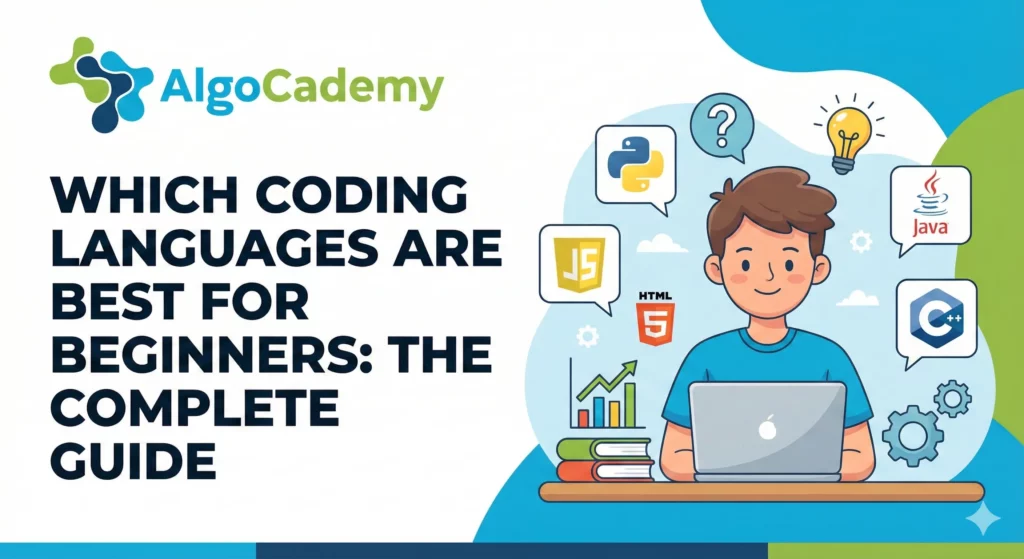
Which Coding Languages Are Best for Beginners: The Complete Guide
Choosing your first programming language feels like a high-stakes decision. With hundreds of languages out there, each with passionate advocates insisting theirs is the best, it’s easy to get paralysed by analysis.
Here’s the truth: your first language matters less than you think, but it’s not irrelevant either. A good first language removes unnecessary friction so you can focus on learning to think like a programmer. A poor choice adds frustration that has nothing to do with programming itself.
This guide breaks down the best options for beginners, explains the trade-offs, and helps you make a decision you won’t regret. More importantly, it explains what actually matters for your long-term success as a developer, which isn’t the language you start with.
Why Your First Language Matters (And Why It Doesn’t)
Let’s address the anxiety first.
Why it matters:
Your first language shapes your initial experience. A frustrating start makes people quit. An encouraging start builds momentum that carries you through harder challenges later.
Some languages have gentler learning curves. Some have better beginner resources. Some give you faster feedback loops that keep motivation high. These differences are real and worth considering.
Your first language also influences which jobs and projects are immediately accessible. If you want to build websites quickly, starting with JavaScript makes sense. If you’re drawn to data science, Python gets you there faster.
Why it doesn’t matter as much as people claim:
Programming concepts transfer across languages. Variables, loops, conditionals, functions, data structures, algorithms: these are universal. Once you learn them in one language, picking up another is mostly learning new syntax, not new concepts.
Most professional developers know multiple languages. Your first language isn’t a life sentence. It’s a starting point. Many successful developers started with languages they no longer use.
The language wars you see online are mostly noise. People defending their favourite language aren’t giving you objective advice. They’re justifying their own choices.
The real question isn’t “which language is best.” It’s “which language will help me learn programming concepts with the least unnecessary friction.”
The Top Beginner-Friendly Languages
Let’s examine the languages most commonly recommended for beginners, with honest assessments of each.
Python
Python is the most commonly recommended first language, and for good reason.
Why Python works for beginners:
Readable syntax. Python code looks almost like English. When you write if score > 90: print("Great job!"), you can understand what it does even without knowing Python. This readability reduces the cognitive load while you’re learning fundamental concepts.
Minimal boilerplate. In some languages, you need to write dozens of lines before anything happens. In Python, your first program is one line: print("Hello, World!"). This immediate feedback keeps beginners engaged.
Forgiving error messages. Python’s error messages are relatively clear about what went wrong. You’re not deciphering cryptic compiler output while also trying to understand programming basics.
Versatile applications. Python is used for web development, data science, machine learning, automation, scripting, and more. Whatever direction your interests take, Python is probably relevant.
Massive learning ecosystem. Because Python is so popular for beginners, there are countless tutorials, courses, books, and communities. You’ll never struggle to find help.
Strong job market. Python developers are in demand across industries. Starting with Python doesn’t limit your career options.
The downsides:
Not ideal for certain domains. If you want to build mobile apps, games, or low-level systems software, Python isn’t the primary tool. You can learn it first, but you’ll need to learn something else for those applications.
Can hide important concepts. Python handles a lot of complexity behind the scenes. Memory management, type systems, and compilation are invisible. This is great for beginners but means you’ll need to learn these concepts later if you go deeper.
Indentation sensitivity. Python uses indentation to define code blocks. Some beginners find this confusing initially, though most come to appreciate it.
Slower execution. Python is interpreted and relatively slow. This doesn’t matter for learning, but you’ll encounter it in certain professional contexts.
Best for: General programming education, data science, automation, web backend development, anyone who isn’t sure what they want to do yet.
Resources:
- Python.org’s beginner guide
- Automate the Boring Stuff with Python (free online)
- Codecademy Python course
JavaScript
JavaScript is the language of the web. Every website you visit runs JavaScript in your browser.
Why JavaScript works for beginners:
Immediate visual feedback. You can write JavaScript that changes things on a webpage and see results instantly. This tangible feedback loop is motivating in ways that command-line output isn’t.
No setup required. Your web browser already runs JavaScript. You can start coding without installing anything. Just open your browser’s developer console and start typing.
Essential for web development. If you have any interest in building websites or web applications, you’ll need JavaScript eventually. Starting there makes sense.
Full-stack potential. With Node.js, JavaScript runs on servers too. You can build entire applications, frontend and backend, with one language.
Huge ecosystem. JavaScript has the largest package ecosystem of any language (npm). Whatever you want to build, there’s probably a library for it.
Strong job market. JavaScript developers are perpetually in demand. The web isn’t going anywhere.
The downsides:
Quirky behaviour. JavaScript has some genuinely weird parts. Type coercion produces surprising results ([] + [] === ""). Historical baggage creates confusion. You’ll encounter behaviour that makes no logical sense.
Too much choice. The JavaScript ecosystem is overwhelming. Dozens of frameworks, constant change, endless debate about the “right” way to do things. This can paralyse beginners.
Asynchronous complexity. JavaScript handles asynchronous operations in ways that confuse beginners. Callbacks, promises, and async/await are powerful but take time to understand.
Browser inconsistencies. JavaScript behaves slightly differently across browsers. Modern tools hide most of this, but it’s an additional layer of complexity.
Easy to write bad code. JavaScript’s flexibility lets you do things that seem to work but are actually problematic. Without guidance, beginners develop bad habits.
Best for: Web development, anyone who wants to build interactive websites, people motivated by visual results.
Resources:
- freeCodeCamp JavaScript curriculum
- JavaScript.info (comprehensive modern tutorial)
- The Odin Project (project-based web development)
Scratch
Scratch is a visual programming language developed by MIT for teaching programming to children. But it’s valuable for adults too, especially those intimidated by traditional coding.
Why Scratch works for beginners:
No syntax errors. You drag and drop blocks instead of typing code. This eliminates an entire category of frustration. You can focus purely on logic.
Visual representation of concepts. Loops, conditionals, and variables are represented as tangible blocks you can see and manipulate. This makes abstract concepts concrete.
Immediate, visual feedback. You create animations and games that you can see working. This is inherently more engaging than text output.
Zero setup. Everything runs in your browser. No installation, no configuration, no command line.
Designed for learning. Scratch was built by education researchers specifically to teach programming concepts. It’s pedagogically sound.
The downsides:
Not used professionally. Scratch is for learning, not building real applications. You’ll need to transition to a text-based language.
Can feel childish. The interface is designed for children. Some adults feel silly using it, even though the concepts are legitimate.
Limited ceiling. You’ll outgrow Scratch relatively quickly. It’s a starting point, not a destination.
Doesn’t teach syntax. Eventually you need to learn to type code. Scratch delays this but doesn’t eliminate it.
Best for: Complete beginners who are intimidated by code, younger learners, anyone who wants to understand programming concepts before dealing with syntax.
Resources:
- Scratch official tutorials
- CS50’s Scratch introduction (Harvard’s intro course starts with Scratch)
HTML/CSS
Technically, HTML and CSS aren’t programming languages. HTML is markup (structure), and CSS is styling (appearance). But they’re often where people start, and there are good reasons for that.
Why HTML/CSS work for beginners:
Instant visual results. You write code, refresh your browser, and see changes. This feedback loop is satisfying and motivating.
Forgiving errors. Unlike programming languages that crash on errors, HTML and CSS fail gracefully. If you make a mistake, something might look wrong, but nothing breaks completely.
Foundation for web development. If you’re interested in web development, you need HTML and CSS regardless. Starting there isn’t a detour.
Low barrier to entry. You can create a webpage in any text editor with no special tools. The simplicity is encouraging.
Transferable skills. Even if you move to other areas, understanding how the web works is valuable.
The downsides:
Not programming. HTML and CSS teach you to describe content and appearance, not to think algorithmically. You’ll still need to learn programming separately.
Can create false confidence. Building a webpage isn’t the same as programming. Some people spend months on HTML/CSS thinking they’re learning to code, then struggle when they encounter actual programming.
Limited on their own. Without JavaScript or a backend language, you can only build static pages. Interactivity requires programming.
Best for: Web-curious beginners who want quick wins, people who want to understand how websites work before diving into programming.
Resources:
Java
Java was the traditional first language in computer science education for decades. It’s less common now for beginners but still has advocates.
Why Java can work for beginners:
Strongly typed. Java forces you to declare variable types explicitly. This catches errors early and teaches type thinking that’s valuable across languages.
Structured approach. Java’s verbosity forces you to be explicit about everything. Nothing is implicit. This can build good habits.
Enterprise relevance. Java dominates enterprise software development. If you’re aiming for corporate environments, Java experience is valuable.
Android development. Java (along with Kotlin) is used for Android app development. If mobile is your goal, Java is relevant.
Abundant resources. Decades of Java education mean extensive learning materials, though some are outdated.
The downsides:
Verbose syntax. A simple “Hello, World!” requires understanding classes, methods, and access modifiers. This front-loads complexity that isn’t relevant to beginners.
Slow feedback loop. Java code must be compiled before running. This adds steps between writing code and seeing results.
Complex tooling. Setting up Java development environments is more complicated than Python or JavaScript.
Can feel tedious. Java’s verbosity means writing more code to accomplish the same things. This can feel frustrating when learning.
Declining as a first language. Most modern CS programmes have moved away from Java for introductory courses. The beginner ecosystem is less vibrant than Python or JavaScript.
Best for: People specifically targeting Android development or enterprise software, those who want to learn typing systems explicitly.
Resources:
- Oracle’s Java tutorials
- MOOC.fi Java course (excellent free course from University of Helsinki)
C
C is one of the oldest languages still in widespread use. It’s the foundation of operating systems, embedded systems, and many other languages.
Why C can work for beginners:
Teaches how computers actually work. C exposes memory management, pointers, and low-level operations. You understand what’s happening under the hood.
Transferable fundamentals. Understanding C makes learning other languages easier because you understand what they’re abstracting away.
Relevant for systems programming. If you want to work on operating systems, embedded systems, or performance-critical applications, C is essential.
Minimal language to learn. C is small. There aren’t many keywords or built-in features. What exists is powerful but learnable.
The downsides:
Steep learning curve. Pointers, memory management, and segmentation faults are confusing for beginners. There’s a lot to understand before you’re productive.
Easy to make dangerous mistakes. Memory bugs in C can be subtle and devastating. The language doesn’t protect you from yourself.
Minimal standard library. Things that are built-in elsewhere (like string manipulation) require more manual work in C.
Less immediately practical. Most beginner projects (websites, apps, automation) don’t use C. You’ll learn a lot but build less.
Frustrating feedback. Compiler errors and runtime crashes can be cryptic. Debugging requires more expertise.
Best for: People specifically interested in systems programming, those who want deep understanding of how computers work, students in rigorous CS programmes.
Resources:
Swift
Swift is Apple’s modern language for iOS and macOS development.
Why Swift works for beginners:
Modern, clean design. Swift was designed recently with decades of language design lessons. It’s more consistent and less quirky than older languages.
Swift Playgrounds. Apple’s learning app makes Swift accessible and visual. It’s designed specifically for beginners.
iOS development path. If you want to build iPhone apps, Swift is the direct path.
Safety features. Swift prevents common programming errors through language design. You’re less likely to encounter cryptic crashes.
The downsides:
Apple ecosystem only. Swift is primarily useful for Apple platforms. If you don’t have a Mac or aren’t interested in iOS, it’s less relevant.
Smaller job market. Swift jobs exist but are fewer than JavaScript or Python. Your options are more constrained.
Requires Mac. Serious Swift development requires a Mac. This is a barrier for some beginners.
Rapid evolution. Swift changes significantly between versions. Old tutorials become outdated quickly.
Best for: People with Macs who want to build iOS apps.
Resources:
- Swift Playgrounds
- Hacking with Swift (excellent free tutorials)
Ruby
Ruby is known for its elegant, readable syntax and the Rails framework that powers many web applications.
Why Ruby works for beginners:
Beautiful syntax. Ruby was designed to be enjoyable to write. Code reads almost like English, making it accessible.
Developer happiness focus. The language philosophy prioritises programmer experience. This translates to a gentler learning curve.
Rails ecosystem. Ruby on Rails lets you build web applications quickly. It’s satisfying to create working apps early in your journey.
Welcoming community. The Ruby community has a reputation for being friendly to beginners.
The downsides:
Declining popularity. Ruby’s market share has shrunk. There are fewer jobs and less excitement around the language.
Slower performance. Ruby is slower than many alternatives, which matters for some applications.
Rails-dependent. Most Ruby jobs involve Rails. If you don’t want to do web development, Ruby is less relevant.
Magic can obscure learning. Rails does a lot automatically. This is productive but can hide how things actually work.
Best for: People specifically interested in web development who value elegant code.
Resources:
How to Choose Based on Your Goals
The best first language depends on where you want to go.
“I want to build websites”
Start with: JavaScript
HTML and CSS first if you want quick wins, then JavaScript. The web is JavaScript’s home, and you’ll need it regardless. Python works too (many people learn Python first, then add JavaScript for web), but JavaScript gets you to web development faster.
freeCodeCamp and The Odin Project offer excellent free curricula for this path.
“I want to do data science or machine learning”
Start with: Python
Python dominates data science. Libraries like pandas, NumPy, and scikit-learn are Python-native. The data science community lives in Python. Starting elsewhere adds unnecessary detours.
DataCamp and Kaggle Learn offer data-focused Python education.
“I want to build mobile apps”
Start with: Swift (iOS) or Kotlin/Java (Android)
If you’re committed to iOS, Swift is the direct path. For Android, Kotlin is modern and preferred, though Java works too. If you want both platforms, learning JavaScript with React Native is an option, though native development provides deeper understanding.
“I want to work at a big tech company”
Start with: Python or JavaScript
Both are widely used and accepted in technical interviews. Python’s clean syntax is often preferred for interview coding problems. What matters more than language choice is developing strong problem-solving skills, which is where AlgoCademy comes in (more on this below).
“I want to understand how computers really work”
Start with: C
C exposes the low-level details that other languages hide. Understanding memory, pointers, and manual resource management gives you insight that transfers everywhere. CS50 is an excellent starting point.
“I’m not sure what I want to do”
Start with: Python
When in doubt, Python. It’s versatile enough to be useful in almost any direction. You can always specialise later after discovering what interests you.
“I’m intimidated by coding and want the gentlest start”
Start with: Scratch, then Python
Scratch lets you learn programming concepts without syntax frustration. Once you’re comfortable with loops, conditionals, and variables as concepts, transition to Python.
The Real Secret: Language Matters Less Than Problem-Solving
Here’s what most “which language should I learn” articles miss: the language is the easy part.
Syntax is memorisable. Any language’s basics can be learned in weeks. What takes months or years is developing the ability to solve problems with code. This means:
- Breaking complex problems into smaller pieces
- Recognising which data structures fit which situations
- Developing algorithms that are efficient and correct
- Debugging code that isn’t working
- Reading and understanding unfamiliar code
These skills transfer across every language. A strong problem-solver can pick up new languages quickly. A weak problem-solver who knows five languages superficially is less capable than someone who knows one language deeply with strong fundamentals.
This is exactly what AlgoCademy focuses on. Rather than teaching syntax (which you can learn anywhere), AlgoCademy’s AI-powered tutoring develops the problem-solving skills that actually determine your success as a developer.
Here’s why this matters for your first language choice:
Don’t obsess over the language. Pick something reasonable (Python or JavaScript for most people) and start. The sooner you begin developing problem-solving skills, the better.
Use your first language to learn thinking, not just typing. Tutorials that walk you through building projects teach you to follow instructions. Platforms like AlgoCademy teach you to think through novel problems yourself. Both have value, but the latter is what separates capable developers from tutorial followers.
Plan to learn multiple languages. Your first language is the beginning, not the end. Once you have strong fundamentals, picking up additional languages takes weeks, not months. Don’t feel locked in by your initial choice.
The AI tutor advantage. AlgoCademy’s AI tutor doesn’t just check if your code works. It helps you develop the thinking process behind solutions. When you’re stuck, it asks guiding questions rather than giving answers. It helps you recognise patterns that apply across languages. This approach to learning transfers regardless of which syntax you’re using.
Common Mistakes When Choosing a First Language
Choosing Based on Job Listings
“I saw a job posting requiring Rust, so I’ll learn Rust first.”
Job postings often list languages for experienced hires, not entry-level positions. Starting with an advanced language because it appeared in a job listing usually backfires. Build fundamentals first, then specialise.
Chasing the “Best” Language
There is no best language. Anyone claiming otherwise is selling something or defending their own choices. Languages are tools. Different tools work better for different jobs.
Switching Languages Too Quickly
“Python is hard, maybe JavaScript will be easier.”
If you’re struggling, the problem probably isn’t the language. It’s the concepts you’re learning. Switching languages just restarts the struggle with different syntax. Stick with one language until you’ve genuinely learned programming, then add others.
Waiting for Certainty
“I’ll start learning once I’m sure which language is right.”
Analysis paralysis prevents learning. An imperfect choice made today beats a perfect choice made never. Start with Python or JavaScript. If you later discover you chose wrong (unlikely), you’ll switch with minimal lost time because the concepts transfer.
Ignoring Your Actual Interests
Learning is easier when you care about what you’re building. If web development bores you but you chose JavaScript because someone said it was best, you’ll struggle with motivation. Pick a language aligned with projects that actually interest you.
Focusing on Language Instead of Problem-Solving
This bears repeating. Many people spend months mastering a language’s features while remaining unable to solve basic problems. Prioritise problem-solving skills over language mastery. AlgoCademy exists specifically because this is where most self-taught developers get stuck.
A Practical Learning Path
Here’s a concrete approach that works for most beginners:
Phase 1: Syntax Basics (2-4 weeks)
Choose: Python or JavaScript based on your goals.
Use: Codecademy, freeCodeCamp, or similar for basic syntax.
Goal: Understand variables, data types, conditionals, loops, and functions. Be able to write simple programs.
Avoid: Spending too long here. Basic syntax doesn’t take months. If you’ve been doing tutorials for more than a month without building anything yourself, you’re procrastinating.
Phase 2: Problem-Solving Foundations (2-4 months)
Use: AlgoCademy becomes your primary platform.
Goal: Develop systematic problem-solving skills. Learn to break down problems, recognise patterns, and build solutions step by step.
This is the critical phase that most learning paths skip. Tutorials teach you to build specific things. AlgoCademy’s AI tutor teaches you to think through novel problems yourself. The AI doesn’t just give you answers; it guides you through developing solutions, building the mental frameworks that transfer to any language and any problem.
This is also where most self-taught developers get stuck. They know syntax but can’t solve problems independently. AlgoCademy specifically addresses this gap with AI-powered guidance that develops genuine capability.
Avoid: Rushing through this phase. Problem-solving skills take time to develop. The investment here pays dividends for your entire career.
Phase 3: Building Projects (Ongoing)
Goal: Apply what you’ve learned by building real things. Start small, increase complexity.
Approach: Choose projects that interest you. Build them without following tutorials step-by-step. Get stuck. Figure it out. This is where learning solidifies.
Use AI assistants like GitHub Copilot thoughtfully. They can help you move faster, but make sure you understand every line of code they suggest.
Phase 4: Interview Preparation (When Ready)
Use: Continue AlgoCademy for guided practice. Add LeetCode for volume and variety.
Goal: Solve medium-difficulty problems consistently within time limits. Explain your thinking process clearly.
If you’ve built strong foundations in Phase 2, interview prep is applying skills you already have. If you skipped Phase 2, interview prep becomes a frustrating grind of memorising solutions you don’t understand.
Phase 5: Add More Languages (As Needed)
Once you have strong fundamentals in one language, adding others is straightforward. You’re just learning new syntax for concepts you already understand.
Most developers learn 3-5 languages over their careers, sometimes more. Your first language is just the beginning.
Language Comparison At a Glance
| Language | Best For | Learning Curve | Job Market | Setup Difficulty |
|---|---|---|---|---|
| Python | General purpose, data science | Gentle | Strong | Easy |
| JavaScript | Web development | Moderate | Very strong | None (browser) |
| Scratch | Absolute beginners, concepts | Very gentle | N/A | None (browser) |
| HTML/CSS | Web basics | Very gentle | N/A (need JS too) | None |
| Java | Enterprise, Android | Steep | Strong | Moderate |
| C | Systems programming | Steep | Moderate | Moderate |
| Swift | iOS development | Moderate | Moderate | Easy (Mac only) |
| Ruby | Web development | Gentle | Declining | Easy |
Frequently Asked Questions
“Should I learn multiple languages at once?”
No. Master one first. Trying to learn multiple languages simultaneously creates confusion and slows progress on all of them. Once you’re comfortable with one language (can solve problems independently, not just follow tutorials), adding another is much easier.
“Is Python or JavaScript better?”
Neither. Both are excellent first languages. Python is slightly easier syntactically and better for data science. JavaScript is essential for web development and gives immediate visual feedback. Pick based on your goals. If you have no preference, Python’s slight edge in readability makes it marginally better for pure learning.
“Do I need to learn HTML/CSS before JavaScript?”
Not necessarily. They’re often taught together, but you can learn JavaScript without knowing HTML/CSS first. If your goal is web development, learning all three makes sense. If your goal is programming more broadly, you can skip HTML/CSS initially.
“Is [trendy new language] worth learning as a beginner?”
Probably not. New languages lack the learning resources, community support, and job market of established options. Once you’re experienced, exploring new languages is valuable. As a beginner, stick with proven options.
“I started with [language] but I’m struggling. Should I switch?”
Usually no. Programming is hard regardless of language. If you’re struggling with logic and problem-solving, switching languages just restarts the struggle. Stick with your current language and focus on developing problem-solving skills (this is where AlgoCademy helps). If you genuinely hate the language for reasons beyond difficulty, switching is okay, but be honest about your motivation.
“How long until I can get a job?”
This varies enormously based on how much time you invest, how effectively you learn, and what jobs you’re targeting. A realistic range for someone learning part-time alongside other commitments: 6 months to 2 years for entry-level positions. Full-time focused learning can be faster. The language you choose matters less than how well you develop problem-solving skills and build a portfolio.
“What about low-code/no-code tools? Should I learn those instead?”
Low-code tools are valuable for certain purposes but don’t replace programming knowledge. They’re built on top of programming languages. Understanding how things work underneath makes you more effective even with low-code tools. Learn to code first, then use low-code tools where they make sense.
The Bottom Line
Your first programming language matters, but not as much as the internet suggests. Python and JavaScript are safe, versatile choices for almost everyone. Pick one based on your goals, or pick Python if you have no strong preference.
What matters far more than language choice is developing genuine problem-solving ability. This is the skill that transfers across languages, that gets you through technical interviews, and that makes you valuable as a developer.
AlgoCademy exists because this is exactly where most self-taught developers get stuck. Knowing syntax isn’t the same as being able to solve problems. The AI-powered tutoring develops the thinking skills that tutorials skip, teaching you how to approach unfamiliar problems systematically rather than just following instructions.
Start with their 7-day free trial on the annual plan. Use it actively. Experience the difference between being given answers and being guided to discover solutions yourself. This approach to learning transfers regardless of which language you’re using.
Stop researching which language to learn. Pick one today. Start tomorrow. The best language is the one you actually begin learning.