
How to Choose the Right Coding Course for Data Science
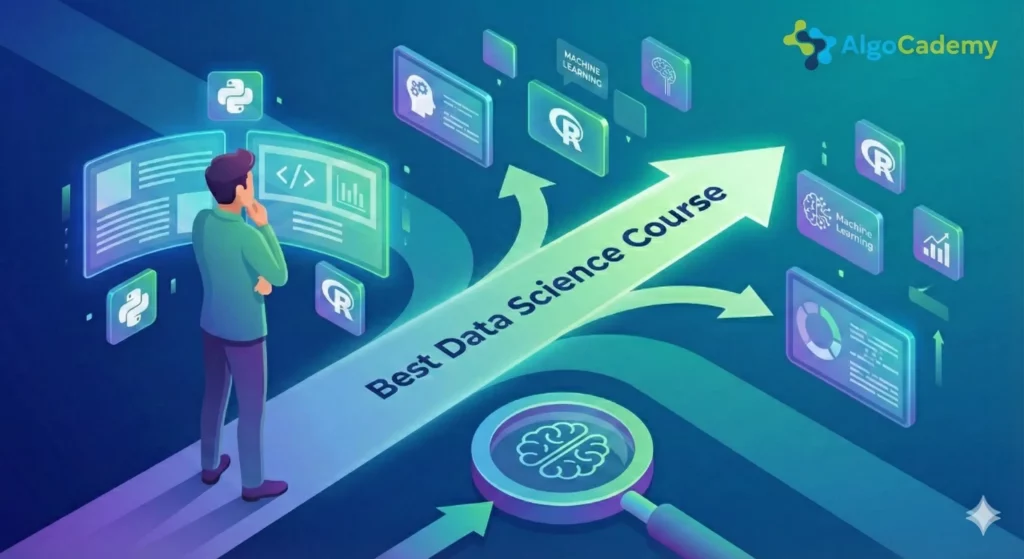
Breaking into data science is one of the most rewarding career moves you can make in 2024. But with thousands of courses flooding the internet, from free YouTube tutorials to $15,000 bootcamps, choosing the right path can feel overwhelming. The wrong choice doesn’t just waste money. It wastes months of your time and can leave you with gaps that hurt you in interviews and on the job.
This guide will help you cut through the noise and pick a learning path that actually prepares you for a data science career.
What Skills Do Data Scientists Actually Need?
Before comparing courses, you need to understand what you’re learning toward. Data science sits at the intersection of three skill sets.
Programming and computational thinking. You’ll spend most of your time writing code. Cleaning data, building models, creating visualizations, automating workflows. Python dominates the field, with R remaining popular in academia and specific industries like pharmaceuticals.
Mathematics and statistics. Linear algebra, probability, and statistical inference form the theoretical backbone. You don’t need a PhD, but you need enough depth to understand why algorithms work, not just how to call them.
Domain knowledge and communication. The most technically brilliant analysis is worthless if you can’t translate it into business decisions. Understanding your industry and explaining results to non-technical stakeholders separates good data scientists from great ones.
Most beginners underestimate the first category. They rush to learn machine learning libraries without building solid programming foundations, then struggle when projects require debugging complex code or optimizing performance.
The Foundation Problem: Why Most Beginners Get Stuck
Here’s a pattern that plays out constantly. Someone takes a data science course, learns to import pandas and scikit-learn, follows along with guided projects, and feels confident. Then they face a real problem (a messy dataset, an edge case, a performance bottleneck) and realize they don’t actually know how to think through problems systematically.
The issue is that many courses teach you to recognize patterns and apply templates rather than to decompose problems and build solutions from first principles. You learn that “for classification problems, try logistic regression, then random forest, then XGBoost” without developing the algorithmic thinking that lets you debug why your model is failing or optimize code that’s running too slowly.
This is why foundational problem-solving skills matter so much. Before diving into data science-specific content, you need to be comfortable breaking down complex problems, writing clean and efficient code, and thinking algorithmically. Platforms like AlgoCademy focus specifically on building these fundamentals through interactive, step-by-step tutorials that develop your problem-solving intuition. These are the same skills that will later help you debug data pipelines, optimize model training, and tackle novel problems that don’t fit neatly into course examples.
Key Factors for Evaluating Data Science Courses
1. Learning Format: Interactive vs. Passive
Video lectures feel productive but often aren’t. You watch someone code, nod along, and retain maybe 10% a week later. Research on learning consistently shows that active practice dramatically outperforms passive consumption.
Look for courses that force you to write code, not just watch it. The best learning happens when you struggle with a problem, make mistakes, and work through the solution yourself. Interactive coding environments where you can’t proceed without solving each challenge create the productive friction that builds real skills.
This is one reason to separate your foundational coding practice from domain-specific learning. Use interactive platforms for building programming and problem-solving skills, then layer data science knowledge on top of that solid base.
2. Curriculum Depth vs. Breadth
Some courses try to cover everything. Python, R, SQL, statistics, machine learning, deep learning, NLP, computer vision, big data, cloud deployment. All in a single program. The result is superficial coverage that leaves you knowing a little about a lot but not enough about anything.
Better courses go deep on fundamentals before expanding. A solid progression looks like this:
- Programming fundamentals and algorithmic thinking
- Data manipulation and analysis (pandas, SQL)
- Statistics and probability
- Core machine learning concepts and implementation
- Specialized areas based on your interests
You can always add breadth later. Depth in fundamentals is much harder to backfill once you’ve moved on.
3. Project Quality and Relevance
Portfolio projects are how you demonstrate skills to employers, but not all projects are created equal. Watch out for courses where everyone builds the same Titanic survival predictor or MNIST digit classifier. These ubiquitous projects signal that you followed a tutorial, not that you can solve real problems.
The best courses either provide unique project ideas or, better yet, teach you to scope and execute your own projects. Can you identify an interesting question, find appropriate data, clean and analyze it, and communicate results? That end-to-end capability matters more than any single technique.
4. Community and Support
Learning in isolation is hard. Questions go unanswered, motivation fades, and you miss the benefit of seeing how others approach problems.
Evaluate what support structure a course offers. Is there an active community? Can you get help when stuck? Are there opportunities to collaborate or get feedback on projects? Even for self-paced learning, some form of community dramatically improves outcomes.
5. Career Support and Outcomes
If your goal is a data science job, look for evidence that the course actually helps people get hired. This doesn’t mean trusting marketing statistics. “95% of graduates get jobs” can mean almost anything. Instead, look for specific success stories, alumni you can contact, or partnerships with companies that hire from the program.
Also consider what career support exists beyond curriculum. Resume reviews, interview prep, and portfolio feedback can be as valuable as the technical content itself.
Building Your Learning Stack
Rather than searching for one perfect course, think about assembling a stack of resources that each serve a specific purpose.
Layer 1: Programming Fundamentals
Start here even if you’re impatient to get to the “real” data science. Strong foundations in programming logic, data structures, and algorithmic thinking pay dividends throughout your career.
For this layer, look for resources that emphasize problem-solving over syntax memorization. AlgoCademy excels here by building your skills through carefully structured problem progressions. Their interactive tutorials force you to think through each step rather than copying solutions, developing the debugging instincts and logical thinking that many data scientists wish they’d built earlier. When you eventually face a data pipeline that’s failing silently or a model that’s not converging, these fundamentals are what let you diagnose and fix the problem.
Layer 2: Data Science Fundamentals
Once your programming foundation is solid, add resources focused on data manipulation, statistics, and core machine learning. This is where traditional data science courses fit best.
Two platforms worth considering here are DataCamp and DataQuest. Both offer structured learning paths specifically designed for data science, with hands-on coding exercises built into the curriculum. DataCamp leans more toward short video lessons followed by practice, while DataQuest is entirely text-based and exercise-driven (no videos at all). Your preference between them might come down to whether you learn better from video or reading. Both cover the core stack well: Python, pandas, SQL, statistics, and machine learning fundamentals.
If you prefer university-style courses or want to keep costs down, there are excellent free options. Andrew Ng’s Machine Learning Specialization on Coursera is the classic starting point that thousands of working data scientists learned from. It’s been updated recently and covers both the theory and intuition behind core algorithms. Stanford also offers CS229 (the on-campus version) with free lecture videos and notes if you want something more mathematically rigorous.
On edX, Harvard’s Data Science Professional Certificate covers the full pipeline from R programming to machine learning, with a strong emphasis on statistics. MIT OpenCourseWare has Introduction to Computational Thinking and Data Science available for free, which builds nicely on programming fundamentals.
For deep learning specifically, fast.ai takes a top-down approach that gets you building neural networks quickly before diving into theory. It’s completely free and taught by Jeremy Howard, who has a knack for making complex topics accessible. Google’s Machine Learning Crash Course is another solid free option if you want something shorter and more focused.
Don’t overlook Khan Academy for shoring up math foundations. Their linear algebra and statistics courses are genuinely good and can fill gaps without the time commitment of a full university course.
At this layer, prioritize depth over breadth. You’re better off deeply understanding linear regression, gradient descent, and cross-validation than superficially covering twenty different algorithms.
Layer 3: Specialization and Projects
After building broad foundations, go deep in areas that interest you or align with target jobs. This might mean natural language processing, computer vision, time series forecasting, or recommendation systems.
This layer is also where personal projects become crucial. Apply what you’ve learned to questions you genuinely care about. Authentic interest produces better projects and better learning.
Layer 4: Production and Professional Skills
The gap between “data science” and “data science job” includes skills like version control, cloud platforms, model deployment, and collaboration workflows. Many courses neglect these, but they’re essential for working on real teams.
Red Flags to Avoid
“Become a data scientist in 3 months.” Realistic timelines for career-ready skills run 12-24 months of serious study, depending on your background. Anything promising mastery in weeks is selling fantasy.
No prerequisites mentioned. Good courses are honest about what you need before starting. If a machine learning course doesn’t mention that you need programming basics, it’s either too shallow or setting you up to struggle.
Certificate focus over skill focus. Certificates can be useful signals, but they’re not the goal. If a course emphasizes the credential more than what you’ll learn, priorities are misaligned.
No way to practice. If the only output is watching videos and taking quizzes, you won’t build practical skills. Code has to be written, not watched.
Outdated content. Data science tools evolve quickly. Check when content was last updated. A course teaching Python 2 or deprecated libraries won’t serve you well.
Making Your Decision
After evaluating options, here’s a framework for deciding.
First, honestly assess your starting point. If you’re new to programming, don’t skip ahead to machine learning. Invest properly in fundamentals. It’s the fastest path to your long-term goal even if it feels slower.
Second, match the format to how you actually learn. If you’ve started and abandoned ten video courses, maybe videos aren’t your format. Try interactive platforms instead. If you need accountability, consider cohort-based options.
Third, start smaller than you think you need. It’s easy to sign up for a comprehensive bootcamp, but a focused course on one topic might be the right next step. You can always add more.
Fourth, commit to one thing. Resource hopping (starting courses without finishing, always looking for something better) is a common trap. Pick something reasonable, finish it, then evaluate what’s next.
The Long View
Choosing a data science course isn’t really about finding the perfect resource. It’s about building sustainable learning habits that compound over time. The best data scientists keep learning throughout their careers as tools and techniques evolve.
Start with fundamentals. Build problem-solving instincts through deliberate practice on platforms designed for that purpose. Layer domain-specific knowledge on top. Work on projects that interest you. Connect with others learning the same things.
No single course makes someone a data scientist. But the right sequence of focused, practical learning, with foundations that include serious work on programming and problem-solving, creates the capabilities that lead to real opportunities.
Your first step isn’t finding the perfect course. It’s starting the next appropriate one and seeing it through.