
Trie Data Structure: 10 Real-World Use Cases and Applications
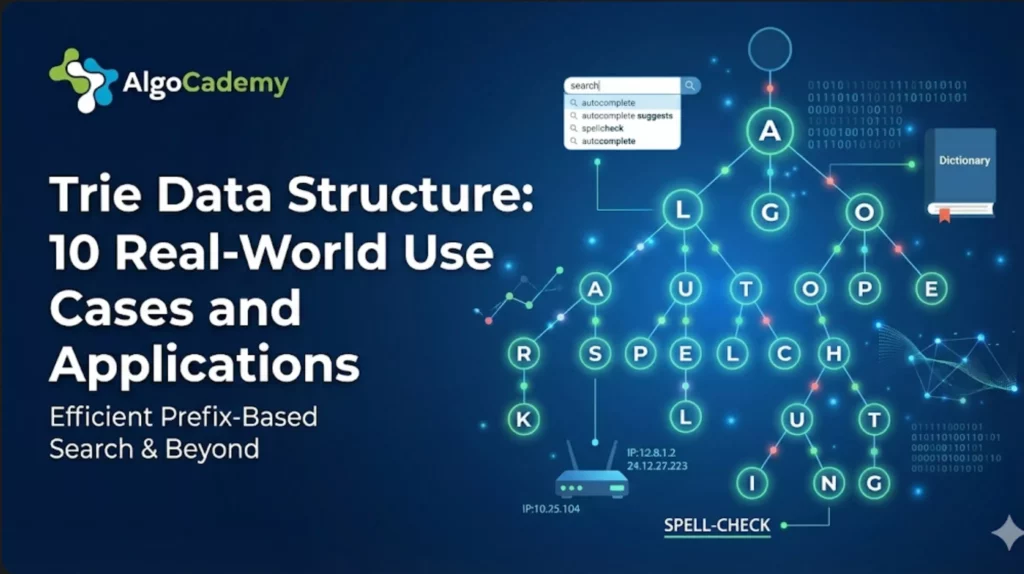
Every time you type on your phone and it magically knows you meant “definitely” instead of “definately,” a trie is working behind the scenes. When you swipe across your keyboard and entire words appear, that’s a trie variant at work. When your code editor highlights every instance of a variable name in milliseconds, you can thank another trie-based algorithm.
Tries (pronounced “try,” from retrieval) are one of the most practically useful data structures that many programmers never learn about. In this post, we’ll explore what makes tries special and dive into their real-world applications, from the autocorrect on your phone to the pattern matching engines in security software.
What Makes Tries Special?
Before we explore use cases, let’s understand what makes tries uniquely suited for string-based operations.
A trie is a tree-like data structure where each node represents a character, and paths from root to leaf spell out stored strings. Unlike hash tables or balanced trees, tries offer something remarkable: the time to search, insert, or delete a string depends only on the length of that string, not on how many strings are stored.
        (root)
       /   |   \
      c    d    t
      |    |    |
      a    o    h
      |    |    |
      t    g    e

Stores: "cat", "dog", "the"
This property makes tries incredibly powerful for prefix-based operations. Finding all words that start with “pre” takes the same time whether your dictionary has 1,000 words or 1,000,000.
Use Case 1: Autocomplete and Search Suggestions
The most visible application of tries is autocomplete. When you type “prog” into a search box and instantly see suggestions like “programming,” “progress,” and “program,” a trie (or trie variant) is typically involved.
Why Tries Excel at Autocomplete
With a trie, finding all words with a given prefix is elegantly simple:
- Navigate to the node representing the last character of the prefix
- Collect all complete words in that subtree
This operation is O(p + w), where p is the prefix length and w is the number of matching words, completely independent of dictionary size.
Real-World Implementations
Google Search processes billions of autocomplete queries daily. While their exact implementation is proprietary, the core principle involves tries storing popular queries with frequency scores, real-time updating as users type, and personalization layers that adjust rankings based on your search history.
IDE Code Completion in editors like VS Code, IntelliJ, and Sublime Text use tries to power their autocomplete systems. When you type str. in Python and see all string methods instantly, the editor has pre-indexed all available symbols into a trie structure. JetBrains IDEs take this further with “camel case matching” where typing NPE matches NullPointerException.
E-commerce Search on sites like Amazon and eBay uses tries to suggest products as you type. Type “iph” and you’ll see “iphone 15,” “iphone case,” and “iphone charger” before you finish typing. These systems weight suggestions by purchase frequency, profit margin, and your browsing history.
Command Line Tools like zsh and fish shell use tries for command completion. When you type git ch and hit tab, the shell searches a trie of git subcommands to suggest checkout, cherry-pick, and cherry.
class AutocompleteTrie:
    def __init__(self):
        self.children = {}
        self.is_word = False
        self.frequency = 0

    def insert(self, word, freq=1):
        node = self
        for char in word:
            if char not in node.children:
                node.children[char] = AutocompleteTrie()
            node = node.children[char]
        node.is_word = True
        node.frequency += freq

    def get_suggestions(self, prefix, limit=5):
        node = self
        for char in prefix:
            if char not in node.children:
                return []
            node = node.children[char]

        suggestions = []
        self._collect_words(node, prefix, suggestions)
        return sorted(suggestions, key=lambda x: -x[1])[:limit]

    def _collect_words(self, node, current_word, results):
        if node.is_word:
            results.append((current_word, node.frequency))
        for char, child in node.children.items():
            self._collect_words(child, current_word + char, results)
Use Case 2: Autocorrect and Spell Checking
Autocorrect is more complex than autocomplete because we’re not just looking for prefix matches. We’re finding words that are similar to what was typed, even when the user made mistakes.
Combining Tries with Edit Distance
Modern spell checkers combine tries with the concept of edit distance (the minimum number of insertions, deletions, or substitutions needed to transform one string into another). The algorithm walks the trie while tracking accumulated edit distance, prunes branches where edit distance exceeds a threshold, and returns valid words within the allowed distance.
Real-World Implementations
Smartphone Keyboards like Gboard, SwiftKey, and the iOS keyboard maintain tries of common words and find the closest matches to your input within 1-2 edit distance. When you type “teh” and your phone corrects it to “the,” this is the algorithm at work.
Microsoft Word and Google Docs use similar approaches for their spell checkers, though they also incorporate context-aware models. The red squiggly line under misspelled words comes from a trie-based dictionary lookup that found no exact match and couldn’t find a close-enough alternative automatically.
Search Engines use fuzzy matching to handle typos in queries. Google’s “Did you mean?” feature uses edit distance combined with query frequency data. If you search for “pythn programming,” Google knows “python programming” is almost certainly what you wanted because it’s a common query within edit distance 1.
Database Systems like PostgreSQL offer trigram indexes (pg_trgm extension) that enable fuzzy text search. While not pure tries, these systems use similar principles to find approximate matches efficiently.
def spell_check(trie, word, max_distance=2):
    """Find all dictionary words within max_distance edits of word."""
    results = []

    def search(node, remaining, current_word, distance):
        if distance > max_distance:
            return

        if not remaining and node.is_word:
            results.append((current_word, distance))

        for char, child in node.children.items():
            if remaining and remaining[0] == char:
                search(child, remaining[1:], current_word + char, distance)
            else:
                if remaining:
                    search(child, remaining[1:], current_word + char, distance + 1)
                search(child, remaining, current_word + char, distance + 1)

        if remaining:
            search(node, remaining[1:], current_word, distance + 1)

    search(trie.root, word, "", 0)
    return results
Use Case 3: Swipe Typing with Ternary Search Trees
Swipe typing (gesture typing) is where tries get really interesting. When you drag your finger from ‘t’ to ‘h’ to ‘e’ across the keyboard, the system must decode your intention from a continuous, imprecise path.
Why Ternary Search Trees?
A Ternary Search Tree (TST) is a space-optimized trie variant where each node has three children: less-than, equal-to, and greater-than. This structure is particularly useful for swipe typing for several reasons.
First, memory efficiency. Standard tries can waste enormous amounts of space with sparse nodes (imagine 26 child pointers per node, mostly null). TSTs only allocate the children that actually exist.
Second, partial matching. TSTs excel at fuzzy matching, which is essential for interpreting imprecise swipe paths where your finger doesn’t hit keys perfectly.
Third, balanced lookup. TSTs provide O(log n + k) lookup where k is the key length, giving you the best of both tries and binary search trees.
Standard Trie Node: 26+ child pointers (for English)
TST Node: Exactly 3 child pointers + character
Real-World Implementations
Gboard and SwiftKey both use TST variants for their swipe typing. When you swipe across “h-e-l-l-o” with some wobble, the TST finds candidates like “hello,” “help,” and “held.” Then geometric scoring (how closely your path matches the ideal path) and language models (what word makes sense in context) select the best match.
Swype, the original swipe keyboard (now discontinued but historically influential), pioneered this approach. Their patent filings describe using TSTs combined with “ideal path templates” for each word.
Voice Assistants like Siri and Google Assistant use similar fuzzy matching when transcribing speech. The acoustic model produces multiple possible interpretations, and a TST-like structure helps find valid word candidates quickly.
class TernarySearchTree:
    def __init__(self):
        self.char = None
        self.is_word = False
        self.left = None
        self.mid = None
        self.right = None

    def insert(self, word):
        if not word:
            return
        self._insert(word, 0)

    def _insert(self, word, index):
        char = word[index]

        if self.char is None:
            self.char = char

        if char < self.char:
            if self.left is None:
                self.left = TernarySearchTree()
            self.left._insert(word, index)
        elif char > self.char:
            if self.right is None:
                self.right = TernarySearchTree()
            self.right._insert(word, index)
        else:
            if index + 1 == len(word):
                self.is_word = True
            else:
                if self.mid is None:
                    self.mid = TernarySearchTree()
                self.mid._insert(word, index + 1)

    def match_swipe_path(self, path):
        """Find words that can be formed from characters in the swipe path."""
        results = []
        self._match_path(path, 0, "", results)
        return results

    def _match_path(self, path, path_idx, current, results):
        if self.char is None:
            return

        for i in range(path_idx, len(path)):
            if path[i] == self.char:
                new_word = current + self.char
                if self.is_word:
                    results.append(new_word)
                if self.mid:
                    self.mid._match_path(path, i + 1, new_word, results)
                break

        if self.left:
            self.left._match_path(path, path_idx, current, results)
        if self.right:
            self.right._match_path(path, path_idx, current, results)
Use Case 4: IP Routing and Network Systems
One of the most critical applications of tries is in network routers, where they’re used to make routing decisions for every single packet that crosses the internet.
Longest Prefix Matching
When a router receives a packet destined for IP address 192.168.45.67, it needs to find the most specific route in its routing table. The table might contain:
- 0.0.0.0/0 (default route)
- 192.0.0.0/8
- 192.168.0.0/16
- 192.168.45.0/24
The router must find the longest matching prefix, which in this case is 192.168.45.0/24. This is exactly what tries are designed for.
Real-World Implementations
Cisco and Juniper Routers use specialized trie variants called Patricia tries (also known as radix trees) for their forwarding tables. A core internet router might have 900,000+ routes and needs to make forwarding decisions in nanoseconds. Patricia tries compress single-child chains, dramatically reducing memory usage and lookup time.
Software Defined Networking (SDN) switches use tries for flow table matching. OpenFlow switches match packets against rules based on multiple header fields, and tries enable efficient multi-field matching.
Firewalls and ACLs (Access Control Lists) use tries to match packets against security rules. When your corporate firewall checks if traffic to a particular IP is allowed, it’s traversing a trie of rules.
Content Delivery Networks (CDNs) like Cloudflare and Akamai use tries for URL routing. When you request cdn.example.com/images/photo.jpg, the CDN uses a trie to determine which origin server or cache should handle the request.
class IPRoutingTrie:
    def __init__(self):
        self.children = [None, None]  # 0 and 1 for binary representation
        self.route = None

    def insert(self, prefix, prefix_len, route_info):
        """Insert a route for the given IP prefix."""
        node = self
        for i in range(prefix_len):
            bit = (prefix >> (31 - i)) & 1
            if node.children[bit] is None:
                node.children[bit] = IPRoutingTrie()
            node = node.children[bit]
        node.route = route_info

    def longest_prefix_match(self, ip_address):
        """Find the most specific route for an IP address."""
        node = self
        best_match = self.route  # Default route if exists

        for i in range(32):
            bit = (ip_address >> (31 - i)) & 1
            if node.children[bit] is None:
                break
            node = node.children[bit]
            if node.route is not None:
                best_match = node.route

        return best_match
Use Case 5: Multi-Pattern Matching with Aho-Corasick
What if you need to find multiple patterns in a text simultaneously? Searching for each pattern individually would be O(n × m × k) where n is text length, m is average pattern length, and k is the number of patterns. The Aho-Corasick algorithm, invented in 1975, solves this in O(n + m + z) where z is the number of matches, regardless of how many patterns you’re searching for.
How Aho-Corasick Works
Aho-Corasick builds on tries with two key additions:
Failure links: When a match fails, these links redirect to the longest proper suffix that might start another match. This is similar to the KMP algorithm but generalized to multiple patterns.
Output links: Track which patterns complete at or can be reached from each node.
Real-World Implementations
Network Intrusion Detection Systems like Snort, Suricata, and Zeek use Aho-Corasick to scan network traffic for thousands of malware signatures simultaneously. When a packet arrives, these systems can check it against 10,000+ attack signatures in a single pass through the data.
Antivirus Software from companies like ClamAV uses Aho-Corasick for signature matching. Your antivirus can check files against millions of known malware signatures efficiently because of this algorithm.
DNA Sequence Analysis tools use Aho-Corasick for finding multiple gene sequences in genomes. When researchers want to find all occurrences of 1,000 different gene markers in a genome, Aho-Corasick makes this tractable.
Plagiarism Detection systems like Turnitin use multi-pattern matching to compare submitted papers against databases of known content. The system breaks documents into chunks and searches for matches across millions of sources.
Ad Blockers like uBlock Origin use Aho-Corasick to match URLs against filter lists. When you visit a webpage, the blocker checks every resource URL against thousands of blocked patterns.
Log Analysis tools use Aho-Corasick to search for error patterns across massive log files. Splunk and Elasticsearch both use similar algorithms for their pattern matching capabilities.
Spam Filters check incoming emails against lists of known spam phrases and patterns. This needs to be fast because email servers process millions of messages.
class AhoCorasick:
    def __init__(self):
        self.goto = [{}]
        self.fail = [0]
        self.output = [[]]
        self.state_count = 1

    def add_pattern(self, pattern, pattern_id):
        state = 0
        for char in pattern:
            if char not in self.goto[state]:
                self.goto[state][char] = self.state_count
                self.goto.append({})
                self.fail.append(0)
                self.output.append([])
                self.state_count += 1
            state = self.goto[state][char]
        self.output[state].append(pattern_id)

    def build(self):
        """Build failure links using BFS."""
        from collections import deque
        queue = deque()

        for char, state in self.goto[0].items():
            queue.append(state)
            self.fail[state] = 0

        while queue:
            current = queue.popleft()
            for char, next_state in self.goto[current].items():
                queue.append(next_state)

                failure = self.fail[current]
                while failure and char not in self.goto[failure]:
                    failure = self.fail[failure]

                self.fail[next_state] = self.goto[failure].get(char, 0)
                self.output[next_state] += self.output[self.fail[next_state]]

    def search(self, text):
        """Find all pattern occurrences in text."""
        state = 0
        results = []

        for i, char in enumerate(text):
            while state and char not in self.goto[state]:
                state = self.fail[state]

            state = self.goto[state].get(char, 0)

            for pattern_id in self.output[state]:
                results.append((i, pattern_id))

        return results
Use Case 6: Suffix Trees for Text Analysis
While standard tries store a set of strings, suffix trees store all suffixes of a single string. This twist unlocks powerful text analysis capabilities that would otherwise require O(n²) or worse algorithms.
What Is a Suffix Tree?
For the string “banana$”, the suffix tree contains all suffixes: banana$, anana$, nana$, ana$, na$, a$, and $. The tree structure allows finding any pattern in O(m) time where m is the pattern length, completely independent of how long the original text is.
Real-World Implementations
Bioinformatics relies heavily on suffix trees. The human genome has about 3 billion base pairs. Tools like BWA, Bowtie, and STAR use suffix arrays (a compressed representation of suffix trees) to align DNA sequencing reads against reference genomes. When a sequencing machine produces millions of short DNA fragments, suffix trees help locate where each fragment came from in the genome.
Text Editors use suffix trees for fast “find all” operations. When you search for a variable name in a large codebase, editors can use suffix-tree-like indexes to find every occurrence instantly rather than scanning the entire file.
Data Compression algorithms like LZ77 (used in gzip, PNG, and ZIP) use suffix-tree-like structures to find repeated patterns. The algorithm finds the longest previous occurrence of the current string, which is exactly what suffix trees optimize.
Tandem Repeat Finders in genomics use suffix trees to find DNA sequences that repeat consecutively (like ATGATGATG). These repeats are important for genetic fingerprinting and studying genetic diseases.
Longest Common Substring algorithms use generalized suffix trees built from multiple strings. This is used in diff tools, version control systems, and document comparison.
Full-Text Search Engines build inverted indexes that share concepts with suffix trees. When you search for a phrase in your email, the search engine uses these indexes to find matches without scanning every message.
class SuffixArray:
    """
    Suffix arrays are a space-efficient alternative to suffix trees.
    They store the same information in a sorted array of suffix positions.
    """
    def __init__(self, text):
        self.text = text + "$"
        self.n = len(self.text)
        self.suffix_array = self._build_suffix_array()

    def _build_suffix_array(self):
        # Create list of (suffix_start_index, suffix_string) pairs
        suffixes = [(i, self.text[i:]) for i in range(self.n)]
        # Sort by suffix string
        suffixes.sort(key=lambda x: x[1])
        # Return just the indices
        return [s[0] for s in suffixes]

    def search(self, pattern):
        """Binary search for pattern occurrences."""
        left = self._lower_bound(pattern)
        right = self._upper_bound(pattern)
        return self.suffix_array[left:right]

    def _lower_bound(self, pattern):
        lo, hi = 0, self.n
        while lo < hi:
            mid = (lo + hi) // 2
            suffix = self.text[self.suffix_array[mid]:]
            if suffix < pattern:
                lo = mid + 1
            else:
                hi = mid
        return lo

    def _upper_bound(self, pattern):
        lo, hi = 0, self.n
        while lo < hi:
            mid = (lo + hi) // 2
            suffix = self.text[self.suffix_array[mid]:]
            if suffix[:len(pattern)] <= pattern:
                lo = mid + 1
            else:
                hi = mid
        return lo

    def longest_repeated_substring(self):
        """Find the longest substring that appears more than once."""
        lcp = self._build_lcp_array()
        max_lcp = max(lcp)
        max_idx = lcp.index(max_lcp)
        start = self.suffix_array[max_idx]
        return self.text[start:start + max_lcp]

    def _build_lcp_array(self):
        lcp = [0] * self.n
        for i in range(1, self.n):
            s1 = self.text[self.suffix_array[i-1]:]
            s2 = self.text[self.suffix_array[i]:]
            common = 0
            while common < len(s1) and common < len(s2) and s1[common] == s2[common]:
                common += 1
            lcp[i] = common
        return lcp
Use Case 7: File Systems and Hierarchical Data
File systems are essentially tries where paths like /home/user/documents/file.txt naturally form a tree structure.
Real-World Implementations
Unix/Linux File Systems organize files in a trie structure. Commands like ls, find, and locate traverse this trie. The locate command builds an index (essentially a flattened trie) of all file paths for instant searching.
Git stores its objects in a trie-like structure based on SHA-1 hashes. The .git/objects directory contains subdirectories named by the first two characters of the hash, with files named by the remaining characters. This is a two-level trie that distributes objects evenly.
Package Managers like npm, pip, and Maven use tries for dependency resolution and package name lookup. When you run npm install, the package manager searches a trie of available packages.
DNS (Domain Name System) is fundamentally a distributed trie. Domain names like www.example.com are stored in a hierarchical structure where .com is one node, example.com is a child, and www.example.com is a grandchild.
Compiler Symbol Tables use tries to store variable and function names. When the compiler sees a variable name, it looks it up in a trie to find its type and scope information.
Use Case 8: Natural Language Processing
NLP applications use tries extensively for tokenization, morphological analysis, and dictionary lookup.
Real-World Implementations
Tokenizers in NLP libraries like spaCy and NLTK use tries to split text into words. When processing “don’t,” the tokenizer uses a trie of exceptions to know this should become [“do”, “n’t”] rather than [“don”, “’t”].
Morphological Analyzers use tries to decompose words into roots and affixes. The word “unhappiness” gets broken into “un-” + “happy” + “-ness” by walking a trie of morphemes.
Word Embeddings systems like Word2Vec and FastText use tries to store vocabulary. When you look up the embedding for a word, the system first finds it in a trie of known vocabulary.
Machine Translation systems use tries for phrase tables that store translations of common phrases. Google Translate uses tries to look up phrase translations before falling back to neural translation.
Named Entity Recognition uses tries of known entities (people, places, organizations) to identify mentions in text. When processing news articles, the system checks each token against tries of known names.
Use Case 9: Gaming and Virtual Worlds
Game engines use tries in ways you might not expect.
Real-World Implementations
Command Consoles in games like Minecraft, Skyrim, and most Source engine games use tries to autocomplete console commands. When you type /give in Minecraft, the game searches a trie of available commands and item names.
Chat Systems in multiplayer games use tries for username autocomplete and mention suggestions. When you type @ in Discord or a game chat, a trie helps find matching usernames quickly.
World of Warcraft’s Addon System uses trie-like structures for searching items, spells, and achievements. The in-game search box can instantly filter through tens of thousands of items.
Scrabble and Word Games like Words With Friends use tries to validate words and suggest moves. The game needs to check if a word exists in the dictionary thousands of times per move calculation.
Use Case 10: Financial Systems
The finance industry uses tries for high-frequency operations where microseconds matter.
Real-World Implementations
Stock Ticker Lookup systems use tries to search ticker symbols. When you type “AAP” in a trading platform, it instantly suggests “AAPL” (Apple), “AAP” (Advance Auto Parts), and related symbols.
SWIFT Code Routing in international banking uses tries to route transactions to the correct bank. Each SWIFT code follows a hierarchical structure perfect for trie organization.
Fraud Detection systems use Aho-Corasick and similar algorithms to scan transactions for patterns associated with fraudulent activity. These systems need to match thousands of patterns in real-time.
Trading Systems use tries for order book matching and symbol lookup. High-frequency trading systems need sub-microsecond lookups that tries provide.
Choosing the Right Trie Variant
| Use Case | Best Structure | Why |
|---|---|---|
| Autocomplete | Standard Trie | Simple prefix queries, frequency tracking |
| Spell check | Trie + Edit Distance | Fuzzy matching with bounded edits |
| Swipe typing | Ternary Search Tree | Memory-efficient partial matching |
| Multi-pattern search | Aho-Corasick | Single-pass, all patterns simultaneously |
| IP routing | Patricia Trie / Radix Tree | Compressed structure for longest prefix match |
| Substring queries | Suffix Tree/Array | O(m) pattern finding after O(n) build |
| Memory-constrained | Compressed Trie (Radix) | Merges single-child chains |
| File paths / URLs | Radix Trie | Efficient for long strings with common prefixes |
Conclusion
Tries and their variants are foundational to how we interact with technology daily. From the autocorrect that saves us from embarrassing typos to the routers that forward every internet packet, from the security systems protecting networks to the genomics tools advancing medicine, these data structures solve problems that would be impractical with simpler approaches.
The key insight behind all trie variants is organizing strings by shared structure. Strings sharing prefixes should share storage and search paths. This principle leads to algorithms that scale gracefully with data size while remaining efficient for the operations that matter.
Understanding tries also opens doors to interview success. Companies like Google, Meta, and Amazon frequently ask trie-related questions because they test both algorithmic thinking and practical system design knowledge. Problems like “design autocomplete,” “implement spell checker,” or “find all words in a board” all become much more approachable once you understand how tries work.
Next time your phone perfectly interprets a sloppy swipe or your IDE instantly highlights all occurrences of a variable, you’ll know there’s a trie working quietly behind the scenes.
Want to implement these data structures yourself? Practice with our interactive coding challenges that guide you through building tries, TSTs, and more from scratch.