
Is AI Making You a Worse Programmer? The Uncomfortable Truth
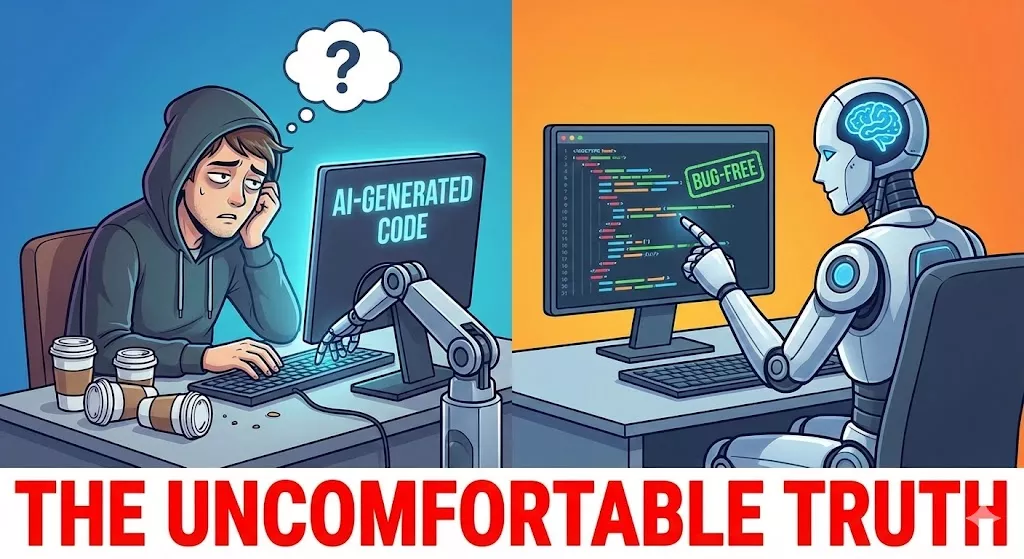
There’s a question nobody in developer communities wants to answer honestly: Is AI making us worse at our jobs?
Not worse at delivering software. That’s clearly improving. I mean worse at the actual craft of programming. Worse at thinking through problems. Worse at understanding what our code actually does.
After watching this debate unfold and seeing data from recent studies, I think the answer is more uncomfortable than either camp wants to admit.
The Rust Theory: Your Brain Doesn’t Wear Out, It Rusts
Here’s a study that should concern every developer who uses AI daily. Researchers found that students who used AI assistants produced better essays in the short term, but their critical thinking skills measurably declined compared to students who didn’t use AI.
Read that again. Better immediate output. Worse underlying capability.
This isn’t surprising when you understand how learning works. Your brain doesn’t wear out from use like a machine part. It rusts from disuse. Every time you let Copilot autocomplete a function you would have written yourself, you skip a rep. Every time you ask ChatGPT to architect a solution instead of sketching it out yourself first, you miss an opportunity to strengthen those neural pathways.
This is the same reason you can’t learn a language by only using Google Translate. Or get stronger by watching someone else lift weights.
That junior developer shipping features faster with AI assistance might be building a career on a foundation that’s slowly eroding. They’re arriving at destinations without learning the routes.
The Vibe Coding Paradox
Here’s where it gets weird. AI might be simultaneously increasing the average quality of software products while decreasing the average skill level of software engineers.
How?
For most applications (your standard CRUD app, your typical REST API, your basic React frontend) AI has been trained on millions of examples of best practices. When you “vibe code” a basic application by describing what you want and letting AI generate it, the output often follows better patterns than what a beginner would produce struggling through it alone.
We’re seeing more code than ever before. The quantity has exploded. But the depth of understanding required to produce that code has collapsed.
We now have an entire generation of developers who can ship working software without truly understanding why it works. They can build a house of cards that stands perfectly. Until something unexpected happens and they have no mental model for debugging it.
The code is better. The coders are worse. And nobody’s quite sure what happens when the music stops.
The Identity Crisis: Are You a Craftsman or an Operator?
Conversations about AI in programming get heated because people are talking past each other. They value fundamentally different things.
The Craftsman View
Some engineers view programming as a craft to be mastered. They take pride in understanding systems deeply, writing elegant solutions, knowing why their code works and exactly what trade-offs they’ve made. They often look at AI-generated code and see garbage. Functional garbage that works, sure. But garbage nonetheless because it lacks nuance, context, and intentionality.
The Operator View
Others view programming purely as a means to an end. Usually business value. They’re operators who combine design, marketing, product sense, and coding to ship things that make money or solve problems. For them, AI is liberation. A tool that lets them bypass the manual labor of syntax and implementation to focus on what actually matters to them.
Neither view is wrong. But they lead to completely different conclusions about AI.
The job market is shifting toward what some call “super unicorns.” People who operate across multiple domains, using AI to handle the how while they focus on the why. These operators don’t need to understand memory management or Big O notation. They need to understand users, markets, and product strategy.
Which kind of career are you building?
The Replaceability Danger Zone
Nobody talks openly about this career risk. If you use AI to do all your thinking, architecture, and coding, you’re training yourself out of a job.
Look at it from an employer’s perspective. If an AI can do your job, why would they pay you to be the human who clicks “accept” on Copilot suggestions? They can just use the AI directly. Your role as a “prompt engineer” or “AI supervisor” is only valuable until the AI gets slightly better and doesn’t need supervision.
The only way to remain valuable is to do work that AI genuinely cannot replicate. Deep architectural thinking. Novel problem-solving. Understanding legacy systems that aren’t in any training data. Navigating ambiguous requirements with stakeholders who don’t know what they want.
Programming is more vulnerable to AI replacement than many other fields. Code is digital, structured, and well-documented. Unlike a psychiatrist reading body language or a plumber dealing with a house built in 1920, programmers work in an environment that’s practically designed for AI to learn.
Your moat is the depth of understanding that lets you solve problems AI hasn’t seen before, in ways it can’t derive from pattern matching.
The Ego Problem: Why Senior Engineers Resist AI
This creates a strange paradox. Senior engineers are best positioned to use AI effectively. They have the deep knowledge to verify output, spot subtle bugs, and know when the AI is confidently wrong. Yet many seniors are the most resistant to adopting AI tools.
Why?
Part of it is legitimate technical skepticism. But a larger part is psychological, and we should be honest about it.
There’s something genuinely painful about watching a skill you spent years mastering become trivially easy. It feels like a devaluation of your entire career. All those late nights debugging pointer arithmetic. All those hours understanding distributed systems. All that accumulated expertise. And now a junior dev can produce something superficially similar in minutes?
It’s the same feeling gamers get when developers patch in easier ways to achieve things they spent months grinding for. The achievement feels retroactively cheapened. Your status as someone who “did it the hard way” gets erased.
This reaction is understandable. It’s also a trap.
The seniors who resist AI aren’t protecting their expertise. They’re accelerating their obsolescence. The ones who embrace it, who use their deep knowledge as a force multiplier, are becoming exponentially more productive.
Ego is expensive. In a field moving this fast, it might be career-ending.
The GPS Paradox: A Framework for Thinking About This
Using AI for coding is like using GPS for navigation.
If your goal is pure efficiency (getting from Point A to Point B as fast as possible) GPS is undeniably superior. It avoids traffic, finds optimal routes, and requires zero cognitive effort from you.
But if you use GPS for every single trip, your internal sense of direction atrophies. You’ve arrived at your destination a thousand times, but you never actually learned the way. When the GPS breaks, or you encounter terrain it hasn’t mapped, you’re completely lost.
So here’s the framework.
If you want to be a taxi driver (someone who delivers business value, gets passengers to destinations, and doesn’t need to understand cartography) use the GPS for everything. Optimize for speed and output. Let AI handle the implementation details.
If you want to be a cartographer (someone who truly understands the terrain, can navigate novel situations, and creates maps others rely on) you need to regularly turn off the GPS and navigate yourself.
The industry needs both. But it needs far fewer taxi drivers than it used to, because AI can now drive the taxi itself.
What I Actually Think Is True
AI is making the average programmer worse at fundamental skills. It removes the repetition required to build deep understanding.
AI is making the best programmers better. They have the foundation to use it as a multiplier rather than a crutch.
The middle is disappearing. The gap between “can ship things with AI assistance” and “deeply understands systems” is becoming a chasm.
Most people are in denial about which side of that chasm they’re actually on.
If you’re learning to code, here’s my honest advice. Use AI tools, but deliberately practice without them regularly. Do LeetCode problems without Copilot. Build a project from scratch without asking ChatGPT for help. Write code that you genuinely understand, even if it takes longer.
The short-term cost is real. You’ll ship slower. You’ll feel less productive. You’ll watch peers crank out features while you’re still figuring out database indexing.
The long-term benefit is a career that AI complements rather than replaces.
In five years, I suspect we won’t be asking “is AI making programmers worse?” We’ll be asking “are there any programmers left who understand what the AI is doing?”
Make sure you’re one of them.
Learning to code the right way? AlgoCademy’s interactive tutorials focus on building real understanding, not just getting the right answer. Because when AI can generate any answer, understanding becomes the only thing that matters.