How to Switch from Free Coding Tutorials to Paid Certification Courses Smoothly?
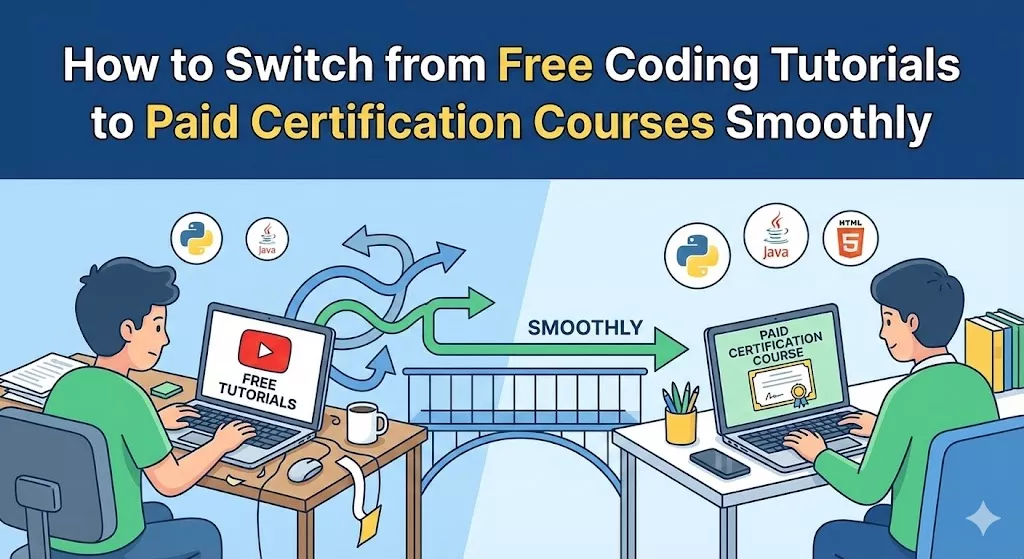
Here’s a truth that might disappoint you: most people don’t actually need to make this switch at all.
After years watching people navigate coding education, I’ve seen a consistent pattern. Someone learns successfully with free resources. They build real skills. Then they start doubting themselves because they haven’t paid for “real” education. So they buy an expensive certification course, complete it, realize the certificate itself doesn’t matter, and discover they already had the knowledge from free resources.
The question isn’t really “how to switch from free to paid.” The real questions are: “Do I actually need to switch?” and “What am I hoping to gain that I can’t get from free resources?”
Let me show you when switching to paid courses makes sense, when it’s a waste of money, and how to make the transition strategically if you do need it.
Why People Think They Need to Switch (And Whether They’re Right)
Before we talk about how to switch, let’s examine why people want to:
Reason 1: “I need a certificate to get hired”
The belief: Employers won’t take me seriously without a certificate from Udemy, Coursera, or a bootcamp.
The reality: Most tech employers don’t care about course certificates. They care about your portfolio, GitHub contributions, and whether you can solve technical interview problems.
A Coursera certificate might help you get past HR filters at some companies. But at the interview, you’ll be judged on actual skills, not certificates.
When paid certificates actually help:
- Very early in your career (first 1-2 jobs) when you have no work experience
- Applying to large corporations with rigid HR requirements
- Career switching and need something formal-looking on resume
- Specific industry certifications (AWS, Azure) that companies actually value
When they don’t help:
- Startups and tech companies (they test your skills directly)
- After you have any professional experience (experience trumps certificates)
- When you already have a portfolio demonstrating skills
Reason 2: “Free resources got me started, but I’ve hit a wall”
The belief: I learned basics from free tutorials, but I need structured paid courses to reach the next level.
The reality: Sometimes true, often not. The “wall” is usually about missing fundamentals or needing practice, not needing paid content.
Most concepts taught in paid courses are available free somewhere. The paid course might package them better or explain differently.
When paid courses actually help:
- You’ve genuinely exhausted quality free resources on a topic
- You need structured curriculum and can’t create your own learning path
- You benefit from specific instructor’s teaching style
- Interactive features (coding environments, instant feedback) significantly help you learn
When they don’t help:
- You haven’t actually exhausted free resources (most people haven’t)
- The “wall” is lack of practice, not lack of instruction
- You’re hoping paid courses are easier (they’re not)
Reason 3: “I want better quality/support than free resources provide”
The belief: Paid courses have better content, clearer explanations, and support when I’m stuck.
The reality: Sometimes true for specific topics or teaching styles. But many paid courses are lower quality than top free resources.
freeCodeCamp, MDN Web Docs, and The Odin Project match or exceed many paid courses in quality. Harvard’s CS50 is free and better than most paid alternatives.
When paid courses actually provide better quality:
- Niche/advanced topics with limited free resources
- Instructor whose teaching style works exceptionally well for you
- Interactive platforms with better learning environments than free alternatives
- Active support/community that free resources lack
When they don’t:
- General web development (free resources are excellent)
- Popular languages/frameworks (free content is abundant)
- Basic computer science (CS50, The Odin Project are free and top-tier)
Reason 4: “I need accountability and structure”
The belief: Free resources let me procrastinate. Paid courses with deadlines and money invested will force me to follow through.
The reality: This one can be true. Financial investment and structured curriculum create accountability some people need.
But buying a course doesn’t guarantee completion. Paid course completion rates are often 10-30%. You can pay $500 and still not finish.
When paid courses provide valuable structure:
- You’ve repeatedly failed to complete free courses due to lack of structure
- You respond well to deadlines and external accountability
- You can afford the cost without financial stress
- The course has active community and check-ins (not just videos)
When they don’t:
- You haven’t honestly tried structured free options (freeCodeCamp has clear paths)
- You’re hoping payment alone creates discipline (it usually doesn’t)
- You can’t afford it and the stress undermines learning
When You Actually Should Switch to Paid
Based on these reasons, here’s when switching makes sense:
Scenario 1: You’ve Exhausted Quality Free Resources
You’ve completed freeCodeCamp certifications, worked through The Odin Project, read MDN docs, built projects, and you genuinely need more advanced or specialized content.
Example: You’ve learned React with free resources and want to master advanced patterns, performance optimization, and real-world architecture. Paid courses like Epic React might offer value.
How to switch: Identify the specific gap in your knowledge. Search for courses addressing that exact topic. Try free trials or samples before buying.
Scenario 2: You Need Structured Accountability
You’ve tried free resources, made some progress, but keep abandoning courses halfway. You need external structure and deadlines.
Example: You’ve started and stopped freeCodeCamp three times. You need a cohort-based program with scheduled classes and accountability.
How to switch: Look for courses with live components, not just videos. Bootcamps, paid cohort programs, or platforms with strong accountability features.
Don’t just buy Udemy courses and expect that to create structure.
Scenario 3: You Need Specific Certifications
Your target employers value specific credentials (AWS, Azure, Google Cloud certifications for cloud roles).
Example: Job postings you’re targeting list “AWS Certified Solutions Architect” as preferred qualification.
How to switch: Research which certifications employers in your target market actually value. Focus on industry-recognized certifications, not course completion certificates.
Scenario 4: A Specific Instructor Resonates With You
You’ve watched free content from a specific instructor (YouTube, blog) and their teaching style works exceptionally well for you. Their paid course offers deeper treatment.
Example: You watched Brad Traversy’s free YouTube content, it clicked, and his paid Udemy courses offer more comprehensive coverage.
How to switch: Focus on that specific instructor’s courses, not random paid courses. You’re paying for teaching style, not just content.
When You Shouldn’t Switch (Save Your Money)
Don’t Switch If:
You haven’t actually completed substantial free resources: “I tried freeCodeCamp for a week” doesn’t count as exhausting free resources. Complete at least one certification before considering paid alternatives.
You think certificates alone get you hired: They don’t. Skills and portfolio matter infinitely more. Focus on building projects, not collecting certificates.
You’re hoping paid courses are easier: They’re not. Learning to code is hard regardless of whether you paid. Paid courses don’t make difficult concepts easier to understand.
You can’t afford it without financial stress: Don’t go into debt for course certificates. Free resources can take you from zero to employed. Save money for after you have income.
You haven’t built any projects yet: Course completion without application doesn’t create job-ready skills. Build projects with your free knowledge before buying more courses.
The Strategic Switching Approach
If you’ve determined switching makes sense, here’s how to do it strategically:
Step 1: Identify Specific Gaps
Don’t just say “I need to learn more.” Get specific.
Vague: “I want to get better at JavaScript.” Specific: “I understand JavaScript basics but struggle with asynchronous programming and promises.”
Vague: “I need to learn backend development.” Specific: “I understand Node.js basics but need to learn database design, authentication, and deployment.”
Target paid courses at your specific gaps, not general topics you can learn free.
Step 2: Evaluate Quality Before Buying
For course platforms (Udemy, Coursera, etc.):
Check ratings and reviews from people at your level. “This is great for beginners” means different things from different reviewers.
Look at the curriculum. Does it actually cover what you need, or is it generic content available free elsewhere?
Watch preview videos. Does the instructor’s teaching style work for you?
Check how recently the course was updated. Technology changes fast. Courses from 2019 might teach outdated practices.
For bootcamps or expensive programs:
Read CIRR reports (standardized outcomes data) if available.
Talk to recent graduates, not just ones the company connects you with. Find them on Reddit, LinkedIn, Discord.
Understand what you’re paying for. Is it curriculum, community, career support, or credentials?
Step 3: Use Free Trials Strategically
Many paid platforms offer trials:
Coursera: Audit most courses free. Only pay if you want the certificate or graded assignments.
Pluralsight: 10-day free trial with full access.
LinkedIn Learning: Often 1-month free trial.
Codecademy Pro: 7-day free trial.
Use trials to:
- Test teaching style and content quality
- Verify the course addresses your specific needs
- Confirm you’ll actually use it (don’t pay for content you won’t consume)
Set calendar reminders to cancel before trial ends if it’s not valuable.
Step 4: Start Small, Scale If Valuable
Don’t immediately buy the $500 comprehensive bootcamp or annual subscription.
Start with:
- Single course ($10-50) on the specific topic you need
- One month subscription to test the platform
- Smallest commitment that lets you evaluate
Scale to bigger investment only if:
- The initial small purchase delivered value
- You completed what you paid for (no point buying more if you don’t finish)
- You have specific reason to continue with this platform/instructor
Step 5: Blend Free and Paid Strategically
You don’t have to choose “all free” or “all paid.” Strategic combination often works best.
Example blend:
Foundation: freeCodeCamp (free) Advanced React patterns: Epic React (paid, $300) AWS certification: A Cloud Guru (paid, $35/month) Portfolio projects: Self-directed with free resources
You’re paying only for specific value paid resources provide over free alternatives.
Step 6: Measure Actual Outcomes
Before buying more courses, evaluate whether previous paid courses delivered value.
Good indicators:
- You completed the course
- You can build projects using what you learned
- You can explain concepts to others
- The specific skill gap you identified is now filled
Bad indicators:
- Course sits half-finished
- You watched videos but can’t apply concepts
- You bought it but haven’t started
- You’re buying courses instead of building projects
If paid courses aren’t delivering measurable skill improvement, stop buying them. Either you need different courses or you need to apply what you’ve learned, not consume more content.
Platform-Specific Transition Strategies
Different platforms serve different needs. Here’s how to transition to each:
Transitioning to Interactive Platforms
If you learned from passive resources (videos, books) and want interactive practice:
Consider: Codecademy Pro, Scrimba, or platforms with hands-on coding environments.
Transition strategy: Start with free tiers to test the interactive format. Some people hate it. Some love it.
Subscribe for 1-3 months with specific goal: “Complete JavaScript track” or “Build three projects.”
Cancel if you’re not actively using it. Monthly subscriptions only make sense if you’re learning monthly.
Transitioning to University-Style Courses
If you want deeper theoretical understanding:
Consider: Coursera, edX courses from universities.
Transition strategy: Audit courses free first. Only pay if you want certificates or graded assignments.
Many university courses are rigorous. Make sure you’re ready for the pace and depth before paying.
Financial aid is available on Coursera/edX if cost is a barrier. Application takes 2 weeks but approval rates are reasonable for genuine need.
Transitioning to Bootcamps
If you need intensive, structured learning with career support:
Consider: General Assembly, Hack Reactor, Springboard, or free alternative like 100Devs.
Transition strategy: Don’t jump to bootcamps without foundation. Complete substantial free learning first (3-6 months minimum).
Bootcamps work best when you already know basics and need structure to reach job-ready level, not when you’re starting from zero.
Research outcomes data (CIRR reports) before committing $10k-$20k.
Consider free bootcamps (100Devs) before paid options.
Transitioning to Specialization Platforms
If you need specific advanced skills (data science, cloud, etc.):
Consider: DataCamp (data science), A Cloud Guru (cloud), Frontend Masters (advanced JavaScript).
Transition strategy: These platforms assume foundation knowledge. Don’t subscribe until you’ve mastered basics with free resources.
Start with shortest subscription term (monthly). Complete what you need, then cancel.
Many of these platforms’ content overlaps with free resources. Verify the paid version offers substantial value over free alternatives.
The “Free Forever” Alternative Path
Before spending money, recognize that many people go from zero to employed using only free resources:
The completely free path to job-ready:
Months 1-3: freeCodeCamp Responsive Web Design + JavaScript Algorithms certifications Months 4-6: The Odin Project Foundations + Full Stack JavaScript Months 7-9: Build 3-5 portfolio projects, contribute to open source Months 10-12: LeetCode for interview prep, apply to jobs
Total cost: $0
Outcome: Job-ready skills comparable to bootcamp graduates who paid $15,000.
What you miss:
- Formal certificates (which matter less than portfolio)
- Structured career support (which you can get from communities)
- Scheduled accountability (which you must self-create)
What you don’t miss:
- Technical knowledge (free resources are comprehensive)
- Practical skills (you build real projects)
- Interview preparation (LeetCode is free)
This path works for disciplined, self-motivated learners. If that’s you, switching to paid courses might be unnecessary expense.
Common Mistakes When Switching to Paid
Mistake 1: Course Collecting
Buying multiple courses on the same topic “just in case.” One good course is better than five mediocre ones you don’t complete.
Fix: Buy one course. Finish it completely. Only then consider another if gaps remain.
Mistake 2: Paying for What’s Already Free
Many paid courses just repackage freely available information. You’re paying for convenience or teaching style, not exclusive knowledge.
Fix: Before buying, verify the content isn’t easily found free through documentation, YouTube, or free course platforms.
Mistake 3: Confusing Consumption With Learning
Watching paid course videos feels productive but doesn’t build skills. Building projects does.
Fix: For every hour of paid course content, spend 2-3 hours applying what you learned to projects.
Mistake 4: Subscription Creep
Subscribing to multiple platforms simultaneously. $20/month here, $30/month there adds to $600+/year of unused subscriptions.
Fix: One active subscription at a time. Cancel before subscribing to another platform.
Mistake 5: Believing Expensive Equals Better
$300 bootcamp prep course doesn’t necessarily teach better than $15 Udemy course or free resources.
Fix: Evaluate based on content quality, teaching style match, and specific needs, not price.
My Honest Recommendation
Most people reading this article don’t actually need to switch to paid courses.
If you’re early in your learning journey:
Stay with free resources. freeCodeCamp, The Odin Project, MDN Web Docs, and CS50 provide comprehensive, high-quality education for free.
Focus on completing projects and building portfolio, not collecting certificates.
If you’ve built foundation with free resources and need specific advanced content:
Identify precise gaps. Buy targeted paid courses addressing those specific topics.
Blend free and paid strategically. Don’t abandon free resources entirely.
If you need external structure and accountability:
Consider paid options with active communities and live components (not just video courses).
But first, try free structured options (The Odin Project, 100Devs) before paying.
If you need industry certifications:
Invest in certifications employers actually value (AWS, Azure, etc.), not generic course completion certificates.
The framework for deciding:
Ask yourself: “What specific gap will this paid course fill that free resources haven’t?”
If you can’t articulate a clear, specific answer, you probably don’t need to switch yet.
The best use of money in coding education is usually after you’re employed: investing in advanced specialization, industry certifications, or conference attendance. Not before you have foundation skills that free resources teach effectively.
The Bottom Line
Switching from free to paid courses is not a necessary step in learning to code. It’s an optional path that makes sense in specific situations.
Switch when:
- Specific gaps free resources don’t address
- Need structured accountability you can’t self-create
- Industry certifications employers value
- Specific instructor’s teaching style significantly helps you
Don’t switch when:
- Haven’t completed substantial free resources yet
- Hoping certificates alone get you hired
- Can’t afford it without financial stress
- Haven’t built projects applying free knowledge
The strategic approach:
- Build foundation with free resources
- Identify specific gaps in knowledge
- Evaluate whether paid courses address gaps better than free alternatives
- Start small (single course, one month)
- Scale only if delivering measurable value
- Blend free and paid strategically
Most successful developers used primarily free resources, supplemented with targeted paid content for specific needs. The inverse (primarily paid content) costs more without better outcomes.
Free resources can take you from zero to employed. Paid resources are optimizations, not requirements. Choose based on specific value they provide to your situation, not on belief that paid equals better.
Your portfolio and skills get you hired, not your collection of course certificates. Focus investment accordingly.