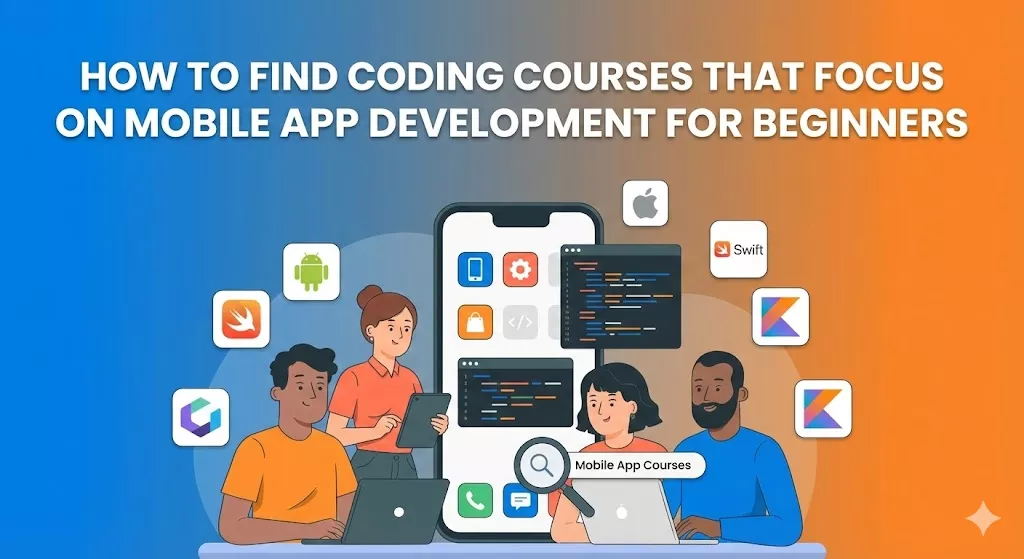
How to Find Coding Courses That Focus on Mobile App Development for Beginners?
Here’s a reality that most mobile development courses won’t tell you upfront: you’re choosing between two completely different career paths before you even write your first line of code.
After years watching beginners navigate mobile development education, I’ve identified the core problem. Someone decides “I want to build mobile apps.” They find a course that looks good. Three weeks in, they realize they chose iOS when they should have picked Android, or vice versa. Or they’re learning native development when they should have started with cross-platform. Or they jumped into React Native without understanding JavaScript first.
The choice paralysis is real: iOS or Android? Swift or Kotlin? Native or cross-platform? React Native, Flutter, or something else? And that’s before you even get to which course teaches these technologies effectively for actual beginners.
Let me show you how to navigate these decisions strategically, which courses actually teach mobile development to beginners (versus assuming you already know programming), and how to avoid the expensive mistakes most people make.
Why Most Mobile Dev Courses Fail Beginners
Before we look at specific courses, understand why generic “mobile development” courses often disappoint:
Problem 1: Wrong Starting Assumptions
Most courses assume:
- You already know a programming language
- You understand object-oriented programming
- You’re comfortable with IDEs and development tools
- You know which platform (iOS/Android) you’re targeting
Actual beginners:
- Might have never coded before
- Don’t know what “object-oriented” means
- Have never used Xcode or Android Studio
- Haven’t decided iOS vs. Android yet
This gap creates immediate frustration.
Problem 2: Platform Lock-In Without Guidance
Courses teach: “Here’s how to build iOS apps with Swift” or “Here’s Android with Kotlin”
What beginners need: “Here’s why you should choose iOS vs. Android based on your goals, then here’s how to learn your choice”
Most courses dive into one platform without helping you make the platform decision first.
Problem 3: Native vs. Cross-Platform Confusion
The reality: You can build mobile apps with native technologies (Swift for iOS, Kotlin for Android) or cross-platform tools (React Native, Flutter, etc.)
The confusion: Courses don’t explain tradeoffs. Beginners don’t know which approach suits their goals.
Problem 4: Missing Fundamentals
What happens: Beginners jump straight into mobile development without programming foundations. They’re learning Swift syntax, iOS APIs, and app architecture simultaneously. It’s overwhelming.
What works better: Learn programming fundamentals first, then apply them to mobile development.
The Decision Tree: Which Mobile Development Path?
Before looking at courses, you need to choose your path. Here’s how:
Question 1: Do You Have Programming Fundamentals?
If NO (complete beginner):
Don’t jump straight into mobile development courses. You’ll struggle.
Spend 4-8 weeks learning programming basics first. Understanding variables, loops, functions, and basic data structures makes everything else easier.
If YES (you know at least one language):
You’re ready for mobile-specific courses. Your existing programming knowledge transfers.
Question 2: iOS or Android?
Choose iOS if:
- You own a Mac (required for iOS development)
- Your target market uses iPhones (US, Western Europe)
- You prefer Apple’s ecosystem and design philosophy
- You’re interested in Swift (cleaner, more modern language)
Choose Android if:
- You don’t own a Mac (Android development works on any OS)
- Your target market is global (Android dominates worldwide)
- You want to reach more users (Android has larger market share)
- You prefer more open ecosystem
Can’t decide?
Start with cross-platform development (React Native or Flutter). Build once, deploy to both iOS and Android. Lower learning curve for beginners, wider reach.
Question 3: Native or Cross-Platform?
Native (Swift/SwiftUI for iOS, Kotlin for Android):
Pros:
- Best performance and platform integration
- Access to latest platform features immediately
- Preferred by many employers for full-time roles
Cons:
- Need to learn separate languages/tools for each platform
- Maintaining two codebases if you want both iOS and Android
Cross-platform (React Native, Flutter):
Pros:
- One codebase for both platforms
- Faster development, lower cost
- Good enough performance for most apps
- Growing job market
Cons:
- Slight performance compromises
- Sometimes delayed access to newest platform features
- Might need native code for some advanced features
For beginners:
Cross-platform (especially React Native if you know JavaScript, or Flutter) is often the better starting point. You learn mobile concepts once and deploy everywhere.
The Best Courses for Mobile Development Beginners
Now that you’ve chosen your path, here are the best courses for each:
For Complete Programming Beginners
Before diving into mobile development, build fundamentals:
CS50’s Introduction to Computer Science (Harvard via edX) – Free
What it teaches: Programming fundamentals using C, then Python, then web development. The mobile development comes after you have foundations.
Why start here: CS50 teaches you to think like a programmer. Once you understand these concepts, learning Swift, Kotlin, or JavaScript for mobile becomes much easier.
Time commitment: 10-12 weeks, 10-20 hours per week
After CS50: You’re ready for mobile-specific courses with solid foundation.
freeCodeCamp – Free
What it offers: Web development fundamentals (HTML, CSS, JavaScript). If you’re going the React Native route, this JavaScript foundation is essential.
Why it works: JavaScript knowledge transfers directly to React Native. You learn programming through web, then apply to mobile.
Time commitment: Self-paced, 300+ hours for certifications
For iOS Development (Native)
Angela Yu’s iOS Development Bootcamp (Udemy) – Usually $10-$15 on sale
What it teaches: iOS development from absolute beginner to building real apps. Covers Swift, SwiftUI, UIKit, APIs, databases, and deployment.
Why it works for beginners: Angela assumes zero iOS knowledge. She explains concepts clearly, builds real projects, and maintains the course regularly (currently updated for latest Swift/iOS versions).
The course includes 50+ hours of video, projects like building a weather app, chat app, and more.
Requirements: Mac computer (iOS development requires Xcode which only runs on Mac)
Best for: Beginners committed to iOS who want comprehensive, well-maintained course.
100 Days of SwiftUI (Paul Hudson) – Free
What it teaches: SwiftUI (Apple’s modern UI framework) through 100 days of progressive projects.
Why it’s excellent: Completely free. Paul Hudson is one of the best iOS educators. The daily structure creates consistency.
You build real projects, not just follow tutorials. By day 100, you’ve built substantial apps.
Format: Daily lessons with projects. Free on Hacking with Swift website.
Best for: Self-motivated learners who can commit to daily practice and want free, high-quality iOS education.
Stanford CS193p (Developing Apps for iOS) – Free
What it teaches: University-level iOS course from Stanford. Currently teaches SwiftUI.
Why it’s valuable: Actual Stanford course available free on YouTube. High-quality instruction covering architecture, design patterns, and best practices.
The challenge: More academic and theoretical than bootcamp-style courses. Moves quickly. Better for people with some programming experience.
Best for: People who want rigorous, university-quality education and can handle faster pace.
For Android Development (Native)
Android Basics in Kotlin (Google) – Free
What it teaches: Official Android course from Google. Teaches Kotlin and Android development from scratch.
Why it’s great for beginners: Created by Google specifically for beginners. Free, high-quality, and kept current with latest Android development practices.
Covers layouts, navigation, data persistence, networking, and more. Includes hands-on codelabs (interactive tutorials).
Format: Self-paced with pathways guiding you through topics progressively.
Best for: Beginners wanting official, free Android education directly from Google.
The Complete Android Development Bootcamp (Angela Yu on Udemy) – Usually $10-$15 on sale
What it teaches: Android development from beginner to building real apps with Kotlin.
Why Angela Yu again: She’s excellent at teaching beginners. The Android course has same quality as her iOS course.
Covers Kotlin, Android Studio, Jetpack Compose (modern UI), APIs, Firebase, and deployment to Google Play.
Best for: Beginners who want comprehensive, well-structured Android course with lifetime access.
Developing Android Apps with Kotlin (Udacity/Google) – Free
What it teaches: Android development using Kotlin and modern Android architecture.
Why it works: Free course created by Google. High production quality. Focuses on current best practices.
The structure: Video lessons with coding exercises. More structured than Google’s Android Basics codelabs.
Best for: Beginners comfortable with self-paced learning who want free, structured Android education.
For Cross-Platform Development (React Native)
React Native – The Practical Guide (Udemy, Maximilian Schwarzmüller) – Usually $10-$15 on sale
What it teaches: Building iOS and Android apps with React Native. Covers components, navigation, styling, device features, deployment.
Prerequisites: JavaScript knowledge required. If you don’t know JavaScript, take a JavaScript course first.
Why it’s good for beginners: Maximilian is excellent at explaining concepts. The course is well-maintained and regularly updated.
Best for: People with JavaScript knowledge who want to build mobile apps for both platforms.
CS50’s Mobile App Development with React Native (Harvard) – Free
What it teaches: Mobile development using React Native, taught at Harvard level.
Prerequisites: CS50 or equivalent programming knowledge. Some JavaScript helpful.
Why it’s valuable: University-quality education for free. Covers mobile-specific concepts well.
The challenge: Moves at university pace. Assumes programming fundamentals.
Best for: People with programming background who want rigorous, free mobile development education.
React Native Tutorial for Beginners (YouTube, Programming with Mosh) – Free
What it teaches: React Native basics in a comprehensive YouTube course.
Why it works: Completely free. Mosh is a clear teacher. Covers fundamentals in focused video.
Limitation: Single long video rather than structured course. No exercises or projects.
Best for: Getting started with React Native to see if you like it before paying for courses.
For Cross-Platform Development (Flutter)
Flutter & Dart – The Complete Guide (Udemy, Maximilian Schwarzmüller) – Usually $10-$15 on sale
What it teaches: Building iOS and Android apps with Flutter. Covers Dart language, Flutter widgets, state management, navigation, deployment.
Why it’s comprehensive: Maximilian’s courses are thorough and well-explained. This covers everything from Dart basics to advanced Flutter concepts.
Best for: Beginners choosing Flutter over React Native. Good if you don’t know JavaScript but want cross-platform development.
Flutter Apprentice (Kodeco, formerly Ray Wenderlich) – $60 book + video
What it teaches: Flutter through building real apps. Project-based learning approach.
Why it works: Kodeco creates high-quality iOS/Android learning materials. The apprentice series is specifically designed for beginners.
Format: Book + video combination. Hands-on projects throughout.
Best for: People who learn well from books and want quality Flutter education.
Google’s Flutter Codelabs – Free
What it teaches: Hands-on Flutter tutorials from Google. Multiple codelabs covering different aspects of Flutter.
Why it’s valuable: Official Google content. Free. Interactive. Each codelab teaches specific concepts through building.
Best for: Supplementing other Flutter learning or exploring Flutter before committing to paid course.
The No-Code Alternative for Mobile Apps
Before learning traditional mobile development, consider whether no-code tools solve your needs:
Adalo
What it does: Build mobile apps visually without code. Drag-and-drop interface.
Who it’s for: Non-developers who want functioning mobile apps quickly. Entrepreneurs testing app ideas.
Limitations: Limited customization. Apps may feel generic. You’re locked into Adalo platform.
Learning curve: Much shorter than traditional development. Days vs. months.
Glide
What it does: Turns Google Sheets into mobile apps. Good for data-driven apps.
Who it’s for: Business professionals needing internal tools or simple apps.
Limitations: Works best for database-style apps. Not for games or highly interactive apps.
FlutterFlow
What it does: Visual builder for Flutter apps. Generate real Flutter code you can export.
Who it’s for: People who want visual development but also want to learn Flutter eventually.
The advantage: You can export code and continue with traditional Flutter development. Bridge between no-code and real coding.
When no-code makes sense:
- Testing app ideas before learning to code
- Building simple apps quickly
- You’re a business professional, not aspiring developer
- Budget/time constrained
When to learn real mobile development:
- You want developer career
- You need custom functionality no-code can’t provide
- You want full control over your apps
- You’re building complex applications
Common Mistakes Beginners Make
Mistake 1: Skipping Programming Fundamentals
Jumping directly into Swift or Kotlin without understanding basic programming creates struggle.
Fix: Spend 4-8 weeks on fundamentals if you’re a complete beginner. Learn variables, loops, functions, data structures basics.
This foundation makes learning any mobile language dramatically easier.
Mistake 2: Trying to Learn Both iOS and Android Simultaneously
Some beginners think they should learn both platforms at once to be “full mobile developer.”
Fix: Pick one platform. Master it. Then learn the second if needed. Trying both simultaneously means mastering neither.
Or choose cross-platform (React Native/Flutter) and build for both with one codebase.
Mistake 3: Tutorial Hell
Watching endless tutorials, building tutorial projects, but never building anything original.
Fix: After completing a course or tutorial, build something yourself without following instructions. Even if it’s similar to tutorial project, doing it independently reveals what you actually learned.
Mistake 4: Not Testing on Real Devices
Building apps in simulator/emulator only. Never testing on actual phones.
Fix: Test on real devices. Simulators don’t catch everything. Performance, touch interactions, camera access, all behave differently on real devices.
Mistake 5: Ignoring Design and UX
Building functional apps that look terrible and are hard to use.
Fix: Learn basic mobile UI/UX principles alongside coding. Mobile apps live or die on user experience, not just functionality.
Study Human Interface Guidelines (iOS) or Material Design (Android).
Mistake 6: Not Learning Version Control (Git)
Building without version control, losing work, or unable to collaborate.
Fix: Learn Git basics early. Every professional developer uses version control. Start good habits immediately.
How to Choose Based on Your Goals
Your learning path should match your actual goals:
Goal: Get a Job as Mobile Developer
Best path: Learn native development (Swift for iOS or Kotlin for Android) deeply. Most full-time positions prefer native expertise.
Courses: Angela Yu’s bootcamps (iOS or Android) or Google’s Android courses. Build substantial portfolio projects.
Time investment: 6-12 months of focused learning to become job-ready.
Goal: Build Your Own App Idea
Best path: Cross-platform (React Native or Flutter) gets you to market faster. Or consider no-code if app is simple.
Courses: Maximilian’s React Native or Flutter courses. Focus on building your specific app, not completing every lesson.
Time investment: 3-6 months to build a working app if you’re focused.
Goal: Freelancing or Indie Development
Best path: Cross-platform maximizes your market (you can build for both iOS and Android clients).
Courses: React Native or Flutter comprehensive courses. Also learn business/marketing basics.
Time investment: 6-9 months to be ready for client work.
Goal: Add Mobile Skills to Existing Career
Best path: Depends on your current role. Product managers might want technical literacy. Designers might want to prototype with Flutter. Decide how deep you need to go.
Courses: Shorter, focused courses on specific aspects rather than comprehensive bootcamps.
Time investment: 1-3 months for practical skills relevant to your role.
Goal: Just Want to Build Apps as Hobby
Best path: Whatever interests you most. No career pressure means you can explore freely.
Courses: Free courses (CS50, Paul Hudson’s 100 Days, Google’s Android Basics) since you’re learning for fun.
Time investment: As long as it remains enjoyable. No rush.
The Recommended Learning Path
Here’s a practical roadmap that works:
Months 1-2: Programming Fundamentals (If Needed)
If you’re a complete beginner:
Take CS50 or complete freeCodeCamp’s JavaScript curriculum. Build solid programming foundation.
If you already know programming:
Skip to Month 3.
Month 3: Platform/Framework Decision
Choose your path:
- iOS (Swift/SwiftUI)
- Android (Kotlin)
- Cross-platform (React Native or Flutter)
Start the course: Begin Angela Yu’s bootcamp, Google’s Android course, or Maximilian’s cross-platform course based on your choice.
Months 4-6: Core Mobile Development
Focus on:
- Platform-specific UI components
- Navigation and routing
- Handling user input
- Working with APIs
- Data persistence
Build projects: Clone simple popular apps (calculator, weather app, todo list) to practice concepts.
Months 7-9: Advanced Topics and Real Projects
Learn:
- State management
- Authentication
- Push notifications
- App deployment
Build original apps: Create 2-3 apps that showcase different skills. These become your portfolio.
Months 10-12: Polish and Professional Skills
Focus on:
- App optimization and performance
- Testing and debugging
- Publishing to App Store/Play Store
- Building portfolio
- (If seeking jobs) Interview preparation
My Honest Recommendations
If you’re a complete beginner:
Start with CS50 or freeCodeCamp to build programming fundamentals. Don’t skip this step.
Then choose cross-platform (React Native if you learned JavaScript, Flutter if you want to start fresh) for wider reach.
Maximilian’s courses on Udemy (usually $10-$15) provide comprehensive, well-taught introductions.
If you have programming background:
Pick iOS (Swift) or Android (Kotlin) based on which ecosystem you prefer or which has better job market in your area.
Angela Yu’s bootcamps provide excellent structured learning. 100 Days of SwiftUI is fantastic free option for iOS.
If you want fastest path to building apps:
Flutter with FlutterFlow (visual builder) gives you quick wins while learning real development.
Or React Native if you know JavaScript already.
If you’re on a tight budget:
Google’s Android Basics in Kotlin (free), Paul Hudson’s 100 Days of SwiftUI (free), or CS50’s mobile course (free) provide quality education without cost.
Supplement with YouTube tutorials and documentation.
If you want job-ready skills:
Focus on native development (iOS or Android). Build substantial portfolio projects demonstrating real-world skills.
Angela Yu’s bootcamps combined with personal projects prepare you for job market.
If you just want to prototype ideas quickly:
No-code tools (Adalo, Glide, FlutterFlow) let you test concepts before investing months in learning to code.
What About Mobile Game Development?
Mobile game development is different from app development:
For games: Unity (C#) or Unreal Engine (C++/Blueprints) are standard, not Swift/Kotlin.
Courses: Look for Unity or Unreal courses specifically, not general mobile development courses.
Different skill set: Game development focuses on game engines, physics, graphics. App development focuses on UI, data, APIs.
The Bottom Line
Mobile development courses for beginners exist, but choosing the right path matters more than choosing the perfect course:
The key decisions:
- Do you need programming fundamentals first? (Usually yes for complete beginners)
- iOS, Android, or cross-platform?
- Native or cross-platform development?
- Career goal or personal project?
Best courses by path:
- iOS: Angela Yu’s bootcamp or 100 Days of SwiftUI
- Android: Google’s Android Basics or Angela Yu’s Android bootcamp
- React Native: Maximilian’s course or CS50 mobile
- Flutter: Maximilian’s Flutter course or Google’s codelabs
The strategic approach:
- Build programming fundamentals if needed (1-2 months)
- Choose platform based on goals and resources
- Take comprehensive course in chosen platform (3-6 months)
- Build original projects, not just tutorials (3-6 months)
- Deploy real apps to store for portfolio
The budget-friendly path: CS50 → Google’s Android Basics (all free) or freeCodeCamp → 100 Days of SwiftUI (all free)
The fastest path to apps: JavaScript basics → React Native course → build your specific app idea (3-6 months)
The career path: Programming fundamentals → Native platform (Swift or Kotlin) → Build substantial portfolio → Apply for jobs (6-12 months)
Don’t get paralyzed by choices. Pick a path (iOS, Android, or cross-platform), find a highly-rated course for that path, and start building. You can always learn additional platforms later.
The best mobile development course is the one you’ll actually complete and apply by building real apps, not the one with the most stars or the fanciest marketing. Start with clear goals, choose your platform strategically, and focus on building rather than endlessly researching courses.