
Stop Memorizing Code. Start Building With It.
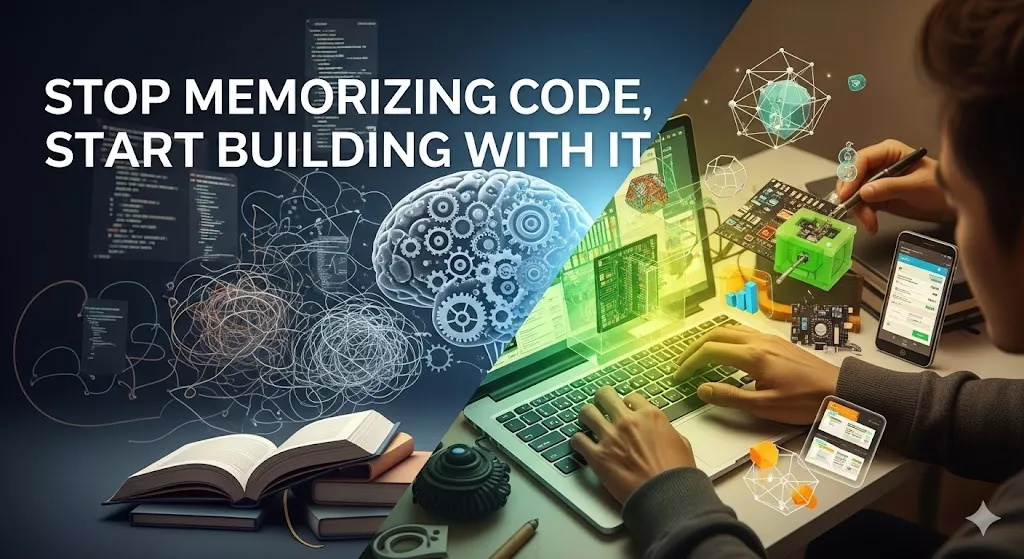
Most non-technical people approach coding the way they approached high school exams: like learning French vocabulary or memorizing historical dates. They assume that if they just memorize enough JavaScript commands, they will magically become a software engineer.
They don’t realize that coding is much closer to playing with Lego blocks. You don’t memorize every possible castle you can build; you learn how the individual pieces snap together so you can build whatever you want. If they just “learn by heart,” the moment they face a bug or a unique feature request, they will completely freeze.
And that freeze? It’s exactly where most aspiring developers give up.
The Memorization Trap
Here’s how the trap works. You sign up for a course. You watch someone build a to-do app. You follow along, line by line. It works. You feel great. Then you close the tutorial, open a blank editor, and try to build something slightly different — say, a habit tracker instead of a to-do list — and your mind goes blank.
This isn’t a sign that you’re “not cut out for coding.” It’s a sign that you were never actually learning to code. You were learning to copy.
There’s a massive difference between recognizing a for loop when you see one and knowing when and why to reach for one. The first is memorization. The second is problem-solving. And problem-solving is the entire game.
Think about it this way: nobody who memorized a French dictionary ever became fluent in French. Fluency comes from using the language — awkwardly at first, then with increasing confidence — to express ideas you’ve never expressed before. Code works the same way.
The Lego Model of Learning
When a kid sits down with a pile of Lego bricks, nobody hands them a list of every possible structure and says “memorize these.” Instead, they learn a few fundamental things:
- These flat pieces make good foundations.
- These tall pieces make good walls.
- If you connect pieces this way, they hold. If you connect them that way, they fall apart.
Armed with just those basics, a kid can build a house, a spaceship, a robot, or something that doesn’t have a name yet. The creativity comes from understanding how pieces interact, not from memorizing finished products.
Programming works exactly the same way. The “Lego pieces” of code are things like variables, conditionals, loops, functions, and data structures. They’re simple individually. But the magic is in learning how they snap together to solve problems you’ve never seen before.
A developer who truly understands how a hash map works, when to use recursion versus iteration, and how to break a messy real-world problem into clean logical steps — that developer can build almost anything. Not because they’ve memorized the answer, but because they know how to construct one.
Why This Matters More Than Ever in the Age of AI
Here’s where it gets interesting. AI can now write code. Tools like ChatGPT and Copilot can generate a for loop, a database query, or a React component in seconds. The memorization part of programming — the part most beginners spend all their time on — has been almost entirely automated.
So what’s left? The thinking.
AI is excellent at producing code when you tell it exactly what to build. But someone still has to figure out what to build, why to build it, and how the pieces should fit together. Someone still has to look at a vague business requirement — “we need users to be able to track their spending” — and decompose it into a logical architecture. Someone still has to debug the mess when the AI-generated code doesn’t quite work.
That someone is a problem-solver, not a memorizer. And that’s exactly the kind of developer who will thrive in the years ahead, while the “I memorized 500 LeetCode solutions” crowd struggles to adapt.
What Problem-Solving Actually Looks Like
Let’s make this concrete. Say you’re asked to build a feature that finds the cheapest way to ship a package through a network of warehouses. A memorizer might panic: “I’ve never seen this exact problem before.” A problem-solver thinks differently:
“Okay, I’ve got locations and connections between them, each with a cost. That’s a graph. I need the cheapest path. That sounds like a shortest-path problem. I know Dijkstra’s algorithm handles weighted graphs. Let me start there and adjust as I learn more about the constraints.”
Notice what happened. The problem-solver didn’t pull the answer from memory. They translated a real-world situation into a structure they understood, connected it to a concept they’d practiced, and reasoned their way toward a solution. That translation skill — from messy reality to clean logic — is the actual core skill of software engineering.
And it’s a skill you build through practice, not flashcards.
How to Actually Learn This Way
If you’re currently stuck in the memorization loop, here’s how to break out:
Start with the problem, not the syntax. Before you write a single line of code, practice describing problems in plain English. “I need to check every item in this list and keep only the ones above a certain value.” Once you can articulate the logic clearly, the code almost writes itself.
Build things that aren’t in the tutorial. The moment you finish a guided project, change it. Add a feature the instructor didn’t cover. Break it on purpose and fix it. This is where actual learning happens — in the gap between the tutorial and your own idea.
Learn patterns, not solutions. Instead of memorizing that “Problem #247 uses a two-pointer technique,” understand why two pointers work: when you have a sorted structure and need to find pairs that meet a condition, scanning from both ends is more efficient than checking every combination. Now you can apply that pattern to problems you’ve never seen.
Get comfortable being stuck. The feeling of “I have no idea how to do this” isn’t failure. It’s the feeling of learning. Every experienced developer spends a significant portion of their day confused. The difference is they’ve developed the confidence and the toolkit to work through it.
Explain your reasoning out loud. If you can’t explain why you chose a particular approach, you don’t truly understand it yet. Practice talking through your logic, even if it’s just to yourself. This is, incidentally, exactly what interviewers are listening for — not whether you memorized the optimal solution, but whether you can think.
The Uncomfortable Truth About Tech Interviews
Speaking of interviews: the best tech companies already test for this. When a Google or Meta interviewer asks you to solve an algorithm problem on a whiteboard, they’re not checking whether you’ve seen that exact problem before. They’re watching how you think. Do you ask clarifying questions? Do you consider edge cases? Can you start with a brute-force approach and then reason about how to improve it?
Candidates who memorized solutions often give themselves away. They jump straight to the optimal answer without showing any thought process, or they crumble the moment the interviewer tweaks the problem slightly. Meanwhile, candidates who learned to problem-solve can handle curveballs — because they’re not retrieving an answer, they’re building one in real time.
The Bottom Line
Learning to code by memorizing syntax is like learning to cook by memorizing recipes. It might get you through a dinner party, but you’ll never be able to improvise, adapt to missing ingredients, or invent something new.
The developers who build careers — the ones who get hired, who get promoted, who build products that matter — are the ones who learned to think in code, not just write it.
So put down the flashcards. Pick up the Lego bricks. And start building.