
Vibe Coding: Jet Pack or Blindfold? Why Your Coding Fundamentals Determine Which One You Get
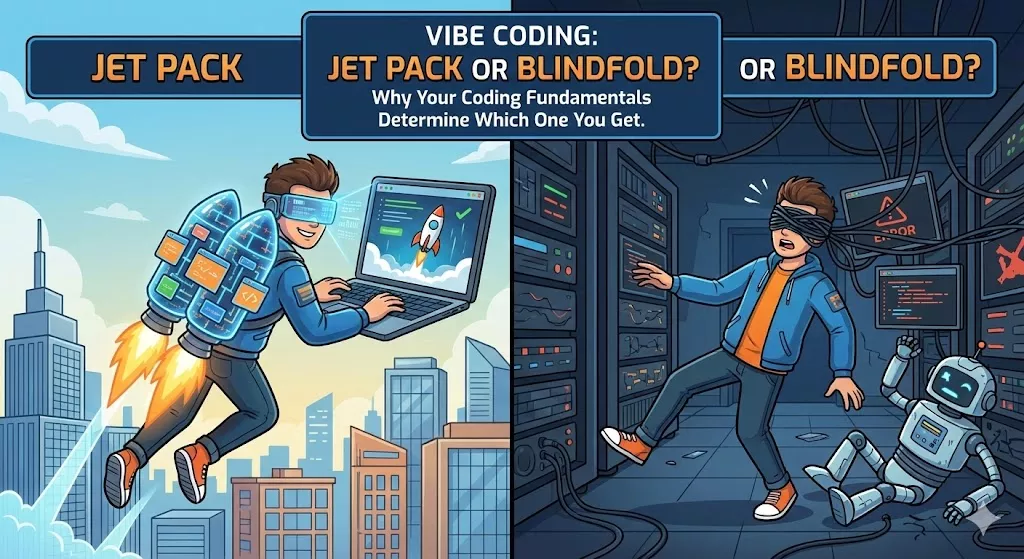
I saw a post recently that I haven’t been able to get out of my head. Someone wrote that when you’re technical and know what you’re doing, vibe coding is like having a jet pack. But if you’re a novice, it’s like wearing a blindfold.
That’s it. That’s the whole AI coding debate in two sentences.
What Is Vibe Coding, Anyway?
“Vibe coding” is when you use AI tools like ChatGPT, Claude, or GitHub Copilot to write code by just describing what you want. You explain the vibe of what you’re building, and the AI produces the code.
Sounds magical. And honestly, it kind of is. If you know what you’re looking at.
The Jet Pack Effect
For experienced developers, AI coding tools really are a superpower. Here’s what having a “jet pack” looks like in practice:
You ask the AI to generate a function. It spits out 40 lines of code. In seconds, you can tell whether it’s using the right data structure, whether the time complexity makes sense for your use case, whether there are edge cases it missed, and whether the approach fits your existing architecture.
You’re not reading every line. You’re pattern-matching against years of accumulated knowledge. When something looks off, alarm bells ring. You know what questions to ask and how to verify the answers.
The AI handles the boilerplate. You handle the thinking. You move at 10x speed because you’ve outsourced the typing, not the understanding.
The Blindfold Problem
Now imagine you’re new to coding. You ask the same question. You get the same 40 lines.
But you have no idea if it’s right.
You can’t tell if the code is elegant or a disaster waiting to happen. You don’t know if it’ll break at scale, introduce security vulnerabilities, or fail silently in edge cases. You copy, paste, and pray.
When it works, you feel like a genius. When it breaks (and it will break), you’re lost. You can’t debug code you don’t understand. You can’t modify code when requirements change. You’re dependent on asking the AI again and hoping it gives you something better.
This isn’t learning. It’s building on sand.
The Uncomfortable Truth About Shortcuts
Here’s what nobody wants to hear: AI tools have made coding fundamentals more important, not less.
Seems counterintuitive, right? If the AI writes the code, why do I need to understand it?
Because the AI is a tool, not a teacher. It doesn’t know your constraints, your context, or your goals. It doesn’t know that your application needs to handle 10,000 concurrent users, or that your company has specific security requirements, or that the “simple” approach will create technical debt that haunts you for years.
You need to know these things. And you need enough foundational knowledge to translate that understanding into good decisions about the code the AI generates.
The Knowledge Threshold
There’s a threshold of understanding you need to cross before AI becomes your jet pack instead of your blindfold. That threshold includes a few things.
First, understanding what code actually does. Not just “this function sorts an array,” but how it sorts, why that matters, and when you’d choose a different approach.
Second, recognizing patterns. Experienced developers don’t read code line by line. They recognize structures. “Oh, this is a binary search.” “This is the observer pattern.” “This is recursion with memoization.” Without this vocabulary, you’re reading a foreign language character by character.
Third, knowing what questions to ask. When AI gives you code, you should immediately wonder: What’s the time complexity? What happens with empty input? What if this runs concurrently? If you don’t know to ask these questions, you won’t catch the problems until production.
And finally, debugging intuition. When something breaks, where do you look? Experienced developers have a mental model of how data flows through a system. Beginners stare at error messages like they’re written in hieroglyphics.
The Path Forward
If you’re learning to code in 2025, here’s the uncomfortable reality: you need to do the hard work first.
That means writing code by hand, even when it’s slow. Understanding why solutions work, not just that they work. Building mental models of how programs execute. Struggling through problems before reaching for AI help. Learning to read and debug code you didn’t write.
This isn’t about avoiding AI tools. It’s about earning the right to use them effectively.
Once you’ve built that foundation, AI becomes incredibly powerful. You can prototype faster, explore solutions you wouldn’t have considered, and automate the tedious parts of development. The jet pack is real. You just have to learn to walk before you can fly.
The Bottom Line
AI hasn’t changed what it takes to be a good developer. It’s just made the gap between good developers and everyone else more visible.
If you’re relying on AI to do your thinking, you’re building a career on borrowed understanding. Eventually, the bill comes due.
But if you’re using AI to amplify genuine knowledge? You’re living in the best time in history to be a developer.
The jet pack is waiting. But first, you have to take off the blindfold.
Learning to code the right way? Our step-by-step tutorials build the foundational knowledge you need to use AI tools effectively, not as a crutch, but as the jet pack they’re meant to be.