
Affordable Coding Challenge Subscriptions: What You Actually Get for Your Money
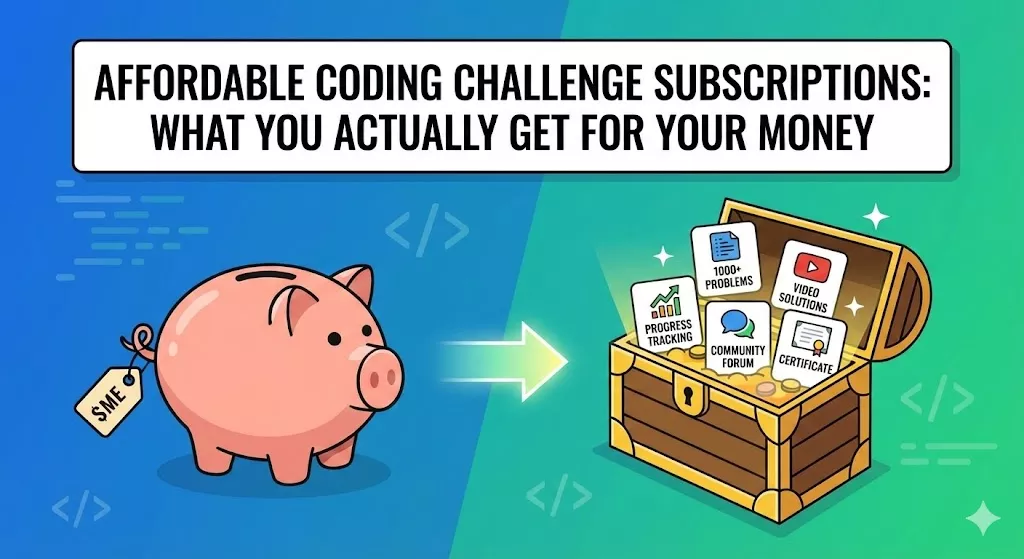
You want to practice coding problems. You’ve seen the free tiers. They’re limited. Now you’re wondering which paid subscription is worth it.
This isn’t a ranked listicle pretending to be objective while collecting affiliate commissions. I’ll tell you what each platform actually offers, what it costs, and who it’s best for. Then you can decide.
What You’re Actually Paying For
Before comparing platforms, understand what separates paid tiers from free ones. It’s usually some combination of:
More problems. Free tiers often lock the harder or more interesting challenges behind a paywall.
Solutions and explanations. You can attempt problems for free, but seeing how to solve them requires payment.
Company-specific questions. Want to know what Google or Amazon actually asks? That’s usually premium content.
No ads or distractions. Some platforms are aggressive with free-tier advertising.
Additional features. Video explanations, debugging tools, progress tracking, mock interviews.
The question is which of these matter for your goals and whether the price is reasonable for what you get.
The Major Platforms
LeetCode
LeetCode is the default choice for technical interview prep. It has the largest problem set, the most active community, and the closest alignment with what big tech companies actually ask.
Free tier: Access to around 2,000 problems, basic filtering, discussion forums. The free tier is genuinely usable. Many people prepare for interviews using only free LeetCode.
Premium ($35/month or $159/year): Unlocks company-tagged questions (see which problems Facebook, Google, Amazon asked recently), official solutions and video explanations, sorting by frequency, and some additional features like a debugging tool.
Who it’s for: Anyone preparing for technical interviews at competitive companies. The company tags alone are worth the premium for many people.
The downside: LeetCode assumes you already know how to code. It throws problems at you without teaching problem-solving approaches. If you’re not already intermediate level, you’ll struggle and not understand why.
HackerRank
HackerRank started as a platform for companies to screen candidates, and that heritage shows. It’s structured more like tests than practice.
Free tier: Large problem library across many domains (algorithms, databases, regex, AI). Completely free to practice. No paywalled problems.
Paid tier: HackerRank’s paid offerings are mostly for companies doing hiring, not for individual learners. As a learner, you don’t really need to pay.
Who it’s for: People who want variety beyond just algorithms. HackerRank has SQL challenges, shell scripting, regex practice, and more. Also useful if you’re preparing for a HackerRank screening specifically, since you’ll be familiar with the interface.
The downside: The interface feels dated. Problems often have awkward input/output requirements. It’s less focused than LeetCode for pure interview prep.
Codewars
Codewars takes a different approach. Problems are called “kata” and organized by difficulty (8 kyu to 1 kyu, borrowing from martial arts). It’s more gamified than LeetCode.
Free tier: All problems are free. No paywalled content.
Paid tier ($9.99/month): Removes ads, adds some convenience features, supports the platform. But you don’t need it to access problems.
Who it’s for: People who enjoy gamification and want to practice in many languages. Codewars supports dozens of programming languages. The community creates problems, so there’s huge variety.
The downside: Less directly mapped to interview questions. The difficulty ratings can be inconsistent since problems are community-created. Good for general practice, less targeted for interview prep.
Exercism
Exercism is free and focused on learning languages through practice. Each track teaches a specific language through progressive exercises with mentor feedback.
Free tier: Everything. Exercism is entirely free and open source.
Paid tier: Doesn’t exist. You can donate to support them.
Who it’s for: People learning a new programming language who want structured practice with human feedback. The mentorship model is unique.
The downside: Not designed for interview prep. The problems teach language features, not algorithms. Great for learning Python or Rust, not for practicing dynamic programming.
AlgoCademy
Full disclosure: I built this one. I’ll describe it honestly and let you judge.
AlgoCademy has 300+ interactive lessons covering fundamentals through technical interview prep. The first 150 lessons start from the absolute basics (first lesson is printing to the console) and focus on problem-solving rather than just syntax. The later lessons cover data structures, algorithms, and interview-style problems.
The differentiator is how problems are taught. Instead of just presenting a problem and a solution, lessons break down the thinking process. How do you approach a problem you’ve never seen? How do you recognize which technique applies? The AI tutor gives hints when you’re stuck rather than just showing the answer, which keeps you in the struggle zone where learning actually happens.
Free tier: Access to a portion of the lessons to see if the approach works for you.
Paid tier ($20/month billed annually): Full access to all 300+ lessons, the AI tutor, and everything else.
Who it’s for: Beginners who want to go from zero to interview-ready in one place. Also intermediate developers who’ve been grinding LeetCode but not improving because they’re memorizing solutions without building problem-solving skills.
The downside: Smaller problem library than LeetCode. If you want thousands of problems and company-specific tags, LeetCode Premium has more. AlgoCademy is deeper but narrower.
Neetcode
Neetcode started as a YouTube channel with LeetCode explanations and evolved into a course platform.
Free tier: The curated Neetcode 150 and Neetcode 75 lists are free references. YouTube explanations are free.
Paid tier ($99 one-time for the course): Structured video courses walking through patterns and problems. One-time payment, not subscription.
Who it’s for: People who learn well from video explanations and want a curated path through LeetCode-style problems.
The downside: It’s videos, not interactive practice. You watch, then go to LeetCode to actually do the problems. Some people prefer this separation. Others want everything in one place.
Interview Cake
Interview Cake focuses specifically on interview prep with detailed explanations and hints.
Free tier: Limited. A few sample questions.
Paid tier ($249 one-time or various course bundles): Full access to their problem set with detailed walkthroughs.
Who it’s for: People who want thorough explanations and are willing to pay more for quality over quantity.
The downside: Expensive. Smaller problem set than LeetCode. The one-time pricing is nice but the upfront cost is high.
Price Comparison
Let me put the numbers in one place.
LeetCode Premium: $35/month or $159/year ($13.25/month)
HackerRank: Free for individuals
Codewars: Free, or $9.99/month to remove ads
Exercism: Free
AlgoCademy: $20/month billed annually
Neetcode: $99 one-time
Interview Cake: $249 one-time
If pure cost matters most and you’re preparing for interviews, LeetCode’s free tier plus free resources like Neetcode’s YouTube channel can take you far without spending anything.
If you want a paid option, AlgoCademy at $20/month and LeetCode Premium at $13.25/month (annual) are in a similar range. The trade-off is depth of instruction (AlgoCademy) versus breadth of problems and company tags (LeetCode).
What “Unlimited” Actually Means
Most platforms offer unlimited access to their problem libraries once you’re subscribed. But “unlimited” is a bit misleading if you think about how practice actually works.
Nobody does unlimited coding challenges. You do as many as you can consistently fit into your schedule. Whether a platform has 500 problems or 5,000, you’re probably going to complete somewhere between 50 and 300 during a typical interview prep cycle.
What matters more than raw problem count:
Problem quality. Are the problems well-written with clear explanations?
Difficulty progression. Can you start at your level and build up, or are you thrown into the deep end?
Teaching vs. testing. Does the platform help you learn, or just test whether you already know?
Retention. Will you actually use it consistently, or will it become another unused subscription?
A platform with 200 great problems you’ll actually complete beats a platform with 3,000 problems you’ll abandon after two weeks.
Matching Platform to Goal
Goal: Pass interviews at big tech companies (FAANG, etc.)
LeetCode Premium is the standard choice. Company tags and frequency data are valuable. Supplement with Neetcode’s free YouTube videos for explanations.
If you’re struggling to improve despite doing problems, consider AlgoCademy first to build problem-solving foundations, then move to LeetCode for volume and company-specific practice.
Goal: Learn to code from scratch and eventually interview
AlgoCademy’s full path from basics through interview prep makes sense here. Starting on LeetCode before you have fundamentals is frustrating and ineffective.
freeCodeCamp or The Odin Project (both free) for fundamentals, then AlgoCademy or LeetCode for interview prep, is another reasonable path.
Goal: Get better at coding generally, not specifically for interviews
Codewars or Exercism. Both are free or nearly free. They’re less interview-focused but good for building general programming skill across languages.
Goal: Prepare for a specific company’s process
Research what that company uses. If they use HackerRank for screening, practice on HackerRank. If they’re known for LeetCode-style questions, use LeetCode with company tags.
Goal: Spend as little money as possible
LeetCode free tier plus Neetcode’s YouTube channel plus Exercism for language practice. All free. Genuinely sufficient if you’re disciplined.
The Honest Conclusion
There’s no single best platform. There’s the best platform for your situation.
If money is the primary constraint, free options are good enough. LeetCode’s free tier, HackerRank, Codewars, and Exercism collectively cover almost anything you need.
If you’re willing to pay for a better experience, the decision comes down to what you need. LeetCode Premium for breadth and company-specific prep. AlgoCademy for depth and problem-solving instruction. Neetcode for video-based learning. Interview Cake if you want premium explanations and don’t mind the higher price.
Most people preparing for interviews end up using multiple resources anyway. A common pattern: learn fundamentals somewhere free, use AlgoCademy or Neetcode to understand patterns and approaches, grind LeetCode for volume and company-specific practice, use mock interviews to test readiness.
The platform that works is the one you’ll actually use. Pick something, start today, and adjust based on what you learn about your own needs.
AlgoCademy offers 300+ interactive lessons from beginner basics through technical interview prep, with an AI tutor that teaches problem-solving rather than just presenting problems. $20/month billed annually. Start learning for free at algocademy.com.