Can You Learn to Code on Your Own? What Self-Teaching Actually Looks Like
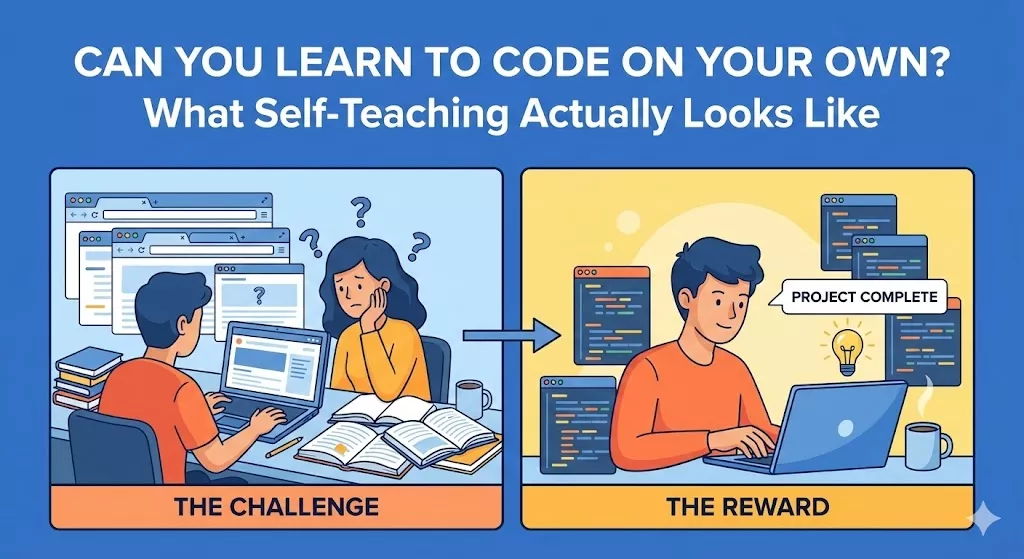
Yes. Plenty of working developers taught themselves. No bootcamp, no computer science degree, just tutorials and projects and persistence.
But “possible” and “easy” aren’t the same thing. Self-teaching works for some people and fails for others, and the difference usually isn’t intelligence. It’s approach.
Here’s what actually determines whether learning on your own will work for you.
The Evidence That It’s Possible
Before getting into the hard parts, let’s establish that self-taught developers aren’t rare exceptions.
Stack Overflow’s developer surveys consistently show that a significant percentage of professional developers are self-taught. Depending on the year and how you count, it’s somewhere between 30% and 50%. These aren’t hobbyists. They’re people with jobs at real companies, building real software.
Some of them learned entirely on their own. Others combined self-study with a bootcamp or some college courses. But the core skill development happened through independent learning.
The resources available today are better than ever. Free curriculums like freeCodeCamp and The Odin Project are comprehensive enough to take someone from zero to job-ready. YouTube has thousands of hours of tutorials from skilled teachers. Documentation is increasingly beginner-friendly. AI tools can explain concepts and help debug when you’re stuck.
The path exists. The question is whether you can walk it.
What Makes Self-Teaching Hard
If self-teaching is possible, why do so many people fail at it? A few reasons.
No external structure
A bootcamp tells you what to learn, in what order, on what schedule. A degree does the same. When you’re teaching yourself, you have to make all those decisions.
This sounds like freedom. Often it becomes paralysis.
Which language should you learn? Which tutorial should you follow? How long should you spend on fundamentals before starting projects? When are you ready to apply for jobs? Nobody tells you. You have to figure it out, and every decision creates doubt.
Some people thrive with this freedom. They enjoy charting their own path. Others spend more time researching what to learn than actually learning. They switch between resources constantly, never going deep on anything, always wondering if they made the wrong choice.
No external accountability
When you pay for a bootcamp or enroll in a class, there are deadlines. Assignments due. Someone noticing if you don’t show up.
When you’re learning alone, nobody cares if you skip a day. Or a week. Or a month. The only person holding you accountable is yourself, and yourself is often tired after work and would rather watch TV.
This is where most self-taught attempts die. Not in a dramatic failure, but in a slow fade. The gaps between study sessions get longer. The momentum disappears. Eventually the bookmark folder of coding resources just sits there, unopened.
No feedback loop
In a class, a teacher looks at your code and tells you what’s wrong with it. In a bootcamp, you get code reviews from instructors or peers.
When you’re alone, your code either works or it doesn’t. If it works, you move on. But “works” and “good” aren’t the same thing. You might be writing functional code that’s also a mess. Bad habits that a mentor would catch in five minutes can become ingrained over months.
This is less of a problem early on. When you’re learning basics, the main feedback you need is “does it run.” But as you advance, the lack of human feedback starts to matter. You don’t know what you don’t know.
Isolation
Learning alone means struggling alone. When you’re stuck at 11pm and nothing makes sense, there’s nobody to ask. You can post on forums, but responses take time. You can ask AI, but sometimes you don’t even know how to phrase the question.
The isolation also affects motivation. You don’t see other people struggling with the same things. You assume everyone else finds this easier. Imposter syndrome thrives in isolation.
What Makes Self-Teaching Work
People who successfully teach themselves usually share certain traits and habits.
They pick one path and stick with it
Successful self-learners resist the urge to constantly switch resources. They pick a reasonable curriculum (freeCodeCamp, The Odin Project, a well-reviewed Udemy course, AlgoCademy, whatever) and follow it to completion before evaluating whether they need something else.
This isn’t because one resource is dramatically better than another. It’s because depth beats breadth. Completing one curriculum teaches you more than starting five.
They build things
Tutorials only take you so far. At some point, you have to close the instructions and try to build something without hand-holding.
This is uncomfortable. You’ll get stuck constantly. You’ll realize you didn’t understand concepts as well as you thought. You’ll spend hours on things that seemed simple.
This discomfort is the learning. The people who push through it develop real skills. The people who stay in tutorial-land forever remain dependent on instructions.
They create accountability
Since external accountability doesn’t exist, successful self-learners manufacture it.
Some commit publicly. They tell friends they’re learning to code. They post progress updates on social media. The fear of public failure keeps them going when motivation dips.
Others use systems. They schedule learning time on their calendar and treat it like a meeting they can’t skip. They use habit-tracking apps. They find an accountability partner learning alongside them.
The specific method matters less than having something. Pure willpower runs out. Systems persist.
They find community
Self-taught doesn’t have to mean isolated.
Discord servers for beginners. Twitter/X communities of people learning in public. Local meetups. Online forums. Study groups with other self-learners.
These communities provide support when you’re stuck, motivation when you’re discouraged, and a reality check on whether you’re progressing. They also provide networking that matters when you start job hunting.
You don’t need to be social to join these communities. Lurking and occasionally asking questions is enough. Just being around other learners helps.
They get comfortable with confusion
Self-learning means spending a lot of time confused with no one to immediately explain things.
The people who succeed develop tolerance for this. They accept that understanding comes slowly. They trust that concepts that seem impossible today will click eventually if they keep showing up.
The people who fail often interpret confusion as a sign they’re not cut out for this. They don’t realize that confusion is normal and universal, not a personal failing.
When Self-Teaching Might Not Be Enough
Self-teaching works for many people, but it’s not the right choice for everyone.
You need structure to function
Some people genuinely need external deadlines and assignments to make progress. There’s no shame in this. It’s self-knowledge.
If you’ve tried self-directed learning before in other areas and consistently failed to follow through, a bootcamp or structured program might be worth the money. You’re paying for accountability as much as content.
You need to switch careers quickly
Self-teaching typically takes longer than a bootcamp. You’re fitting learning around a job and life obligations. You’re making curriculum decisions that slow you down. You don’t have the intensity of full-time immersion.
If you need to be employable in six months rather than twelve to eighteen, a bootcamp might compress the timeline. The trade-off is cost and the requirement to go full-time.
You want the credential
Some employers still filter for degrees or bootcamp certificates. This is becoming less common in tech, but it exists, especially at large traditional companies.
If you’re targeting employers who require credentials, self-teaching alone won’t get you in the door. You’ll need to either get the credential or target companies that don’t require it.
You learn best from live instruction
Some people absorb information better from a person explaining it in real time than from reading or watching recorded videos. If that’s you, a class environment might accelerate your learning enough to justify the cost.
You can partially replicate this with YouTube tutorials and AI explanations. But it’s not quite the same as live instruction where you can ask questions and get immediate clarification.
The Middle Path: Structured Self-Learning
There’s a path between “completely alone” and “expensive bootcamp” that works for a lot of people.
Structured self-learning means using a comprehensive curriculum that tells you what to learn and in what order, but going through it at your own pace without live instruction.
freeCodeCamp and The Odin Project are free versions of this. They provide the structure that prevents paralysis while keeping costs at zero.
AlgoCademy is another option. The first 150 lessons take you from printing to the console through all the fundamentals, with a focus on problem-solving rather than just syntax. The AI tutor gives you hints when you’re stuck, which addresses the “no feedback” problem without requiring a human instructor. You get the structure of a curriculum with the flexibility of self-paced learning.
The advantage of structured self-learning is that it removes the “what should I learn next” decision while keeping costs low and schedule flexible. The disadvantage is that you still need self-discipline to show up consistently.
How to Maximize Your Chances
If you’re going to try self-teaching, here’s how to set yourself up for success.
Commit to a specific schedule
Not “I’ll learn when I have time.” That means never. Pick specific days and times. Treat them as non-negotiable. Start with something sustainable, like 30 to 45 minutes a day, five days a week.
Pick one resource and finish it
Don’t compare ten different options. Pick something reasonable (any of the resources I’ve mentioned work) and commit to completing it before switching. The best curriculum is the one you actually finish.
Build projects as soon as possible
Once you have the absolute basics down, start building. A simple project that you struggle through teaches more than ten tutorials you follow passively.
Start small. A to-do list app. A calculator. A personal website. It doesn’t matter what. What matters is building without step-by-step instructions.
Find at least one community
Join a Discord server, a subreddit, a local meetup. Something. You don’t have to be active. Just being present and seeing others struggle with the same things normalizes the experience.
Track your progress
Keep a log of what you learn. Write short notes after each session. Track your streak of consecutive days practiced.
This serves two purposes. It creates mild accountability. And it gives you evidence of progress when motivation dips. On bad days, you can look back and see how far you’ve come.
Set a checkpoint
Give yourself a defined trial period. One month, two months, whatever seems reasonable. At the end, honestly evaluate: Am I making progress? Am I still interested? Can I see myself doing this for another six months?
This prevents both quitting too early and dragging on forever without real progress.
The Bottom Line
Can you learn to code on your own? Yes. Many people have. The resources are freely available and better than ever.
Will you learn to code on your own? That depends on how well you handle lack of structure, how disciplined you are without external accountability, and whether you can push through months of confusion without a teacher to reassure you.
The honest answer is that self-teaching is harder than having someone guide you. But it’s also free, flexible, and absolutely possible for people with the right approach.
Try it. Give yourself a real chance with a real schedule and a real curriculum. See how it feels. Adjust based on what you learn about yourself.
Worst case, you discover self-teaching isn’t for you and you need more structure. That’s valuable information. Best case, you join the thousands of developers who built careers from free resources and persistence.
Either way, you have to start to find out.
AlgoCademy gives you the structure of a curriculum with the flexibility of self-paced learning. 300+ interactive lessons focused on problem-solving, not just syntax. An AI tutor that helps you through stuck points without just giving away answers. Start from the basics and see if self-teaching works for you. Start learning for free at algocademy.com.