
Can Anyone Learn to Code? The Honest Answer
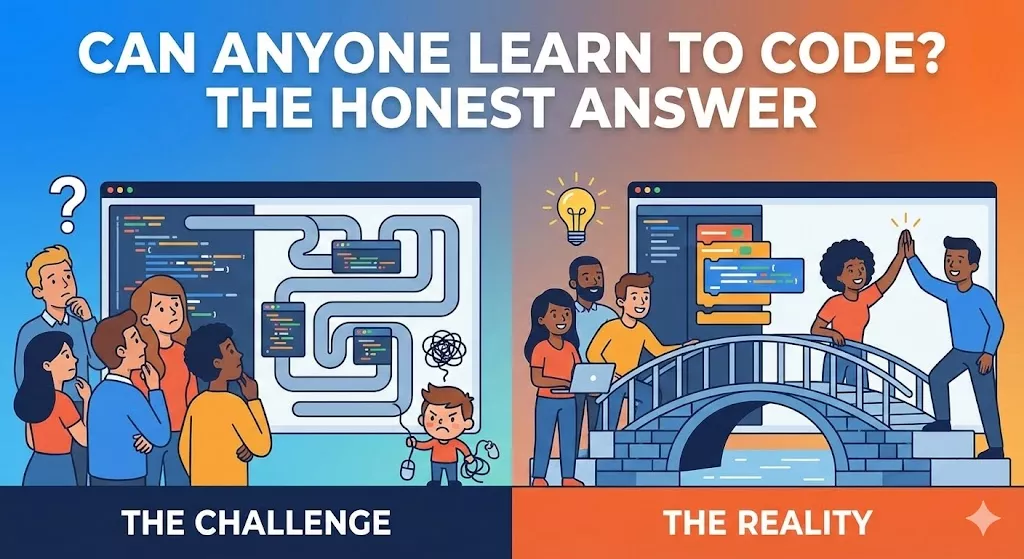
The short answer is yes, almost anyone can learn to code.
The longer answer is that “can” and “will” are different things. Most people have the ability to learn programming. Fewer people have the disposition to push through the frustrating parts. And a small number of people genuinely aren’t suited for it, not because they’re not smart enough, but because the work itself doesn’t match how their brain likes to operate.
Let me break down what actually determines success.
The Myths That Stop People From Starting
“I’m not smart enough”
This is the most common fear, and it’s mostly unfounded.
Programming doesn’t require genius-level intelligence. It requires patience, persistence, and a willingness to be confused for extended periods. Some of the best developers I know describe themselves as average in intelligence but above average in stubbornness.
The confusion is normal. Everyone feels stupid when they’re learning to code. The error messages don’t make sense. The concepts blur together. You fix one bug and create three more. This isn’t a sign that you’re not smart enough. It’s a sign that you’re learning something hard.
The people who succeed aren’t the ones who find it easy. They’re the ones who keep going when it’s hard.
“I’m not good at math”
Most programming has nothing to do with advanced math.
Yes, there are areas of programming that require serious mathematical skill. Graphics programming, machine learning, cryptography, certain algorithms. But the vast majority of working developers rarely use anything beyond basic arithmetic and occasional algebra.
If you struggled with calculus in school, that tells you nothing about whether you can build a web application or write a script to automate your workflow. These are different skills.
The “coding requires math” myth probably comes from computer science degrees, which do include math courses. But plenty of successful developers are self-taught and never touched that math. They learned what they needed for the work they actually do.
“I’m too old”
You’re not.
People learn to code in their 30s, 40s, 50s, and beyond. The human brain remains capable of learning new skills throughout life. It might take a bit longer than it would have at 20. You might have less free time because of work and family. But the ability is there.
The oldest student I’ve heard of who learned to code and got a job was in their 60s. That’s extreme, but it’s not impossible. If you’re younger than that, age isn’t your obstacle.
What might be an obstacle is available time. Learning to code takes consistent effort over months. If your life is so full that you can’t carve out 30 to 60 minutes most days, that’s a real constraint. But it’s not about age. It’s about time.
“You need a special kind of brain”
There’s no “programmer brain.” There’s no gene for coding ability.
Some people pick it up faster than others. That’s true of every skill. But the variation is smaller than people assume. What looks like natural talent is usually prior exposure (someone who played with computers as a kid) or more time spent practicing (someone who codes as a hobby, not just in class).
Studies on this are clear. The best predictor of programming success isn’t IQ or spatial reasoning or any innate trait. It’s practice. Hours spent writing code, making mistakes, and figuring out why things broke.
You don’t need a special brain. You need to put in the work.
What Actually Matters
If natural intelligence isn’t the determining factor, what is?
Tolerance for frustration
This is the big one.
Learning to code involves being stuck constantly. Your code doesn’t work. You don’t know why. You try things. They don’t help. You read documentation that assumes knowledge you don’t have. You Google error messages and find Stack Overflow answers that don’t quite apply to your situation.
This is normal. This is the process. It doesn’t mean you’re doing it wrong.
Some people find this frustration energizing. It’s a puzzle. They want to figure it out. Other people find it demoralizing. Each obstacle feels like evidence that they’re not cut out for this.
If you’re in the second group, you can still learn to code. But you’ll need to actively manage your mindset. Remind yourself that frustration is part of the process, not a sign of failure. Take breaks when you’re stuck. Come back with fresh eyes. Celebrate small wins.
Willingness to be bad at something
Adults often hate being beginners. We’re used to being competent at our jobs, our hobbies, our daily routines. Starting something new means being incompetent again, and that’s uncomfortable.
Learning to code requires months of being bad at coding. Your first programs will be ugly. Your solutions will be inefficient. You’ll make mistakes that seem obvious in retrospect. This is unavoidable.
The people who learn fastest aren’t the ones who avoid mistakes. They’re the ones who make mistakes quickly, learn from them, and move on without spiraling into self-criticism.
Consistency over intensity
Coding for 30 minutes a day, five days a week, beats coding for 8 hours once a month. The brain needs repeated exposure to form new patterns. Long gaps between practice sessions mean you spend half your time relearning what you forgot.
This doesn’t mean you need to quit your job and code full-time. It means you need to show up regularly, even when you’re tired, even when you don’t feel like it. Small consistent efforts compound over time.
The people who fail to learn to code usually don’t fail because they can’t. They fail because they stop. Life gets busy. Motivation fades. The gap between sessions stretches from days to weeks to months, and eventually they never come back.
Curiosity about how things work
This isn’t strictly required, but it helps a lot.
Some people naturally wonder how software works. When they use an app, they think about what’s happening behind the interface. When something behaves unexpectedly, they want to understand why.
If that’s you, programming will probably feel satisfying. You’re building answers to the questions you already have.
If you’ve never once wondered how a website works, you can still learn to code. But you might need to cultivate that curiosity deliberately. Find projects that genuinely interest you. Connect the abstract skills to things you actually care about.
Who Might Genuinely Struggle
I said almost anyone can learn to code. Let me be honest about the exceptions.
People who hate sitting at computers
Programming is screen-based work. For hours. There’s no way around this. If being at a computer for extended periods makes you miserable, programming will make you miserable.
This isn’t a skill gap. It’s a preference mismatch. Some people thrive in physical, hands-on work. They should do that work, not force themselves into a career that conflicts with how they want to spend their time.
People who need immediate results
Programming feedback loops can be long. You might spend days stuck on a problem. You might work for weeks before you have anything to show for it. Progress is often invisible until suddenly it clicks.
If you need constant visible progress to stay motivated, this can be brutal. Some people can adapt. Others genuinely can’t tolerate the ambiguity and should find work with faster feedback.
People who can’t handle ambiguity
Programming rarely has one right answer. There are many ways to solve most problems. Some are better than others, but “better” depends on context and trade-offs. Documentation is often incomplete. Best practices evolve.
If you need clear rules and definite right answers, programming can feel chaotic. The constant judgment calls and trade-off evaluations might exhaust you rather than energize you.
People who are learning for purely external reasons
If you’re only learning to code because someone told you to, or because you think you should, or because it seems like a good career move, that motivation often isn’t enough to push through the hard parts.
The people who succeed usually have some internal pull toward the work. They want to build something. They’re curious about the problems. They find the puzzle-solving at least somewhat satisfying.
External motivation can get you started. It rarely sustains you through months of frustration.
How to Find Out If You Can
Here’s the practical answer to “can I learn to code.”
Try it for two weeks. Not casually. Actually do it. Spend 30 to 60 minutes a day working through a beginner resource. Write code. Get stuck. Try to get unstuck.
After two weeks, check in with yourself. Not “am I good at this yet” because you won’t be. Ask instead: “Do I want to keep going?”
If you felt occasional sparks of satisfaction when something worked, if you found yourself curious about why things behaved the way they did, if the frustration was annoying but not devastating, you can probably learn to code. Keep going.
If every minute was misery, if you felt nothing but dread when you sat down to practice, if you genuinely can’t imagine months more of this, that’s valuable information too. Maybe coding isn’t for you, and that’s fine. You’ve spent two weeks finding out instead of two years.
The Real Barrier
The real barrier to learning code isn’t ability. It’s follow-through.
The people who post online asking “can I learn to code” almost always can. The question is whether they will. Whether they’ll start today instead of next month. Whether they’ll practice when they’re tired. Whether they’ll push through the weeks when nothing makes sense.
I can’t answer that for you. Only you can.
What I can tell you is that the beginning is the hardest part. The confusion peaks in the first few months, then gradually lifts. The people who make it through that initial fog usually make it to competence. The ones who quit during the fog never find out what’s on the other side.
Starting the Right Way
If you’ve read this far and still want to try, here’s how to set yourself up for success.
Pick a structured resource. Having a clear path reduces decision fatigue. freeCodeCamp, The Odin Project, Codecademy, and AlgoCademy all provide structured progression from zero to functional.
Focus on problem-solving from the start. Learning syntax is necessary but not sufficient. The real skill is breaking down problems and figuring out solutions. The sooner you start building that skill, the better.
This is why AlgoCademy’s first 150 lessons focus on problem-solving from day one. The first lesson is printing to the console, but immediately after that, the emphasis shifts to logic and thinking through problems step by step. We built an AI tutor that gives you hints when you’re stuck rather than just showing answers. The struggle is where learning happens, and skipping the struggle means skipping the learning.
Whatever resource you choose, commit to consistency. Two weeks of daily practice to start. Then reevaluate. Then keep going or stop, based on what you actually experienced, not what you imagine it might be like.
You probably can learn to code. The question is whether you will.
AlgoCademy teaches programming fundamentals through 300+ interactive lessons focused on problem-solving, not just syntax. Our AI tutor helps you through the hard parts without skipping the productive struggle. Start from the very basics and find out if coding is for you. Start learning for free at algocademy.com.