Which Programming Language Should I Learn First? An Honest Answer
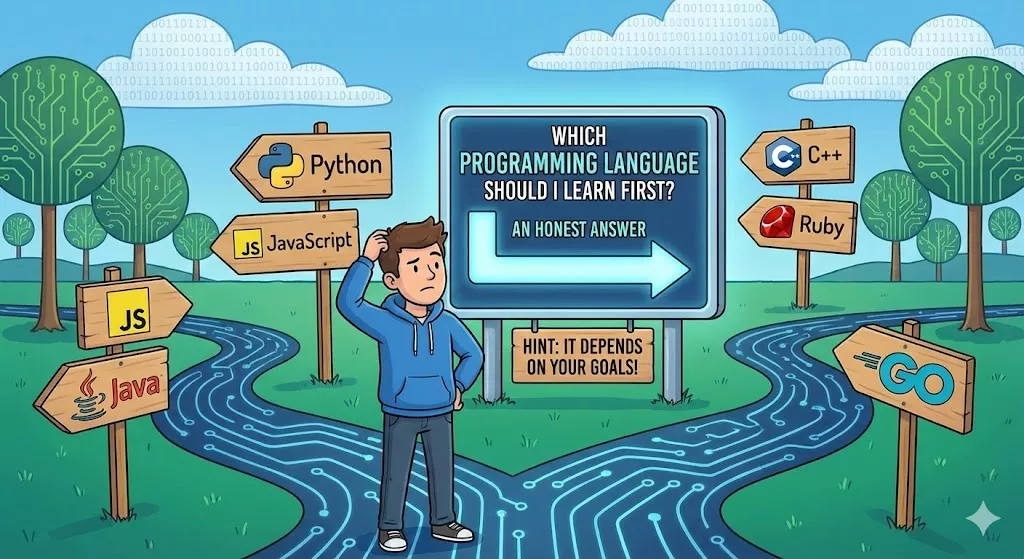
This question has started more Reddit arguments than almost any other topic in programming. Python people swear Python is the obvious choice. JavaScript developers insist you need JavaScript because “it runs everywhere.” Some old-timer will inevitably show up recommending C so you “really understand what’s happening.”
Most of these people are just defending whatever they learned first.
Here’s the honest answer: the language matters less than you think, but it’s not irrelevant either. Let me explain what actually matters when picking your first language, and then give you a real recommendation based on what you’re trying to do.
Why the Language Debate Is Mostly Noise
Programming languages are tools. Asking “which language should I learn” is a bit like asking “which instrument should I learn to make music.” The answer depends on what kind of music you want to make, but also, once you learn one instrument well, picking up others becomes dramatically easier.
The core concepts of programming transfer across languages. Variables, loops, conditionals, functions, data structures. These ideas exist in every language. The syntax is different. The philosophy might be different. But the fundamental mental models are the same.
I’ve watched people spend months researching which language to learn, reading comparison articles, watching YouTube videos, asking on forums. Then they pick Python, do two tutorials, switch to JavaScript because someone told them it’s more marketable, do one tutorial, hear that Rust is the future, and six months later they still can’t write a program that does anything useful.
The language you stick with beats the “perfect” language you abandon.
That said, some languages are genuinely better starting points than others. Let me break down the real considerations.
The Actual Factors That Matter
Syntax Friendliness
Some languages have cleaner, more readable syntax than others. Python reads almost like English. JavaScript has some quirks but is generally approachable. C++ will punish you with semicolons, pointers, and memory management before you even understand what a variable is.
For beginners, friendlier syntax means less friction. You spend more time learning concepts and less time debugging missing brackets.
Error Messages
This one is underrated. When your code breaks (and it will break constantly), the quality of error messages determines how quickly you can fix it and learn from the mistake.
Python’s error messages are decent. Rust’s are famously excellent. JavaScript’s can be cryptic. C’s will sometimes just say “segmentation fault” and leave you to figure out the rest.
Job Market
If you’re learning to code for career reasons, the job market matters. There’s no point becoming an expert in a language nobody hires for.
JavaScript, Python, Java, and TypeScript dominate most job boards. More niche languages like Rust, Go, or Kotlin have smaller but growing markets. Languages like Haskell or Clojure have devoted fans but limited job opportunities outside specific niches.
What You Want to Build
Different languages dominate different domains. If you want to build websites, JavaScript is unavoidable. If you want to do data science or machine learning, Python is the standard. If you want to build mobile apps, you’re looking at Swift, Kotlin, or cross-platform options like React Native or Flutter.
Learning a language that doesn’t apply to your goals creates unnecessary friction.
The Main Contenders
Python
Python is the most recommended first language, and for good reason. The syntax is clean. The community is huge. The applications are broad. You can use Python for web development, data science, automation, scripting, and more.
Python forces good habits like readable indentation. Error messages are reasonably helpful. You can go from zero to “I built something that works” faster than almost any other language.
The downsides: Python is slow compared to compiled languages (though this rarely matters for beginners). And if your goal is front-end web development, you’ll eventually need JavaScript anyway.
JavaScript
JavaScript is the language of the web. Every website you’ve ever visited runs JavaScript in your browser. If you want to build anything users interact with on the internet, you need JavaScript eventually.
The advantage of starting with JavaScript is that you can see results immediately in a browser. No special setup required. You can make things move, respond to clicks, change colors. This visual feedback loop can be motivating for beginners.
The downsides: JavaScript has genuinely weird parts. The type system is loose in ways that cause subtle bugs. The ecosystem moves fast, which means tutorials from two years ago might already be outdated. And JavaScript’s “this” keyword has confused approximately 100% of beginners who’ve encountered it.
Java
Java was the default “teach programming” language for decades. It’s verbose but explicit. It forces you to understand types and object-oriented programming from day one.
Java is still huge in enterprise environments, Android development (though Kotlin is taking over), and backend systems. If you’re targeting a corporate job or want to build Android apps the traditional way, Java is practical.
The downsides: Java is wordy. Printing “Hello World” requires understanding classes, methods, and access modifiers before you even get to the print statement. This front-loaded complexity can be discouraging for beginners.
C
Some people recommend C as a first language because it teaches you “what’s really happening” at a low level. You learn about memory, pointers, how data is actually stored.
I think this is bad advice for most beginners. It’s like recommending someone learn to drive in a manual transmission car with no power steering on a mountain road. Yes, you’ll learn a lot. You’ll also probably crash and give up.
C makes sense as a second or third language once you already understand programming fundamentals. Starting with it is unnecessary suffering for most people.
Rust
Rust is beloved by developers and has topped “most loved language” surveys for years. The compiler catches bugs before they happen. The error messages are helpful. The concepts are modern.
But Rust is hard. It introduces concepts like ownership and borrowing that even experienced developers find challenging. The learning curve is steep. For a first language, it’s probably overkill unless you’re specifically interested in systems programming and have a high tolerance for frustration.
Swift and Kotlin
If you specifically want to build iOS apps, Swift is your language. If you want Android apps, Kotlin is the modern choice. Both are well-designed, relatively friendly languages.
The downside is specialization. If you’re not sure you want to build mobile apps, learning a platform-specific language limits your options.
The Question Behind the Question
Most people asking “which language should I learn” are really asking something else. Usually one of these:
“Which language will get me a job fastest?”
Probably JavaScript or Python. Both have massive job markets across experience levels. JavaScript edges ahead if you want front-end or full-stack roles. Python wins for data-related positions.
“Which language will teach me ‘real’ programming?”
They’re all real programming. But if you want to understand computer science fundamentals deeply, Python is commonly used in university courses and has clean enough syntax that the concepts stay in focus. Java also works for this if you don’t mind verbosity.
“Which language is future-proof?”
Nobody knows. Five years ago people were hyping Ruby on Rails. Now Ruby jobs are harder to find. JavaScript and Python have been dominant for long enough that they’re safe bets for the foreseeable future. But technology shifts, and any language you learn deeply will give you transferable skills.
“Which language is easiest?”
Python, probably. But “easy” is relative. If you’re doing something you care about with a language, the difficulty matters less than your motivation.
My Actual Recommendation
If you have no idea what you want to build and just want to learn programming as a skill, start with Python. It’s the lowest-friction path to understanding core concepts. You can always specialize later.
If you know you want to build websites or web apps, start with JavaScript. You’ll need it eventually, and seeing your code do things in a browser provides satisfying feedback.
If you’re targeting data science, machine learning, or automation, Python is the clear choice. The ecosystem and library support is unmatched.
If you want to build mobile apps and are sure about that, pick Swift (iOS) or Kotlin (Android). Or learn JavaScript and use React Native if you want cross-platform.
If you’re already technical (maybe you work in IT or have dabbled before), Java or Go might suit you if you’re targeting backend development and enterprise environments.
The More Important Question
Here’s what I’ve learned from watching thousands of people try to learn to code.
The language doesn’t determine whether you succeed. Your ability to push through confusion does.
Every beginner hits a wall where the tutorials stop making sense and you don’t know how to build what you want to build. This happens regardless of language. The people who become programmers push through that wall. The people who don’t, don’t.
What helps push through that wall isn’t picking the perfect language. It’s having the right kind of practice. Practice that makes you think, not just copy. Practice that builds problem-solving skills rather than just syntax memorization.
This is why AlgoCademy’s curriculum focuses on problem-solving from the very first lesson. The first 150 lessons take you from printing to the console through all the fundamentals, but the focus is on how to think through problems, not just how to write the code. We have an AI tutor that gives you hints when you’re stuck rather than just showing you the answer, because struggle is where learning happens.
The language is the vehicle. Problem-solving is the skill. Get good at the skill and you can switch vehicles whenever you need to.
Just Start
If you’ve been researching languages for more than a week, you’re procrastinating. Pick Python or JavaScript. They’re both fine. Start today.
Do one lesson. Then another. Keep going until you hit confusion. Push through the confusion. Build something small that you actually care about. Then build something bigger.
A year from now, you’ll either be a programmer or you’ll still be reading articles about which language to learn.
The language won’t make the difference. You will.
AlgoCademy teaches programming fundamentals through 300+ interactive lessons focused on problem-solving, not just syntax. Start from “print to console” and build real thinking skills. Our AI tutor helps you through the hard parts without just giving you answers. Start learning for free at algocademy.com.