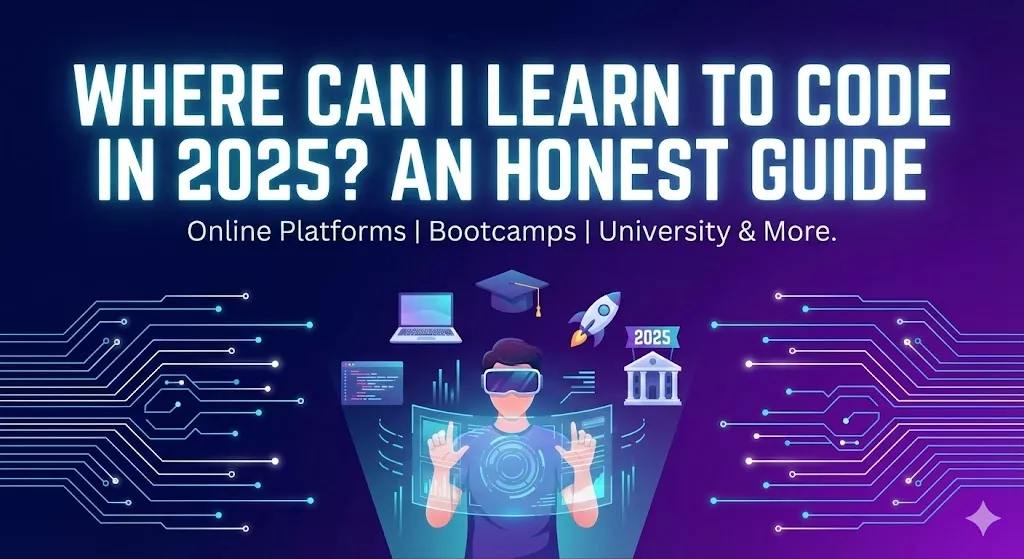
Where Can I Learn to Code in 2026? An Honest Guide
If you Google “where can I learn to code,” you’ll get a wall of listicles ranking the same ten platforms in slightly different orders. Most of these articles are written by people who haven’t actually used the platforms they’re recommending. They’re SEO content farms collecting affiliate commissions.
This isn’t that.
I’m going to tell you what actually works, what doesn’t, and how to pick the right path based on your specific situation. Because the honest answer to “where should I learn to code” is “it depends on who you are and what you’re trying to do.”
The Four Types of Learners
Before picking a platform, you need to figure out which category you fall into. The best resource for one type is often terrible for another.
Type 1: Career Changers
You’re working a job you don’t love. Maybe you’re in marketing, finance, customer support, or something completely unrelated. You’ve heard developers make good money and have interesting problems to solve. You want to switch careers within the next 6 to 18 months.
Type 2: Students
You’re in high school or college. You might be studying computer science formally, or you might be in a completely different field but curious about coding. You have more time than money. You’re not sure yet if this is what you want to do long-term.
Type 3: Entrepreneurs
You have a business idea. You don’t necessarily want to become a full-time developer, but you want to build your own product without hiring expensive contractors. Or you want to understand code well enough to manage a technical team without getting bullshitted.
Type 4: Interview Preppers
You already know how to code. You’ve built things. But you need to pass technical interviews to land the job you want. You’re not learning programming from scratch. You’re learning how to perform programming under interview conditions.
Each of these types needs something different.
The Honest Truth About Free Resources
Let’s start with free options, because that’s where most people begin.
YouTube
YouTube has more free programming content than you could watch in a lifetime. Channels like Fireship, Traversy Media, The Coding Train, and hundreds of others publish genuinely excellent tutorials.
The problem with YouTube is structure. Or rather, the lack of it. You can learn almost anything on YouTube, but you have to assemble your own curriculum. For most beginners, this leads to tutorial hopping. You watch a Python basics video, then a JavaScript crash course, then something about machine learning, and three months later you’ve “learned” five languages but can’t actually build anything.
YouTube works best as a supplement, not a primary resource. Use it to understand specific concepts you’re stuck on, or to see how experienced developers actually work. Don’t use it as your main learning path unless you have exceptional self-discipline.
freeCodeCamp
freeCodeCamp is legitimately good and completely free. Their curriculum is structured, project-based, and comprehensive. If you’re a career changer with limited budget, this is probably your starting point.
The downsides: the interface feels dated, the instruction can be dry, and you’re largely on your own when you get stuck. There’s a forum and Discord community, but working through confusion without real-time help can be demoralizing for beginners.
The Odin Project
Similar to freeCodeCamp but more focused on web development specifically. The curriculum is excellent, the community is active, and it’s entirely free. It’s more opinionated than freeCodeCamp, which is actually a good thing for beginners. Having someone tell you “learn this, then this, then this” removes the paralysis of infinite choice.
Downside: it’s challenging. The Odin Project doesn’t hold your hand. Some people love this. Others quit in frustration. Know which type you are before committing.
CS50 from Harvard
If you want a proper computer science foundation and don’t mind a more academic approach, CS50 is free and genuinely world-class. David Malan is one of the best lecturers in computer science education. The production quality is high and the content is rigorous.
This is overkill if you just want to build a website. But if you’re serious about understanding how computers actually work, not just how to write code that runs on them, CS50 is worth the time investment.
Paid Platforms: What You’re Actually Paying For
The main thing you’re paying for with coding education isn’t the content. Content is everywhere. You’re paying for structure, accountability, and sometimes feedback.
Codecademy
Codecademy’s free tier is limited enough to be frustrating. Their Pro subscription gives you full access to their interactive courses, projects, and career paths.
The good: the interface is polished, the progression feels satisfying, and you’re actually writing code from day one rather than watching videos.
The bad: Codecademy can create an illusion of competence. Completing their exercises feels like learning, but the scaffolding is so heavy that many learners struggle when they try to build something from scratch. You know the syntax but not how to think like a programmer.
AlgoCademy
I’ll be transparent here since I built this one. AlgoCademy started as an interview prep platform, but the first 150 lessons are actually designed for complete beginners. The first lesson is literally “print to the console.”
The difference from other beginner platforms is the focus. Most courses teach you syntax. How to write a for loop. How to declare a variable. AlgoCademy teaches problem-solving. How to break down a problem. How to think through logic step by step. The syntax comes along for the ride, but it’s not the point.
We also have an AI tutor that gives hints instead of answers. This keeps you in the struggle zone where actual learning happens, rather than just showing you the solution when you get stuck.
The later lessons (150+) shift toward technical interview preparation, so if you start as a beginner you have a natural path all the way to job-ready.
Udemy
Udemy is a marketplace. The quality varies wildly. Some courses are exceptional. Others are rushed cash grabs. The trick is to ignore everything except courses with thousands of reviews and high ratings from instructors with proven track records.
The pricing is fake. Never pay full price on Udemy. Everything goes on sale for $15-20 regularly. If a course isn’t on sale, wait a week.
Good instructors to look for: Colt Steele, Angela Yu, Maximilian Schwarzmüller, Stephen Grider. These people have been teaching for years and constantly update their content.
Coursera and edX
These platforms offer university courses, often for free to audit. You only pay if you want a certificate. The content is generally high quality because it comes from actual universities.
The downside is pace. University courses are designed to run over weeks or months. If you want to move faster or slower than the scheduled pace, it can feel awkward. And the certificate you pay for is not worth much in terms of actually getting hired. Nobody in a technical interview cares that you have a Coursera certificate in Python.
Bootcamps
I’m going to be blunt about bootcamps. Some are excellent. Many are scams. The industry is poorly regulated and the incentives are often misaligned.
A good bootcamp can compress 6-12 months of self-study into 3 months of intensive work. A bad bootcamp will take your $15,000 and leave you with superficial knowledge and an inflated sense of competence.
If you’re considering a bootcamp, do your research. Look for job placement rates, but verify them independently. Talk to actual graduates, not just the success stories the bootcamp showcases. Check if they have income share agreements and read the fine print carefully.
Bootcamps work best for career changers who have savings, can commit full-time, and need external structure and accountability to make progress.
For Interview Prep Specifically
If you already know how to code and need to prepare for technical interviews, the learning landscape is completely different. You’re not learning programming. You’re learning a performance art that happens to involve programming.
LeetCode
LeetCode is the industry standard for algorithm practice. Thousands of problems, company-tagged questions, active discussion forums. If you’re preparing for FAANG-style interviews, you’re probably going to spend time here.
The problem with LeetCode is that it can feel like grinding. Doing 500 problems doesn’t necessarily make you better at interviews. Doing 100 problems with deep understanding and pattern recognition does. Quality over quantity.
Neetcode
Neetcode has become popular for its curated lists and video explanations. The “Neetcode 150” is a reasonable problem set if you want a structured path through LeetCode rather than doing random problems.
AlgoCademy (for interview prep)
If you’ve been grinding LeetCode and feel like you’re not improving, the issue might be that you’re practicing execution without building mental models. AlgoCademy’s interview prep lessons (the second half of the curriculum) focus on teaching the patterns and problem-solving frameworks behind interview questions. The goal is to help you derive solutions rather than memorize them.
Cracking the Coding Interview
The book that started it all. Still relevant, though some of the content feels dated. Worth reading through once, but the book format makes it harder to actually practice than online platforms.
My Honest Recommendations by Type
Career Changers with Limited Budget
Start with freeCodeCamp or The Odin Project. Supplement with YouTube for concepts you don’t understand. Join a community (Discord servers, local meetups, Twitter/X) so you’re not completely alone. Expect this to take 6-12 months of consistent effort before you’re job-ready.
Career Changers Who Can Invest
Consider a reputable bootcamp if you need structure and accountability. Or use a combination of Udemy courses and a paid platform like Codecademy or AlgoCademy for the structured curriculum. The money you spend isn’t buying better content. It’s buying a higher probability that you’ll actually finish.
Students with Time
Take CS50. Seriously. Use your time advantage to build a real foundation. Then pick a specific area (web development, mobile, data science) and go deep with free resources. Build projects that interest you. Your portfolio matters more than certificates.
Entrepreneurs
Be honest about your goals. If you want to build a quick MVP, learn just enough to be dangerous. A focused Udemy course on your specific tech stack plus Claude or ChatGPT as a coding assistant can get you surprisingly far. You don’t need to become a “real” programmer. You need to build the thing.
If you want to manage technical teams, you need broader but shallower knowledge. Understanding how web apps work, what databases do, how APIs communicate, what deployment involves. You don’t need to master any of this. You need to not be fooled when someone explains it to you.
Interview Preppers
Pick a problem set (Neetcode 150 or similar), work through it systematically, and focus on understanding patterns rather than memorizing solutions. Use AlgoCademy or similar platforms that teach problem-solving approaches rather than just presenting problems. Practice explaining your thinking out loud. The interview is a performance, and performances require rehearsal.
The One Thing That Actually Matters
I’ve given you a lot of options. But here’s what I’ve learned from years of watching people try to learn to code.
The platform matters less than consistency.
Someone who spends 30 minutes every day on a mediocre platform will outlearn someone who spends 8 hours on a great platform once a month. The best resource is the one you’ll actually use. Regularly. For months.
Most people who “fail” at learning to code don’t fail because they picked the wrong platform. They fail because they stop. Life gets busy. Motivation fades. The gap between tutorials gets longer and longer until it becomes permanent.
Pick something reasonable, start today, and protect your learning time like it matters. Because it does.
AlgoCademy teaches programming fundamentals and technical interview preparation through 300+ interactive lessons. Start from “print to console” and work your way to job-ready. Our AI tutor helps you think through problems instead of just giving you answers. Start learning for free at algocademy.com.