How to Apply for Scholarships or Financial Aid on Leading Coding Education Websites?
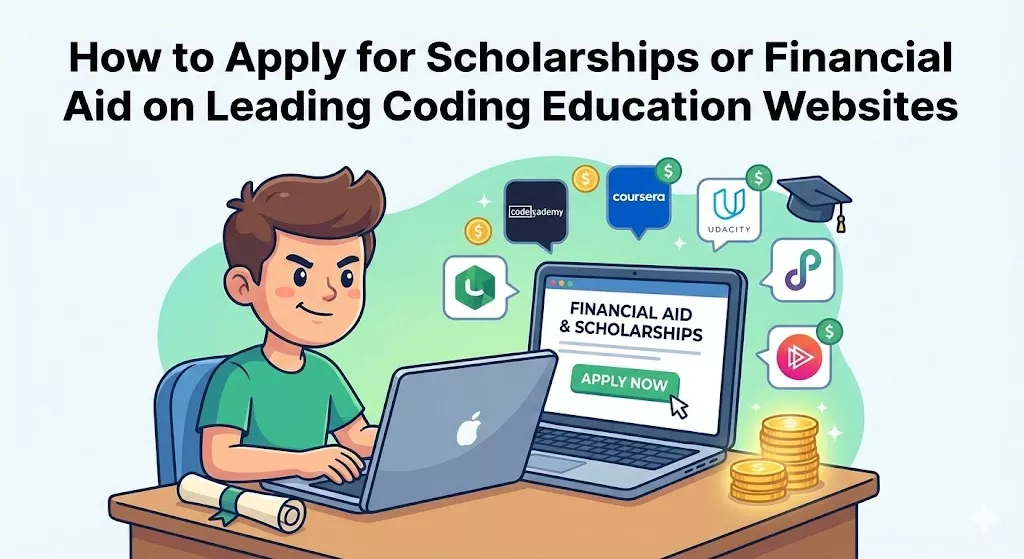
Here’s something that will save you a lot of wasted effort: most “scholarships” advertised by coding platforms are marketing gimmicks. They’re designed to make expensive courses look affordable while actually giving away very little money to very few people.
After years watching people navigate coding education financing, I’ve seen the patterns clearly. Someone sees “scholarships available!” on a $15,000 bootcamp. They get excited, spend hours on the application, and then either get rejected or receive a “scholarship” that’s really just the standard discount they give to everyone who asks.
Real financial aid exists on some platforms. But you need to know where to find it, how to actually qualify, and which “opportunities” are worth your time versus which are just lead generation for sales teams.
Let me break down which platforms offer genuine financial assistance, what the application processes actually look like, and how to maximize your chances of getting real money instead of falling for marketing theater.
What “Scholarships” and “Financial Aid” Actually Mean
Before we dive into specific platforms, let’s clarify what these terms mean versus what marketing wants you to think:
Real Scholarships
What they should be:
- Actual reduction in course cost (not just payment plans)
- Competitive application process with clear criteria
- Money you don’t have to repay
- Limited number awarded (scarcity is real, not artificial)
- Goes to students who meet specific qualifications
What platforms sometimes call “scholarships” but aren’t:
- Discounts available to anyone who asks
- Deferred payment programs that look free upfront but cost later
- “Apply now to see if you qualify!” where everyone qualifies
- Conditional offers (“scholarship if you get a job making $50k+”)
- Discounts that bring the price down to what competitors charge anyway
Real Financial Aid
What it should be:
- Need-based assistance for people who can’t afford full price
- Income verification required
- Sliding scale based on financial situation
- Available to people who genuinely need help, not marketing to everyone
What platforms sometimes call “financial aid” but isn’t:
- Payment plans (you still pay full price, just over time)
- Income share agreements marketed as “free” (you pay later, often more)
- Employer reimbursement programs (your company pays, not the platform)
- “Flexible financing” which is just standard credit
Understanding these distinctions saves you from wasting time on applications that are really just sales qualification processes.
The Platforms With Actual Scholarships (Real Money)
freeCodeCamp: The Ultimate “Scholarship” – Everything’s Free
freeCodeCamp doesn’t offer scholarships because they don’t need to. Everything is completely free forever.
What you get for $0:
- Comprehensive web development curriculum
- Interactive coding lessons
- Certification projects
- Active community support
- No applications, no qualifications, no hidden costs
Why this matters: If you need financial assistance to learn coding, freeCodeCamp eliminates the entire problem. You’re not competing for limited scholarship spots. You’re not proving you’re “worthy” of help. You just start learning.
The catch: There is no catch. It’s actually free. Funded by donations from people who used it successfully and want to help others.
Best for: Anyone who needs to learn coding without spending money. No application process. No waiting. Just start.
The Odin Project: Also Completely Free
The Odin Project is another entirely free resource with no scholarships because, again, no cost to begin with.
What you get for $0:
- Full stack web development curriculum
- Project-based learning
- Active Discord community
- No strings attached
Why this matters for “financial aid”: The conversation about scholarships and financial aid mostly exists because coding education is expensive. When it’s free, the conversation becomes irrelevant.
Best for: People who want comprehensive learning without any cost or application processes.
Codecademy Pro Scholarships: Limited But Real
Codecademy occasionally offers real scholarships through partnerships, but they’re inconsistent and limited.
How it actually works:
Codecademy partners with organizations (like Google, nonprofits, diversity-focused groups) to offer free Pro access to specific populations.
For example, they’ve had programs offering free access to underrepresented minorities in tech, students at specific schools, or people in certain geographic regions.
The application process:
When scholarships are available, they’re announced on Codecademy’s blog or scholarship page. Applications typically require:
- Basic demographic information
- Why you want to learn coding
- What you’ll do with the skills
- Sometimes essay questions (500-1000 words)
Response times vary from weeks to months.
The reality check:
These scholarships are genuinely free (no repayment) but highly competitive with limited spots. Hundreds or thousands apply for dozens of scholarships.
The scholarships also tend to be time-limited (6-12 months of Pro access, not lifetime).
Best for: People in target demographics who have time to write thoughtful applications and can accept likely rejection.
Coursera Financial Aid: Actually Exists and Works
Coursera has a legitimate financial aid program that many people don’t know about.
How it works:
Almost every paid course and specialization on Coursera has a “Financial Aid available” link. You click it, fill out an application, and if approved, you get the course for free.
The application process:
Two essay questions (150 words each):
- Why are you applying for financial aid?
- How will this course help you achieve your career goals?
Processing time: 15 days. They actually review applications. It’s not instant.
Approval rates: Coursera doesn’t publish stats, but anecdotally, genuine need cases get approved frequently. You do need to write thoughtful responses, not generic ones.
What you actually get: Free access to the course including graded assignments and certificate. Same experience as paid students.
The limitations:
You can only have two active financial aid applications at a time. You need to complete aided courses before applying for more.
Some newer Professional Certificates don’t qualify for financial aid, only individual courses and older specializations do.
Best for: People who genuinely can’t afford Coursera courses and can wait 15 days for approval. Worth applying if you actually need it.
edX Financial Assistance: Similar to Coursera
edX offers financial assistance for verified certificates.
How it works:
Click “Learn more about financial assistance” on course pages. Fill out application explaining your financial situation and why you want the course.
The application:
Similar to Coursera. Short essay questions about financial need and career goals.
Processing time: 2-3 weeks typically.
What you get: Free verified certificate for the course. Access to graded assignments. Same as paid experience.
Approval rates: Reasonably high for genuine need cases. They want to help people who can’t afford courses, not give free access to people who just don’t want to pay.
Best for: Similar to Coursera. Real financial assistance for people who need it.
Udacity Scholarships: Competitive Programs with Partners
Udacity runs scholarship programs in partnership with companies like Google, AWS, and others.
How it works:
Udacity announces scholarship programs periodically. These are competitive programs with thousands of applicants for hundreds (sometimes thousands) of spots.
For example, “Google Cloud Computing Foundations scholarship” might offer 1,000 spots for a specific nanodegree track.
The application process:
Varies by program but typically includes:
- Basic information and background
- Short essay questions (why you’re interested, what you’ll do with skills)
- Sometimes video introduction
- Often preference for underrepresented groups in tech
The structure:
Many Udacity scholarships are two-phase:
- Phase 1: Get free access to first course in the nanodegree
- Phase 2: Top performers from Phase 1 compete for full nanodegree scholarships
This means you might “win” a scholarship but still need to compete further for the full program.
What you actually get if you win:
Full nanodegree access (normally $400-$500/month for 3-4 months). This is real financial value ($1,200-$2,000).
The reality:
These scholarships are genuinely valuable but extremely competitive. Thousands apply. Hundreds win. You need strong application materials and often need to be in target demographic.
Best for: People in underrepresented groups with strong motivation who can craft compelling applications and accept high rejection likelihood.
The Platforms With Questionable “Scholarships”
Let me save you time by identifying platforms where “scholarships” are mostly marketing:
Most Coding Bootcamps: “Scholarships” That Are Just Discounts
Many bootcamps advertise “up to $3,000 in scholarships!” The reality is less impressive.
How it actually works:
You apply for the bootcamp. During the enrollment process, they offer you a “scholarship” that’s really just a discount available to most applicants who ask.
The $15,000 bootcamp offers you a “$3,000 scholarship” bringing the cost to $12,000. But if you’d negotiated or waited for a sale, you’d get the same price.
The tell-tale signs:
- “Apply now to see your scholarship amount!”
- Everyone you talk to got roughly the same “scholarship”
- The scholarship seems to expire urgently (creating pressure to enroll)
- The final price after scholarship matches competitor pricing
Why they do this:
Psychological pricing. Saying “was $15,000, now $12,000 with scholarship!” feels better than just pricing at $12,000. You feel like you got a deal.
Which bootcamps do this:
Most of them. App Academy, Flatiron School, General Assembly all have scholarship programs, some genuine, some just discounts with fancier names.
How to tell the difference:
Real scholarships: Competitive application, limited spots, clear criteria, not everyone gets them.
Fake scholarships: Sales team offers them during enrollment, “special” discounts available to anyone, urgency-based.
Platforms With Income Share Agreements Marketed as “Scholarships”
Some platforms say “pay nothing until you get a job!” and call this a scholarship. It’s not.
What ISAs actually are:
Loans. You pay nothing upfront. After you get a job making above a threshold (usually $40k-$50k), you pay a percentage of your income (typically 15-17%) for a set period (2-4 years).
The math:
If you make $60,000 and pay 15% for 3 years, you pay $27,000 for a bootcamp that might have cost $15,000 upfront. You’re paying nearly double.
Why they call it a “scholarship”:
Marketing. “No upfront cost!” sounds like charity. It’s actually just deferred payment at higher total cost.
Platforms that use ISAs:
Lambda School (now Bloom Institute), some App Academy programs, various others.
Are ISAs bad?
Not necessarily. They shift risk from student to platform (you don’t pay if you don’t get a job). But they’re not scholarships or financial aid. They’re payment plans.
Best for: People with no money upfront who can’t get traditional loans and are confident they’ll get well-paying jobs. Know you’ll pay more total.
The Hidden Financial Aid: What Nobody Talks About
Beyond formal scholarship programs, some real financial assistance exists that platforms don’t advertise heavily:
Workforce Development Programs
Many states and cities have workforce development funds for people learning in-demand skills like coding.
How it works:
Government programs partially or fully fund your education if you’re unemployed, underemployed, or career-changing.
Where to find these:
Your state’s workforce development board, unemployment office, or career centers. Ask about “training vouchers” or “workforce development funding.”
Some coding bootcamps work with these programs. General Assembly, for example, partners with workforce programs in various cities.
The catch:
Bureaucracy. Applications take time. Funding is limited. You often need to be unemployed or low-income to qualify.
Best for: Unemployed people or those making below certain income thresholds who can navigate government programs.
Employer Tuition Reimbursement
Many employers offer tuition reimbursement for skill development.
Typical terms:
$2,000-$5,000 per year for courses related to your job. You pay upfront, get reimbursed after completing the course.
Which platforms work with this:
Most established platforms can provide documentation for employer reimbursement: Coursera, Udacity, Pluralsight, LinkedIn Learning.
The process:
- Check if your employer offers tuition assistance
- Get pre-approval for specific course
- Pay for course yourself
- Complete it
- Submit proof of completion
- Get reimbursed
Best for: Employed people whose companies offer this benefit and who can front the money temporarily.
VA Benefits for Veterans
Veterans can use GI Bill benefits for coding bootcamps and courses.
Qualifying programs:
Bootcamps need VA approval. Some that qualify: Flatiron School, General Assembly, Hack Reactor.
What’s covered:
Tuition plus housing allowance in many cases. Can be substantial financial support.
The process:
More complex than regular enrollment. The bootcamp’s veteran affairs office guides you through VA paperwork.
Best for: Veterans with unused GI Bill benefits.
Nonprofit Organizations
Some nonprofits offer coding education scholarships:
Operation Code: Scholarships for military veterans and families Year Up: Free intensive training for young adults (18-24) from low-income backgrounds NPower: Free tech training for young adults and military veterans
These are genuine free programs, not discounts. But they’re competitive and have strict eligibility requirements.
How to Actually Apply for Real Financial Aid
If you’ve identified a legitimate financial aid opportunity, here’s how to maximize your chances:
For Need-Based Financial Aid (Coursera, edX):
1. Be honest about your financial situation
Don’t exaggerate poverty if you’re not poor. But do honestly explain why you can’t afford the course.
Good: “I’m a single parent working part-time making $25,000/year. After rent and childcare, I have no discretionary income for courses.”
Bad: “I don’t want to spend money on this.”
2. Connect course to career goals clearly
Explain how this specific course helps you achieve specific career goals.
Good: “This Python course teaches automation skills I need to transition from data entry to data analyst, increasing my earning potential.”
Bad: “I want to learn Python because it’s popular.”
3. Show you’ll complete the course
Financial aid is wasted on people who don’t finish. Demonstrate commitment.
Good: “I’ve completed three free Coursera courses and maintained a part-time learning schedule for six months.”
Bad: “This looks interesting.”
4. Proofread everything
Sloppy applications with typos suggest you’re not serious.
5. Apply early
Financial aid budgets are limited. Apply when the course opens, not last minute.
For Competitive Scholarships (Udacity, bootcamps):
1. Target scholarships you actually qualify for
Don’t waste time on scholarships for “women in tech” if you’re a man. Don’t apply for “career changers” if you’re a CS student.
Match your background to their target demographic.
2. Craft compelling narratives
Scholarship committees read hundreds of applications. Generic answers get rejected.
Good: “As a teacher for 10 years, I’ve seen students struggle with outdated curricula. Learning to code will let me create educational software that addresses real classroom needs I’ve witnessed firsthand.”
Bad: “I want to learn coding because jobs pay well.”
3. Be specific about impact
Vague promises don’t impress. Specific plans do.
Good: “I’ll use these skills to build an inventory management system for the food bank where I volunteer, improving their efficiency in serving 500 families weekly.”
Bad: “I’ll help my community.”
4. Show work you’ve already done
You’re more attractive if you’ve demonstrated commitment before asking for money.
Good: “I’ve completed freeCodeCamp’s Responsive Web Design certification and built three portfolio projects (links).”
Bad: “I’m interested in learning.”
5. Follow all instructions exactly
If they ask for 500 words, write 500 words. If they want a video, make a video. If they ask for references, provide them.
Ignoring instructions is an instant rejection.
Red Flags That “Financial Aid” Is Fake
Red flag 1: “Everyone qualifies for some scholarship amount!”
Real scholarships are competitive. Not everyone gets them.
Red flag 2: Pressure to enroll immediately to claim the scholarship
Real scholarships have clear deadlines. Fake ones create artificial urgency.
Red flag 3: The “scholarship” just brings price to market rate
If competitors charge $10k and you’re getting a “$5k scholarship” on a “$15k program,” that’s not a scholarship.
Red flag 4: You have to pay money to apply
Never pay application fees for scholarships. That’s a scam.
Red flag 5: No clear criteria for who qualifies
Real scholarships state requirements (income, demographics, background, etc.). Vague criteria suggest marketing.
The Brutal Truth About Coding Education Financing
Most people looking for scholarships should probably start with free resources instead:
The math:
- Bootcamp with 30% “scholarship”: $7,000-$10,000
- freeCodeCamp + The Odin Project: $0
- Self-study with paid resources as needed: $100-$500
Unless you’re getting a full scholarship or have very specific reasons to pay for education, free resources teach the same skills.
When paid education makes sense:
- You genuinely can’t learn without structure and accountability
- The specific program has proven job placement support you need
- You’re getting substantial scholarship (75%+) or employer is paying
- You’ve tried free resources and they didn’t work for your learning style
When free resources make more sense:
- You’re self-motivated and disciplined
- You can’t afford paid options even with scholarships
- You’re exploring whether coding interests you
- You have time but not money
The scholarship many people need is permission to learn for free instead of feeling like they need to pay for education to make it “real.”
My Honest Recommendations
If you need to learn coding but have no money:
Start with freeCodeCamp and The Odin Project. They’re completely free and comprehensive. No applications. No waiting. Just start.
Don’t spend weeks applying for scholarships when you could spend those weeks learning for free.
If you want university-branded certificates but can’t afford them:
Apply for financial aid on Coursera and edX. The approval rates are reasonable for genuine need cases. The process is straightforward and worth the 15-day wait.
If you’re in a target demographic for tech diversity:
Watch for scholarship programs from Udacity, Codecademy partnerships, or nonprofit organizations. These are competitive but can provide real value if you win.
Craft strong applications. Don’t spam apply to everything. Target scholarships you actually qualify for.
If you’re employed:
Check if your employer offers tuition reimbursement before looking at scholarships. Many companies will pay for professional development.
If you’re a veteran:
Explore GI Bill benefits for VA-approved coding bootcamps. This can cover full tuition plus housing allowance.
If you’re unemployed or low-income:
Check with your state workforce development board about training vouchers. Government programs exist specifically to help people gain employment skills.
If bootcamps offer you “scholarships” during sales calls:
Be skeptical. Real scholarships are competitive. Sales team discounts are pricing tactics. Ask: “Is this scholarship amount unique to me or do most applicants receive similar offers?”
The Questions to Ask Before Applying
Before investing time in scholarship applications:
1. Is this real financial aid or a discount?
Google “[platform name] scholarship reddit” and see what actual applicants say about their experiences.
2. What’s my total time investment vs. potential savings?
If an application takes 10 hours for a 20% chance at $500 savings, that’s $10/hour expected value. Your time might be better spent learning.
3. Could I learn the same material free?
For most web development skills, yes. For specialized topics or university certificates, maybe not.
4. What are the strings attached?
Repayment terms? Time limits? Employment requirements? Read the fine print.
5. What’s the opportunity cost?
Time spent applying is time not spent learning. Is the potential scholarship worth the delay in starting?
The Bottom Line
Real scholarships and financial aid exist in coding education, but they’re rarer than marketing suggests:
Genuinely free:
- freeCodeCamp (no application needed)
- The Odin Project (no application needed)
Legitimate financial aid:
- Coursera financial aid (straightforward application, reasonable approval rates)
- edX financial assistance (similar to Coursera)
Competitive but real:
- Udacity scholarship programs (competitive, legitimate value if you win)
- Nonprofit organization programs (competitive, strict eligibility)
Usually marketing:
- Most bootcamp “scholarships” (discounts disguised as merit awards)
- “Everyone qualifies!” programs (not actually selective)
- ISAs marketed as scholarships (deferred payment, not aid)
Worth exploring if eligible:
- Employer tuition reimbursement
- VA benefits for veterans
- State workforce development programs
The best “scholarship” is recognizing that comprehensive coding education is available completely free through freeCodeCamp, The Odin Project, and other open resources.
Apply for scholarships if you have genuine need, qualify for specific programs, or want university-backed certificates. But don’t delay your learning waiting for scholarship decisions when you could start learning today for free.
The time spent applying for a small scholarship might be better spent building skills with free resources. Choose strategically based on your situation, not what marketing tells you that you need.