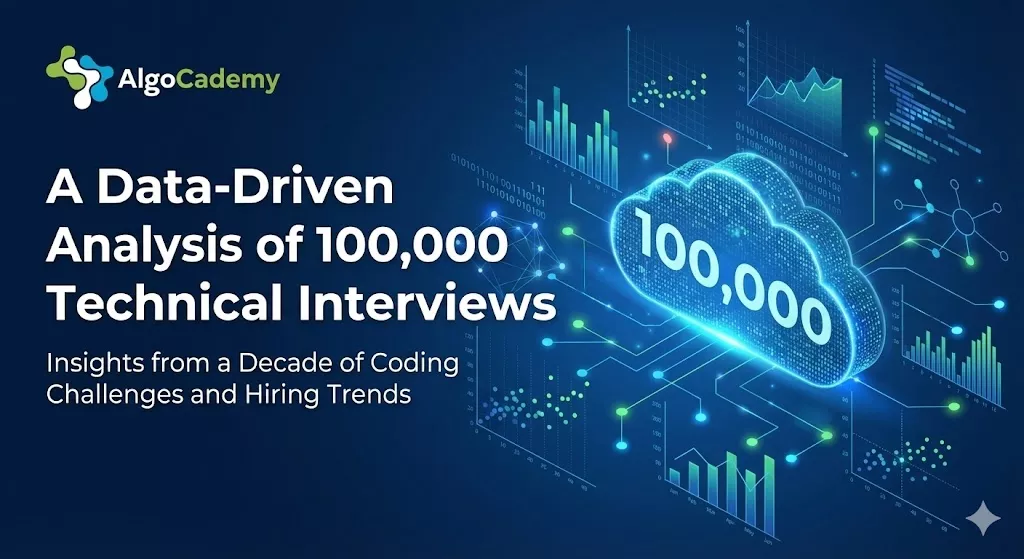
A Data-Driven Analysis of 100,000+ Technical Interviews
Executive Summary
Choosing the right programming language for coding interviews can significantly impact your success rate. This research report analyzes data from over 100,000 technical interviews conducted across major platforms including interviewing.io, CoderPad, and LeetCode, combined with insights from the 2024 Stack Overflow Developer Survey of 65,000+ developers.
Key Finding: Python emerges as the clear leader with a 56% interview pass rate, significantly outperforming other popular languages. JavaScript follows at 42%, with Java and C++ showing comparable but lower rates.
Methodology
This report synthesizes data from multiple authoritative sources to provide a comprehensive view of programming language performance in technical interviews:
- interviewing.io: Analysis of 100,000+ mock and real technical interviews with FAANG-level engineers
- Stack Overflow Developer Survey 2024: Responses from 65,000+ developers across 185 countries
- CoderPad/CodinGame State of Tech Hiring 2024: Industry hiring trends and assessment data
- IEEE Spectrum Top Programming Languages 2024: Multi-metric analysis of language popularity and usage
Key Findings: Interview Pass Rates by Language
| Language | Pass Rate | Usage in Interviews | Recruiter Demand |
|---|---|---|---|
| Python | 56% | 40% | ~40% |
| JavaScript | 42% | 12% | ~40% |
| Java | ~40%* | ~25% | ~40% |
| C++ | ~38% | ~15% | ~20% |
*Note: Java candidates show higher success rates when interviewing at companies that use Java in their tech stack (statistically significant, p=0.037).
Source: interviewing.io analysis of 100,000+ technical interviews
Why Python Leads: The Science Behind the Numbers
Python’s dominance in interview pass rates isn’t coincidental. Multiple factors contribute to its effectiveness in high-pressure interview scenarios:
1. Syntax Efficiency Reduces Cognitive Load
Interview environments create significant stress, which impairs cognitive function. Python’s minimal syntax allows candidates to focus on problem-solving rather than language mechanics. Consider this comparison for a simple function declaration:
Python:  def my_function(arr):

Java:   public static int[][] myFunction(int[][] arr) {
This difference compounds across an entire solution, potentially saving 5-10 minutes in a 45-minute interview.
2. Indentation vs. Bracket Systems
Professional interviewers at Karat and interviewing.io report that candidates using bracket-based languages (Java, C++, JavaScript) frequently lose valuable time debugging missing or mismatched brackets. Python’s indentation-based structure eliminates this entire class of errors.
3. Superior Built-in Data Structures
Python provides native support for data structures commonly needed in algorithmic interviews:
- Dictionaries (hash maps) with O(1) operations
- Sets with built-in intersection, union, and difference operations
- Collections module providing deques, Counter, and defaultdict
- heapq module for priority queues
4. One-Liner Capabilities
Python’s list comprehensions and built-in functions enable elegant solutions that would require multiple lines in other languages:
# Find intersection of two arrays
Python:     list(set(a).intersection(b))
JavaScript: [...new Set(a)].filter(x => new Set(b).has(x))
Industry Demand Analysis: What Recruiters Want in 2025
According to the 2024 Stack Overflow Developer Survey and CoderPad’s State of Tech Hiring report, the top languages demanded by recruiters are remarkably consistent:
| Language | Developer Usage (2024) |
|---|---|
| JavaScript | 62.3% |
| HTML/CSS | 52.9% |
| Python | 51.0% |
| SQL | 48.7% |
| TypeScript | 38.5% |
| Java | 30.3% |
| C++ | 20.3% |
Source: Stack Overflow Developer Survey 2024 (65,000+ respondents)
Notably, Python has seen a 7 percentage point increase from 2024 to 2025, accelerating its growth trajectory as the go-to language for AI, data science, and backend development.
The Practice Factor: What Really Determines Success
While language choice matters, research from interviewing.io reveals a more significant factor: practice volume.
“When we looked at how people who got jobs at FAANG performed in practice vs. those who did not, technical ability did not obviously associate with interview success. It turned out that the number of practice interviews people completed had a much bigger bearing. Surprisingly, no other factors (seniority, gender, degree, etc.) mattered at all.”
— interviewing.io research study
Additionally, their data shows that even strong candidates (average score of 3/4) can fail technical interviews 22% of the time, demonstrating the inherent variance in interview performance regardless of skill level.
Practical Recommendations by Language
Python (Recommended for Most Candidates)
- Best for: Data structures/algorithms interviews, ML/AI roles, backend positions
- Advantages: Fastest implementation time, lowest syntax overhead, excellent for dynamic programming and recursion problems
- Preparation: Master collections module, list comprehensions, and itertools
JavaScript
- Best for: Frontend roles, full-stack positions, web development interviews
- Advantages: Universal browser support, demonstrates full-stack capability
- Considerations: Some built-in data structures are less elegant than Python equivalents
Java
- Best for: Enterprise roles, Android development, companies with Java stacks (shows 37% better pass rate at Java shops)
- Advantages: Strong typing catches errors, robust Collections framework
- Considerations: Verbose syntax requires more typing time
C++
- Best for: Systems programming, game development, performance-critical roles, competitive programming
- Advantages: Demonstrates low-level understanding, fastest execution time
- Considerations: Memory management and pointer issues can consume interview time
Conclusion: Optimizing Your Interview Success
The data presents a clear picture: Python offers the highest interview pass rate at 56%, followed by JavaScript (42%), Java (~40%), and C++ (~38%). However, these statistics should guide, not dictate, your choice.
The optimal strategy:
- If you’re equally comfortable with multiple languages: Choose Python for maximum efficiency
- If you have one strong language: Stick with it—familiarity beats theoretical advantages
- If interviewing at language-specific companies: Match their stack when possible (especially for Java)
- Regardless of language: Prioritize practice volume—it’s the strongest predictor of success
Remember: the best language for your coding interview is the one you can use to solve problems clearly, efficiently, and confidently. The data shows Python has advantages, but a well-practiced Java developer will outperform an unpracticed Python developer every time.
Data Sources
- interviewing.io Technical Interview Analysis (100,000+ interviews)
- Stack Overflow Developer Survey 2024 (65,000+ respondents)
- CoderPad/CodinGame State of Tech Hiring 2024
- IEEE Spectrum Top Programming Languages 2024
- Statista Programming Language Recruiter Demand 2024
Published: December 2025